The Seven Stages of Human Life
***
Overview of the Seven States of Life
Adi Da Samraj, 1986
***
“In this Way or Yoga, the ‘seven stages of life’ and the ‘seven practicing stages’ do not correspond to one another exactly (number by number), except in the… fifth, sixth, and seventh stages of life respectively. Practicing stages one through four…are initially a culture of adaptation to (or toward) the fourth stage of life, and then, progressively, to the seventh, stage by stage. (Of course…the seventh stage of life informs and inspires the practice at every stage of the Way that I Teach.)” – Adi Da Samraj, The Illusion of Relatedness
“Beezone Seven Stages of Life interviews with Klik and Klak have become a rich source of inspiration for my book. I’m so glad you have done these! (and all the others too), for they’re invaluable!” – Beezone visitor.
Table of Contents



Beezone’s Educational Video Series
The Seven Stages of Life
“A big thank you to Frank and Ed for doing this stuff. This is really helpful in learning more of Adi Da’s teachings. Please is it possible for you guys to continue to post more clips on You Tube, as for newbies to Adidam such as myself, this is really useful? Thanks again.” –
Beezone visitor
***
Study of The Seven Stages of Life
The following materials come from various publications from The Dawn Horse Press, the publishing arm of the Reality-Way of Adidam, and other materials produced and collected over many years by Beezone.
Introduction and Overview
Beezone Video Series – Introduction
What is the total process of human growth? What would occur in us if we were able to grow to the full extent of our potential? Avatar Adi Da Samraj offers a schema of seven stages of life which represents His Wisdom on the entire spectrum of human possibility. He has systematically described not only our physical, emotional, and mental development, but also all the phases of Spiritual, Transcendental, and Divine unfolding that are potential in us, once we are mature in ordinary, human terms. This unique schema, which proceeds from birth to the final phases of Divine Enlightenment, is a central reference point in Avatar Adi Da Samraj’s Wisdom-Teaching. It is an invaluable tool for understanding how we develop as individuals, and also for understanding how the Teachings and practices proposed by the various schools of religion and spirituality fit into the entirety of human potential.
This model of the seven stages of life is an important conceptual tool formulated by the Spiritual Master Adi Da Samraj to clarify, and so help others to similarly understand, the spiritual implications of all the individual and collective expressions of human experience and knowledge. The following paragraphs will provide a general introduction to this unique model.
1. Human life potentially develops or unfolds in seven stages.
2. The first three stages of human life are the stages of lower functional (physical, emotional, and mental) adaptation to the universal Life-Energy.
3. The fourth stage of human life is the stage of whole bodily surrender and adaptation to the universal Life Current via Love-Communion (the disposition of the heart or deep psyche of pure energy).
4. The fifth stage of human life is the stage of mysticism, or evolutionary adaptation to the higher brain and mind.
5. The sixth stage of human life is the stage of ego-death, or transcendence of mind, independent self, and primal fear.
6. The seventh stage of human life is the stage of bodily Translation or Transfiguration of the total body-mind and the atomic soul in the Infinite Radiance of the Living God.
Keys to remember as you read and study the Wisdom-Teaching of Adi Da’s Seven Stages of Life:
If you do not fulfill a stage before proceeding to the next one, then there will be complications, and any attempt at future growth will in effect be retarded.
Stages of life overlap one another. There is a period of time at the end of each of the first six stages wherein some characteristics and capabilities of the next stage begin to appear.
Education in every stage of life is not a one-shot matter. The study of even the basic points must be entered into again and again and again, throughout one’s life.
The First Stage of Life

Beezone Video Series – The First Stage of Life
Main points of the First Stage of Life
• Occupies us from conception to seven years of age.
• Period of physical adaptation to functional existence.
• Child must individuate from the mother and all others.
• At completion of first stage of life the child exists in a state of conscious relatedness to all others and the world of Nature.
• Signs of the end of the first stage of life: individuation, socialization, cooperation, sensitivity to Nature.
From Love, Wisdom, and Happiness and the First Three Stages of Life
The first stage of life, occupying the years from conception and birth to age seven, is the stage of the human individual’s vital-physical adaptation to the world into which he or she is born. In this first stage the being learns “simple” skills like focusing with the eyes, grasping and manipulating objects, walking, talking, assimilating and converting food and breath into energy, and controlling bladder and bowels.
From Laughing Man Magazine, Vol 4, NO 4
Individuation
The first stage of life is the process of adapting to life as a separate individual, no longer bound to the mother. Most important for the first stage child is the process of eating and learning to accept sustenance from outside the mother’s body. In fact, this whole stage of life could be described as an ordeal of weaning, or individuation.
Tremendous physical growth occurs in the first stage of life (the first seven or so years) as well as an enormous amount of learning; one begins to manage bodily energies and begins to explore the physical world. Acquiring basic motor skills is a key aspect of the first stage of life: learning to hold a spoon and eat with it, learning to walk and talk and be responsible for excretion. If the first stage of life unfolds as it should, the separation from the mother completes itself in basic terms. But there is a tendency in most human beings to struggle with this original individuation, or to not accept its necessity. The result of such resistance is that, by the age of seven or so, we are left with a chronic (usually lifelong) feeling of being separate from the source of life and support. (Note that this feeling of separation from the food source is an overlay on top of the original feeling and activity of separation that is the ego itself, the self-contraction).
Stage 1 represents individuation, the struggle to transcend infantile dependency on the mother (sustenance) and to accept the reality of independent bodily existence.
Failure to adapt to this stage creates separation and a sense of disconnection from the sustaining source of life and doubt (betrayal) of those (and the world) on whom one depends for love and support. The primary reactive emotion in the failure to adapt to this stage is fear.
Adi Da describes the signs of fulfillment of the first stage of life as:
“When this stage is complete, we will not exist in isolation but in a state of conscious relatedness to all others and the world of Nature. Thus, the fulfillment of the first stage of life is marked by the beginnings of the movement toward more complex socialization, cooperation with others, and sensitivity to the total world of Nature.” – Early-Life Education, or, My Seventh Stage Way of Schooling In The First Three Stages of Life – Adi Da Samraj
Signs of Maturity in the First Three Stages of Life
A child has fully adapted to the first stage of life when he or she shows the following signs:
a. The child has achieved physical, emotional, mental, and psychic independence from the mother, and is moved towards a more complex socialization with adults and peers. From the moment of birth, and then continuing throughout the first stage of life, the child is adapting to the fact that he or she is a person autonomous from the mother, When this adaptation is complete, when the child has fully grown beyond the feeling sense of identification with the mother, then the child can be said to be fully individuated, and mature in the first stage of life.
It is important to note that even in the maturity of the first stage of life the child is still functionally dependent on others. In other words, the child is still not capable of living independently on his or her own without the help of adults. What has been relinquished is the feeling sense of the “two-who-are-one” bond with the mother and a happy resolution about the child’s actual circumstance of dependency on, rather than identification with, others. At the point of maturity in this stage, the child naturally turns outward in his or her feeling towards the greater realm of relationships with others, because the concentration on the mother as the sole source of sustenance, support, and identification has been outgrown.
b. The child feels sustained by food, other individuals, and the Divine. For the young child, the mother is intimately associated with the sense of sustenance. Because of this, food (and the whole relationship to food-taking) is one of the primary arenas in which an individual’s maturity in the first stage is demonstrated. A child who is mature in the first stage feels sustained, and has a healthy and uncomplicated relationship to food. Similarly, the child feels sustained by other individuals upon whom he or she depends. And most importantly, the mature first stager feels sustained by and connected to the Living Divine, who is the Ultimate Source of support and love.
c. The child demonstrates a feeling orientation to other people and the realm of nature. As the first stager has increasingly relinquished his or her concentration on the mother, he or she has naturally become increasingly aware of and sensitive to relationships with others. Thus, simultaneous with maturity in the first stage of life, the child demonstrates an awakening of feeling-sensitivity to the relational realm. This truly marks the point of readiness to begin the second stage. At this point, the mature first stager should be responsible for the rudimentary relational practices of using manners, being respectful of adults, and being responsive and obedient when asked to go beyond himself or herself.
Excerpts from Love, Wisdom, and Happiness in the First Three Stages of Life, Adi Da Samraj
Completing the Work of the First Stage of Life
In The Dawn Horse Testament, Beloved Adi Da Samraj makes it clear that very few individuals complete the work of the first stage of life within the first seven years. Most of us begin the second stage with unfinished business, or what Beloved Adi Da Samraj calls a “workable (though un-Happy, or self-contracted) settlement”. An individual who is not fully mature in the first stage of life tends to associate individuation with a feeling of separation. This primarily involves the sense of being separate or cut-off from the Divine. Secondarily, it also manifests as a sense of doubt or anxiety relative to all others upon whom one depends for love.
Incomplete adaptation to the first stage of life is also characterized by an unwillingness (to some extent or another) to relinquish the feeling of dependency upon one’s mother, or others in general. An unhappy or irresponsible relationship to food and food-taking is also a sign of unfinished business in the first stage of life.
It is definitely optimal for children to complete the full adaptation to the first stage of life by the age of seven (or the beginning of the second stage) because this provides the base of free energy and attention for continued growth in the second and third stages. However, this is not always the case. In fact most adults (and even many second and third stage children) have an incomplete adaptation to the first stage of life. Beloved Adi Da Samraj has Gracefully accounted for this by indicating that any unfinished business from the first three stages of life is completed in the initial period of adult practice in the Way of the Heart, as part of the listening-hearing process.
Excerpts from Love, Wisdom, and Happiness in the First Three Stages of Life, Adi Da Samraj
The Second Stage of Life
Beezone Video Series – The Second Stage of Life
Main Points in the Second Stage of Life:
• Occupies us during second seven years of life.
• Early stage of adaptation to the etheric dimension of conditionally manifested existence, which is the emotional sexual dimension of the being, and which is also the dimension of life-energy, nerve-force, and feeling-sensitivity to conditions of existence.
• Primary adaptation is to feeling, or sensitivity to the etheric energy inherent in one’s person, all others, and all of Nature.
• This is the primary stage of socialization, involving moral or right relational development. This socialization is based on feeling-sensitivity to the etheric dimension and one’s effect on all others, rather than conventional socialization or worldliness.
• Genital sexuality is bypassed, but learning in this stage provides the emotional base for later sexual activity.
• Stage is complete when a basic level of social individuation is achieved. Individual no longer requires parent-child style of relationship, but can associate with the larger community of adults as a socially responsible, relationally positive young person.
The above is from a variety of writings of Adi Da Samraj and the editors of The Dawn Horse Press
This phase occupies approximately the second seven years of life. “In the second stage there appears the potential of full relational feeling and the necessity for responsibility for the communication of life-force and sympathy with its vital processes. Thus, the individual develops an expanded bodily life through the extension of feeling, and he also becomes sexually aware, even very early in life.” – Birth Until Death: The Culture of Resurrection.
However, genital sexuality is not rightly engaged in the second stage of life. Instead, sexuality is developed as a matter of emotion and energy in relationship with others.
“The second phase of life is the time of the development of the etheric, or emotional-sexual, life, of polarization to etheric life, of feeling alive and flowering, as the primitive physical sense, which once was the primary goad to living adaptation, begins to submit itself to awareness of the greater world of energy relations, the living world wherein solidity gives way to animation and rapid changes. It is the time of the development of sexual polarization (or sexual character) and sensitivity, and of emotional life based on the forces contained in sexual differentiation. Emotion and physical energy of every kind, including sexuality, are simultaneously awakened as parts of the same process.” – Birth Until Death: The Culture of Resurrection.
The development of sexual maturity depends on the ability to enter into a mature emotional relationship with others. Most people fail to make this transition into emotional-sexual maturity while in their youth. Consequently, unless they embark on a conscious course of self-transcendence later in life, their psychological-spiritual growth remains stunted.
Stage 2 represents the process of socialization, the development of social and emotional-sexual awareness and psychic or feeling sensitivity to others and to the natural world.
Failure to adapt to this stage shows itself as self-doubt, the feeling to being rejected (betrayed) and the need to reject, find fault (be superior) to others. The primary reactive emotion in the failure to adapt to this stage is sadness, sorrow.
The second stage of life is the process of socialization, based on the development of emotional sensitivity to the psycho-physical self, to others, and to the natural world. The second stage of life is also associated with the anal function and the conflict between privacy and the search for social visibility.
The anal function begins to develop coincident with the oral function, but socialization itself truly begins only after the basic struggle with individuation has reached a workable settlement.
“Character motivations that are rooted in the biology and psychology of sex-differentiation are, in the second stage of life, extended and developed in an expanded social context, and individuation, rather than ambiguously differentiated dependency, becomes a catalyst toward social exploration.”
The Dawn Horse Testament, Chapter 16, 1991.
When individuation Has Become A Workable egoic Settlement, the individual Begins To Struggle, As an individual, With relationships (First On the intimate scale, and Then In an ever larger social sphere). The Second Stage individual Tends To Continue To function In The Context Of Dependency, but With A More Fully Developed Sense Of Separate self, Independence, and Mobility. Likewise, There Is A Gradual Discovery That There Are many kinds of relationships, and all of them Carry A Test, A Demand, and An Obstacle That Offends The Want To Be Dependent. The anal Phase Of Development Represents An Early Stage Of self-Awareness, In Which the individual’s self-Esteem (Desirability or Lovableness) Is Apparently At Stake. Thus, Doubt Of the ego-self and Doubt Of The Love In others Appears. And So, The Second Stage Of Life Tends To Develop Only To The Degree Of A Tentative (or ego-Based and Ultimately Unsatisfactory) Resolution Of the relational and social character. Whereas The Feeling Of Separation (and Of Separating, and Of Separatenness, and Of Separativeness) Characterizes The First Stage Reaction (or egoic Presumption), The Feeling Of Being Rejected (and The Felt Need To Reject or Punish others For Un-Love) Characterizes The Second Stage Reaction (or egoic and Necessarily Un-Happy Presumption). – The Dawn Horse Testament, Chapter 16, Adi Da Samraj
Many readers find Adi Da’s writing style difficult to read. To that, what follows is the same paragraph above without capital letters and parentheticals. In doing so, I want to bring the reader’s attention to WHY ADI DA WROTE IN THE STYLE HE DID.
When individuation has become a workable egoic settlement, the individual begins to struggle, as an individual, with relationships. The second stage individual tends to continue to function in the context of dependency, but with a more fully developed sense of separate self, independence, and mobility. Likewise, there is a gradual discovery that there are many kinds of relationships, and all of them carry a test, a demand, and an obstacle that offends the want to be dependent. The anal phase of development represents an early stage of self-awareness, in which the individual’s self-esteem is apparently at stake. Thus, doubt of the ego-self and doubt of the love of others appears. And, the second stage of life tends to develop only to the degree of a tentative resolution of the relational and social character. Whereas the feeling of separation characterizes the first stage reaction, the feeling of being rejected characterizes the second stage reaction.
Beezone’s paraphrase of The Dawn Horse Testament, Chapter 16, 1991.
Socialization
Between the ages of five and eight years, we begin to become aware of the emotional dimension of existence; how we feel and how others respond to us emotionally becomes of great importance. This is the beginning of the second stage of life, the stage of social adaptation and all that goes with it: a growing sense of sexual differentiation, awareness of the effects of one’s actions on others, a testing of whether one is loved. These are all the natural follow-ups to the individuation of the first stage of life. Avatar Adi Da Samraj points out that in the second stage of life, children naturally develop their psychic capacity and their sensitivity to etheric energy. For this reason, and for the sake of their future Spiritual growth, children should be encouraged to feel that they are “more than what you look like”, they are not just their physical bodies, for the sake of their future Spiritual growth. The full process of growth in the second stage of life is frustrated if we become locked in patterns of feeling rejected by others and rejecting and punishing others in return.
Adi Da describes the second stage of life as an “awakened sensitivity to the etheric, or emotional-sexual forces of life.” He defines the etheric dimension of life as “the dimension of energy, nerve-force, and direct feeling-sensitivity to the conditions of existence.” Through growth in feeling-sensitivity to the surrounding world, the child lays the foundation for a benign and moral involvement in all social relations, as well as the capacity for entering into heartfelt relationship with the Living Divine Reality.
Signs of Maturity in the Second Stage of Life
Adi Da characterizes maturity in the second stage of life in the following manner:
… the second stage of life is fulfilled when the individual has realized a state of social individuation. In other words, the individual is free, not merely of the unconscious bond to the mother, but free of the parent-child style of relationship altogether. He or she can function as a socially independent or free individual responsible to the adult community. He or she is not yet an adult, or a person who can go into the world and do what he or she wants, but rather he or she is a physically and socially individuated person who is responsible to and is to be guided by the adult community….
Excerpts from Love, Wisdom, and Happiness in the First Three Stages of Life, Adi Da Samraj
There are two specific components involved in the maturity of the process of socialization.
They are:
a. The individual has fully learned about the etheric energy dimension, and is responsible for it. The individual knows how to communicate through the etheric energy field, and how to be sensitive and helpful to others in terms of etheric energy.
b. The individual is capable of transcending the presumption of unlove, and living as “I love you” in relationship with others.
Like the first stage of life, most individuals only partially complete their adaptation to the second stage of life by the beginning of the next stage. As Beloved Adi Da Samraj says in The Dawn Horse Testament, “The Second Stage Of Life Tends To Develop Only To The Degree Of A Tentative (or ego-Based and Ultimately Unsatisfactory) Resolution Of the relational and social character.” An individual who is struggling with issues of self-esteem, self-doubt, or doubt of the love of others is still dealing with incomplete second stage business. The second stage egoic presumption is characterized by the feeling of being rejected, and the feeling that we must, in turn, reject or punish others for their unlove.
Another sign of incomplete adaptation to this stage is not being fully sensitive to and responsible for the etheric dimension of life. This includes responsibility for one’s own etheric energy, one’s effect on others relative to the etheric dimension, and the communication of positive, happy energy etherically. And a fully mature second stager should also be responsible and unproblematic in regard to the functions of elimination.
Obviously, this sensitivity to etheric energy and the knowledge of how to conduct it in relation to self and others is a remarkable and important adaptation, one that most adults still very much need to develop. And the capability to transcend the ritual of betrayal and the tendency to punish others when they fail to love (or even when they only seem to fail to love) is a major developmental step. As it stands in this day and age, almost every adult on the planet is dealing with this issue until the day they die. Reflecting on this, we can understand what a great process of learning is involved in this stage. How fortunate we are to have Beloved Adi Da’s Graceful Help to extend to our children, and to help us complete this important adaptation!
Like the first stage of life, we can (and indeed, must) complete our unfinished business from this stage in the listening-hearing stages of adult practice in the Way of the Heart…
Excerpt from Love, Wisdom, and Happiness in the First Three Stages of Life, Adi Da Samraj
The Third Stage of Life
Beezone Video Series – The Third Stage of Life
Main Points in the Third Stage of Life:
• Occupies us during the third seven years of life.
• Period of adaptation to the psychic dimension of existence.
• Involves development of the will, the thinking mind, and the mind of the psyche.
• Stage is complete when the individual is fully prepared (physically, emotionally, ethically, psychically, mentally, and with a free or intelligent will) to enter into the social, personal, and spiritual responsibilities of adult life.
• The third stage of life is the stage in which, based on true learning, one’s true adulthood is established, and one goes on from there to live as true human beings. The later stages of life lead one into what is beyond the human, what transcends human life and life in Nature.
The third stage of life, stretching approximately from the fifteenth to the twenty-first year, is the stage of the development of the thinking mind and the will, and of the integration of the vital-physical, emotional-sexual, and mental-intentional functions. This stage marks the transition to truly human autonomy wherein the first two stages of life are adapted to a practical and analytical intelligence and an informed will or intention and the individual gains responsibility for and control over vital life.
Introduction, Nirvanasara, Georg Feuerstein
“The third stage of life is mature when the individual enjoys integrated responsibility for the whole of the living being (physical, emotional-sexual, and mental). Thus, he is in that case able to be present as a clear will and as love under all the otherwise frustrating or pleasurable conditions of lower experience. Those who seek to begin spiritual life must be mature in this sense in order to move on to higher maturity.” – First Become Human – Enlightenment of the Whole Body.
“The Third Stage Of Life Is The Process Of Integration Of The psycho-physical Patterns (Both Individual And relational) Of the frontal personality, By Means Of The Development and Application Of the functions of mind, discriminative intelligence, and the will. And This Process Is Also Associated With The genital Phase Of human Development. Genital Development and sex-Differentiation Begin Even In infancy, and The Emotional Trial Of The Second Stage Of Life Relates To the sexually Defined character, but The Great Struggle Of integration and self-Presentation (As a Fully Differentiated and Defined sexual and social character) Takes Place Only After puberty.
The Third Stage Of Life Tends To Be Wasted (or Made Un-Happy) By Indulgence In Patterns That May Be Called adolescent. That Is To Say, The Third Stage Of Life Does Not Tend Toward Full (and Happy) Resolution, Because The First Two Stages Of Life (Which Are The Basis For Growth In The Third) Tend To Be Unresolved (or Patterned by Un-Happiness). As A Result, The Third Stage Of Life Becomes A Fruitless Drama Of Conflict Between Two Alternating and Contrary Impulses, The One Toward infantile and childish (or Passive and Weak-minded) Dependence, and The Other Toward willful and Rebellious (or self-Destructive and other-Destructive) Independence. The Life-Process Is Disturbed By This Un-Happy and Irresponsible Drama, and the mental faculties and the integrating function of the will Are Thus Impaired or Retarded In Their Ability To Develop the True adult character, which character Is Characterized By Basic human Equanimity, Discriminative Intelligence, Responsive Heart-Feeling, and The Active Impulse (or Counter-egoic Will) To Always Continue To Grow (By self-Transcendence, and, Necessarily, By Entering Into The Devotional and, Eventually, Spiritual Context Of The Fourth Stage Of Life).”
The Dawn Horse Testament, Adi Da Samraj
Stage 3 is the process of integration and full development of the individual as a sexual and social character. It is also the development of mental faculties, discriminative intelligence, and the will, which then become the means of integrating the personality as a whole.
The failure to fully adapt to this stage shows its signs in a personality that is characteristically “adolescent”–“don’t tell me what to do”. It also shows itself in the vacillation between childish dependency and patterns of rebellious, destructive independence.
The primary reactive emotion in the failure to adapt to this stage is anger.
The third stage of life is the process of integration of the psycho-physical patterns of the frontal personality, by means of the development and application of the functions of mind, discriminative intelligence, and the will. And this process is also associated with the genital phase of human development. Genital development and sex-differentiation begin even in infancy, and the emotional trial of the second stage of life relates to the sexually defined character, but the great struggle of integration and self-presentation takes place only after puberty. The third stage of life tends to be wasted by indulgence in patterns that may be called adolescent. That is to say, the third stage of life does not tend toward full resolution, because the first two stages of life tend to be unresolved. As a result, the third stage of life becomes a fruitless drama of conflict between two alternating and contrary impulses, the one toward infantile and childish dependence, and the other toward willful and rebellious independence. The life-process is disturbed by this un-happy and irresponsible drama, and the mental faculties and the integrating function of the will are thus impaired or retarded in their ability to develop the true adult character, which character is characterized by basic human equanimity, discriminative intelligence, responsive heart-feeling, and the active impulse to always continue to grow. – Beezone’s adaptation of The Dawn Horse Testament, Chapter 16, 1991.
Integration
“In the early to mid teens, the third stage of life establishes itself. The key development of this stage is the maturation of mental ability—the capacity to use mind and speech in abstract, conceptual ways—together with the power to use discrimination and to exercise the will. On the bodily level, puberty is continuing (having begun during the later years of the second stage of life) with all its attendant bodily and emotional changes.
“The purpose of the third stage of life is the integration of the human character in body, emotion, and mind, so that the emerging adult is a fully differentiated, or autonomous, sexual and social human character. If the process of growth in the first and second stages of life has proceeded unhindered, then this integration can take place in a natural manner. If, however, there have been failures of adaptation in the earlier stages—a chronic feeling of being separate or unsustained or chronic feelings of being rejected or unloved, and consequent difficulties in relating happily to others—the process of integration is disturbed.
“In fact, in most individuals, the process of the third stage of life becomes an adolescent struggle between the conflicting motives to be dependent on others and to be independent of them. This adolescent drama tends to continue throughout adult life. It is one of the signs that growth has stopped, that the work of the first three stages of life was never completed.
“So how does one begin to grow again? By participating in a culture of living religious and Spiritual practice that understands and rightly nurtures each stage of development. This is Adi Da Samraj’s recommendation, and the circumstance that He has Worked to create for His devotees by establishing the Way of the Heart. Anyone, at any age, who chooses the Way of the Heart can begin the process of understanding and transcending the limits of his or her growth in the first three stages of life and in all the stages of life that follow.
“Avatar Adi Da Samraj refers to the first three stages of life as the ‘foundation stages’ because the ordeal of growth into human maturity is mere preparation for something far greater—Spiritual Awakening, and, ultimately, Divine Enlightenment. This greater process begins to flower in the fourth stage of life on the basis of a profound conversion to love.”
Excerpt from The Heart’s Shout, Adi Da Samraj, 1993, pp. 75-6 (emphases added by Beezone).
Most adults never pass beyond the complications of failed adaptation in the first three stages of life. This includes those individuals regarded by society as “successful” because they only represent a greater or lesser degree of the FULL development of the third stage of life. The third stage of life is not only about adaptation but about failure. This failure includes the inherent dissatisfaction with the elements of worldly happiness as a “way of life.”
The individual who has matured in the third stage of life is fully prepared (physically, emotionally, ethically, psychically, mentally, and with a free or intelligent will) to enter into the social, personal, and Spiritual responsibilities of true man or woman. Then he or she is able to be “present as a clear will and as love under all the otherwise frustrating or pleasurable conditions of lower experience”. Those who seek to begin Spiritual life must be mature in this sense in order to move on to higher maturity.
Beezone
Signs of Maturity in the Third Stage of Life
Adi Da Samraj has Said that ‘the third stage of life is the summary or the crown of the early life of the individual who has achieved competence and responsibility for everything that you ordinarily call human.’
Maturity in the third stage of life is characterized by:
a. Basic human equanimity.
b. Discriminative intelligence.
c. Responsive heart-feeling.
d. The active impulse (or counter-egoic will) to always continue to grow (by self-transcendence, and, necessarily, by entering into the devotional and, eventually, Spiritual context of the fourth stage of life).
“Adi Da Samraj summarizes maturity in the third stage of life in the following Talk:
AVATAR ADI DA SAMRAJ: The third stage of life is mature when the individual enjoys integrated responsibility for the whole of the living being (physical, emotional-sexual, and mental). In that case, he or she is able to be present as a clear will and as love under all the otherwise frustrating or pleasurable conditions of ordinary human experience. To truly begin Spiritual life, in order to move on to the advanced and ultimate stages of practice in the Way of the Heart, you must be mature in this sense. Otherwise, you will have no stability of will and love to keep you in the practice.
Those who are constantly complaining and regressing in the practice of the Way of the Heart are simply not yet mature in the ordinary human sense. They are weak of will (thus of mind) and of love (thus of life and body and feeling). Prepare yourself first. Become strong in the human way—and waste no time in that preparation. Otherwise you will only suffer a life and future that is mediocre, foolish, frustrated, obsessed, and unawakened to Truth and Happiness.”
Excerpt from Love, Wisdom, and Happiness in the First Three Stages of Life, Adi Da Samraj.
The Fourth Stage of Life
Beezone Video Series – The Fourth Stage of Life
Main Points in the Fourth Stage of Life:
The first three stages may generally be associated with the first twenty-one years of life (three periods of seven years), but the later stages (which grow beyond the limits of the grosser elements and functions) may not truly be considered in terms of limits of time, whether brief or long.
The Enlightenment of the Whole Body, Adi Da Samraj, p. 192
The duration of the higher stages of life depends entirely upon the individual’s qualities and his or her spiritual practice of self-transcendence.
The Enlightenment of the Whole Body, Adi Da Samraj, p. 192
The individual’s entrance into the fourth stage of life begins with the awakening of the “psychic heart,” which is marked by a clear sensitivity to the Life-Current. In this stage, the Divine Presence or Life-Force is felt to exist independent of, or senior to, the body-mind. By cultivating a conscious relationship to this Presence, the spiritual practitioner begins to demonstrate and enjoy the spiritual qualities of faith, love, and surrender.
The Fire Gospel, Adi Da Samraj, p. 202
In the fourth stage of life, this now complex psycho-physical being is surrendered beyond itself, to and into the Living-Current of Being that pervades it and the total world. This is done to the point of generally harmonizing the body-mind in that Life Current and otherwise Realizing self transcending devotional Union with that Living Reality in occasions of Love-Bliss that involve and simultaneously transcend the body-mind.
The Bodily Location of Happiness Is the Way Itself, Introduction
Devotional surrender (sacrifice) to the Living Reality is the essential feature of the fourth stage of life. The individual is obliged to persist beyond religious conventions and customs, by means of continuous and concentrated attention and devotion via heartfelt feeling-attention to the Ultimate Reality and Source-Condition.
Nirvanasara, Adi Da Samraj, p 188
Spiritualization
“Even while still maturing in the first three stages of life, many people devote themselves to religious practices, submitting to an ordered life of discipline and devotion. This is the beginning of establishing the disposition of the fourth stage of life, but it is only the beginning. The real leap involved in transitioning to the fourth stage of life is one that very few ever make. It is nothing less than the breakthrough to a Spiritually-illumined life of Divine contemplation and selfless service. How does such a life become possible? Only on the basis of a heart-awakening to the Divine that is so profound that the common human goals—to be fulfilled through bodily and mental pleasures—lose their force.
“The purpose of existence for one established in the fourth stage of life is devotion—a moment to moment intimacy with the Spiritual Reality, an intimacy that is tangible and ecstatic, and which changes one’s vision of reality. Everything that appears, everything that occurs is now seen as a process full of Spirit-Presence. This new vision of existence is given through Spirit-Baptism, an infilling of Spirit-Power (usually granted by a Spiritually Awakened Master), which is described in many different religious and Spiritual traditions…
“The fourth stage of life, though it represents a profound and auspicious advance beyond the foundation stages, is only the beginning of truly Spiritual growth. Avatar Adi Da Samraj points out that the primary presumption of one in the fourth stage of life is that God and the individual personality are inherently separate from one another. God is the Sublime ‘Other’ with Whom one Communes and in Whom one may become ecstatically absorbed at times, even to the point of apparent union. Nevertheless, such raptures pass, and one is left with the continuing urge for union with the Divine Beloved. The individual being is still a separate ego, still searching, even though the goal of seeking is Spiritual in nature.”
Excerpt from The Heart’s Shout, Adi Da Samraj, 1993, pp. 76-77.
The longer we’ve lived a life given over to bodily and mental self-indulgence, the more difficult the task of transcending that force of habit later on Is. This is the necessary prerequisite for the transition to the fourth stage of life.
The fourth stage of life is a Spiritually illumined life of Divine contemplation and selfless service. Both elements are necessary. We often point to people who have devoted their lives to helping others and call them “saints”. They are good people, no doubt. But they are only saints that is (in the fourth stage of life) if their selfless service is, first of all, to God, and only secondarily to others—and that on the basis of awareness of and communion with God. True saints are Spiritual Realizers, not merely moral human beings.
In the fourth stage development of human life, the will is adapted to aspiration, or intuitive self-transcendence.
Beezone
See more on the Fourth Stage of Life
The Transition to the Fourth Stage of Life (and the completion of the third stage of life) Sutra 44 – The Dawn Horse Testament
The Fifth Stage of Life
Beezone Video Series – The Fifth Stage of Life
Main Points in the Fifth Stage of Life:
“The fifth stage is associated with the mystical aspect of spirituality. The individual’s awareness shifts from the perception of the physical dimension to the experience of the ‘subtle physiology’ of the brain-mind. The mystical ascent through the psychic centers of the body-mind is conditioned by the nervous system. Experience in this stage reaches its peak in the state of ‘conditional nirvikalpa samadhi’, or formless ecstasy. At the apex of the fifth stage, the individual has transcended his or her fascination with mental forms and images.
AVATAR ADI DA SAMRAJ: In the fifth stage of life, yogic mysticism raises attention into the extremities of subtle experience — or the heavens of ascended knowledge. But liberation in God is not Realized at that stage or by such means. In order for the Life-Current to cross the Divide between the “third eye” and the “sahasrar”, or between the body-mind and Infinity, the gesture of attention and the illusion of an independent conscious self must be utterly Dissolved in the true Self.
The highest extreme of the ascent of attention is called “nirvikalpa samadhi”, or total Absorption of self-consciousness in Radiant Transcendental Consciousness. But, in fact, the seed of the differentiated self remains in such ascended Absorption of attention. Attention is yet extended outside the heart, or the root of self-consciousness, as a gesture toward an independent Object, and, therefore, such “samadhi” is not only temporary, but it remains a form of subject-object Contemplation.”
Excerpt from The Adept, Adi Da Samraj, pp. 100-01.
Higher Spiritual Evolution
AVATAR ADI DA SAMRAJ: All Yogic, and religious (or mystical) practices associated with the process of Spiritual ascent (via the spinal line and the brain core, to and through the subtle levels of mind, and to and through the crown of the head, and, ultimately, to the “Highest” Realization, above the body, the brain, the mind, all conditional knowledge, all conditional experience, and all conditional worlds) may, in some general sense, be described as “fifth stage” practices. However, that ascent is made in two distinct phases (or steps). The first step is associated with ascent to the “ajna door” (or brain core) [in the fourth stage of life], and the second step is associated with ascent above the “ajna door” [in the fifth stage of life]. The first step is associated with bodily exercises (of posture, breath, and so on) as well as exercises of feeling (or intentional emotion) and attention (and mind in general), whereas the second step is almost exclusively associated with the exercise of attention alone.
Source: The Seventeen Companions Of The True Dawn Horse, Book Sixteen, The Perfect Guide To Perfectly Unified Understanding Of The One and Great Tradition Of Mankind, and Of The Divine Way Of Adidam As The Perfect Completing Of The One and Great Tradition Of Mankind, By The Divine World-Teacher, Ruchira Avatar Adi Da Samraj (Emphases added by Beezone)
“The fifth stage of life could be described as the domain of accomplished Yogis—individuals involved in the pursuit of Enlightenment through mystical experience, such as the vision of the ‘blue pearl’, and through the attainment of psychic powers. But it is important to note that just as exceedingly few religious practitioners fully Awaken to the Spiritual Reality in the fourth stage of life, even fewer would-be Yogis become fifth stage Realizers.
“The important difference between the fifth stage of life and all the stages of life that precede it is that awareness on the gross physical plane is no longer the normal mode of existence. Rather, attention is attracted into subtle realms—dreamlike or visionary regions of mind.
“The phenomena of the fifth stage of life arise as a result of the further movement of the Spirit-Current, now in the higher regions of the brain. In the fifth stage of life the Spirit-Current moves from the ajna chakra through and beyond the crown of the head. At its point of highest ascent, the Spirit-Current triggers the Yogic meditative state traditionally called ‘Nirvikalpa Samadhi’ (‘formless ecstasy’) in which all awareness of body and mind is temporarily dissolved in the Divine Self-Condition… Such an experience marks an enduring change in one’s being. It is now clear that the individuated self has no eternal existence or significance. Only the Divine Condition of absolute Freedom and Happiness truly exists. Once the Divine Condition has been glimpsed in the state of ‘formless ecstasy’, one’s relationship to embodied existence is entirely different—one begins to see the body as an arbitrary, even humorous phenomenon.
“Even so, a limit remains. This great Samadhi, the culminating achievement of the fifth stage of life, is fleeting. At some point bodily consciousness returns, and so does the ache to restore that boundless, disembodied Bliss. Fifth stage conditional Nirvikalpa Samadhi, for all its profundity, is achieved on the basis of a subtle stress. It is the ultimate fruit of the Yogic strategy to escape the body by directing one’s awareness upward into infinite Light…
“[In the mature phase of the fifth stage of life] one is not susceptible to the fascinations of visionary experience, even when such experiences arise. Neither is one moved to direct one’s attention up and out of the body into the infinitely ascended state of ‘formless ecstasy’. Rather, the ‘tour’ of mystical experience has been revealed to be simply more of the futile search to be completely Happy and fulfilled. And so that whole pursuit of mystical satisfaction relaxes, and the devotee may be easily drawn beyond all habits of identification with bodily states and even beyond identification with the subtle mind states of the fifth stage of life into the pristine understanding of Reality as Consciousness Itself.”
Excerpt from The Heart’s Shout, Adi Da Samraj, 1993, pp. 77-78 (Emphases added by Beezone.)
The Sixth Stage of Life
Beezone Video Series – The Sixth Stage of Life
Main Points in the Sixth Stage of Life:
“Through further spiritual growth, by means of the transcendence of the ego that has been disclosed in the experiences of the first five stages of life, the spiritual practitioner no longer presumes any illusion of independent psycho-physical existence, though the individual is still not freed from the primary ego-contraction (as the exclusive self-essence). The sixth stage of life, wherein self and attention are sacrificed in Truth, leads not to the annihilation of the self, but rather to awakening as the Self. Adi Da explains:
“The sixth stage of life is the last of the progressive stages previous to Transcendental Awakening. It is the basic stage in which the transition is made from terrestrial and cosmic conceptions of the Divine or Real Being to conceptions of the Ultimate as the Transcendental Reality and Condition and Identity of all apparent beings and conditions. And the process of self-sacrifice is thus transformed from an effort that serves the development of knowledge and experience in the planes of the psycho-physical personality to a direct effort of utter self-transcendence.
“In the sixth stage of life, the body-mind is simply relaxed into the Life-Current, and attention (the root or base of the mind) is inverted, away from gross and subtle states and objects of the body-mind and toward its own Root, the ultimate Root of the ego-self, which is the ‘Witness’ Consciousness (when attention is active) and also simple Consciousness (prior to objects and self-definition). The final result of this is conditional Self-Realization or the intuition of Radiant Transcendental Being via the exclusive self-essence (inverted away from all objects).”
Extract from Enlightenment and the Transformation of Man, Adi Da Samraj, pp. 58-59.
Awakening to the Transcendental Self
“In the sixth stage of life, one is no longer perceiving and interpreting everything from the point of view of the individuated body-mind with its desires and goals. One stands in a Transcendental Position, Awake as the Very Consciousness that is the Ground of all that exists. In that Position, one stands as the ‘Witness’ of all that arises, even while continuing to participate in the play of life. While life goes on like a movie on a screen, one sees the greater import of Existence and the non-necessity of all that arises. This is the beginning of what Avatar Adi Da Samraj calls ‘the ultimate stages of life’, or the stages of Identification with Consciousness Itself.
“The sixth stage of life may include the experience of Jnana Samadhi, which, like fifth stage conditional Nirvikalpa Samadhi, is a form of temporary Realization of the Divine Self. However, fifth stage conditional Nirvikalpa Samadhi comes about through the strategy of ascent, the urge to move attention up and beyond the body-mind; in Jnana Samadhi, awareness of gross and subtle states is excluded by concentration in Transcendental Self-Consciousness.
“Most prominent among the great sixth stage Realizers, historically, have been the Hindu and Buddhist, and in some cases Taoist sages, who eschewed the fascinations of experience from the beginning. These great Realizers turned away from the enticements of ‘money, food, and sex’ in the first three stages of life, as well as from the attractions of devotional (fourth stage) rapture and of Yogic (fifth stage) mysticism. Instead, the Sages of the sixth stage of life have traditionally contemplated the freedom and purity of Consciousness—to the degree of Realizing that Consciousness Itself, eternal and Prior to any mortal form or temporary experience, is our True Condition, or True Self.
“But even deep resting in the freedom of Transcendental Consciousness is not Most Perfect Enlightenment. Why not? Because there is still a stress involved. Sixth stage Realizers have one last barrier to Divine Self-Realization to be penetrated. Sixth stage practice and Realization is expressed by turning within, away from all conditional objects and experiences (including the energies and the movements of attention of one’s own body-mind), and concentrating upon What is felt to be the Source of individual consciousness. Thus, the root of egoity is still alive. The search still remains, in its most primitive form. The sixth stage of life is the search to identify with Pure Consciousness Prior to and exclusive of phenomena.”
Excerpt from The Heart’s Shout, Adi Da Samraj 1993, p, 79.
The philosophical point of view of the sixth stage of life, particularly evident in the traditions of Hinayana Buddhism and Advaita Vedanta, bears some likenesses to the seventh stage disposition. Both sixth and seventh stage schools speak of or point toward Transcendental Being (as opposed to conventional ideas or ideals of God, mystical objects, conventional meditative experiences, and so forth). But the primary difference between sixth and seventh stage schools is that sixth stage schools generally conceive of the phenomenal world as a problem to be escaped, and they likewise conceive of the Transcendental Self or Reality or Enlightenment to be inherently and logically different from the phenomenal self and world. Thus, sixth stage Realization tends toward the viewpoint of ascetical inversion, or ascetical dissociation from phenomena, and the reduction of the dynamic paradoxes of existence to a conventional monistic equation.
Beezone
The Seventh Stage of Life
Beezone Video Series – The Seventh Stage of Life
Main Points in the Seventh Stage of Life:
“During the first six stages of life, the various aspects of human potential are awakened and tested to the point of real maturity. But the complete sacrifice of the whole-body-being into the Radiant Transcendental Being is realized in the seventh stage of life. The Transcendental Self which was realized in the sixth stage is no longer pitted against the phenomenal world. The Self no longer seeks to remain concentrated in the heart-root, exclusive of all objects. The ‘eyes’ of the heart open. The liberated ‘individual’ now Realizes everything to be a modification of the Radiant Transcendental Being. The world is recognized as continuously arising in the Ultimate Being, which is coessential with the Self.
AVATAR ADI DA SAMRAJ: In the seventh stage of life there is native or radical intuitive identification with Radiant Transcendental Being, the Identity of all beings (or subjects) and the Condition of all conditions (or objects). This intuitive identification (or Radical Self-Abiding) is directly Realized, entirely apart from any dissociative act of inversion. And, while so Abiding, if any conditions arise, or if any states of body-mind arise, they are simply recognized in the Radiant Transcendental Being (as transparent or non-binding modifications of Itself). Such is Sahaj Samadhi, and it is inherently free of any apparent implications, limitations, or binding power of phenomenal conditions. If no conditions arise to the notice, there is simply Radiant Transcendental Being. Such is Bhava Samadhi, about Which nothing sufficient can be said, and there is not Anyone, Anything, or Anywhere beyond It to be Realized.”
From The Bodily Sacrifice of Attention, Adi Da Samraj, pp. 29-30.
Divine Enlightenment
The seventh stage of life is release from all the egoic limitations of the previous stages of life. Remarkably, the seventh stage Awakening is not an experience at all. The true Nature of everything is simply obvious. Now the Understanding arises that every apparent “thing” is Eternally, Perfectly the same as Reality, Consciousness, Happiness, Truth, or God. And that Understanding is Supreme Love-Bliss.
Avatar Adi Da Samraj calls this Divine Awareness “Open Eyes”. No longer is there any need to seek meditative seclusion in order to Realize Identification with the One Divine Reality. The Ecstatic and world-embracing Confession, “There Is Only God”, is native (and therefore effortlessly perpetual) to one who enjoys the State of “Open Eyes”. Consciousness is no longer felt to be divorced from the world of forms, but Consciousness Itself is directly understood to be the very Nature, Source, and Substance of that world. And so the life of the seventh stage Realizer becomes the Love-Blissful process of Divinely Recognizing, or intuitively acknowledging, whatever arises to be only a modification of Consciousness Itself.
The Divinely Self-Realized Being is literally “Enlightened”. The Light of Divine Being Flows in him or her in a continuous circuitry of Love-Bliss, that rises in an S-shaped curve from the right side of the heart to a Matrix of Light above and Beyond the crown of the head. This is Amrita Nadi, the “Nerve of Immortal Bliss”, mentioned in the esoteric Hindu Spiritual tradition.
It is easy to fall into the pattern of conventional thinking that belongs to the fourth, fifth, and sixth stage schools of the traditions and to feel, therefore, that the radical considerations of the seventh stage are more or less restatements of the point of view inherent in the fourth, fifth, and sixth stages of life.
In the seventh stage of life, or the context of Divine Enlightenment, the evolutionary process continues. Avatar Adi Da Samraj describes the seventh stage of life as having four phases: Divine Transfiguration, Divine Transformation, Divine Indifference, and Divine Translation.
Beezone
Summary of Introduction and Overview
The following excerpts are from books and writings by Avatar Adi Da Samraj.
In the first three stages of life, the gross body-mind-complex is developed and coordinated. First the gross physical is developed, then the emotional-sexual functions are developed and coordinated with the gross physical, and, finally, the mental functions and the function of the will are developed and coordinated with the emotional-sexual and gross physical functions. All of this is optimally nurtured and done in a spirit of love, trust, and surrender in relation to the Living Divine or All-Pervading and Transcendental Reality.
In the fourth stage of life, this now complex psycho-physical being is surrendered beyond itself, to and into the Living Current of Being that pervades it and the total world. This is done to the point of generally harmonizing the body-mind in that Life-Current and otherwise Realizing self-transcending devotional Union with that Living Reality in occasions of Love-Bliss that involve and simultaneously transcend the body-mind.
In the fifth stage of life this harmonizing trend is continued, as well as the ecstatic gesture toward Union, but the plane of self-awareness ascends, to become dominantly subtle (or psychic) rather than gross (or merely physical), and the Realization of Union involves experiences of ascended attention that eventually go beyond physical references and, at last, even beyond mental references.
In the sixth stage of life, the body-mind is simply relaxed into the Life-Current, and attention (the root or base of the mind) is inverted, away from gross and subtle states and objects of the body-mind, and toward its own Root, the ultimate Root of the ego-self, which is the “Witness” Consciousness (when attention is active) and also simple Consciousness (prior to objects and self-definition). The final result of this is conditional Self-Realization or the intuition of Radiant Transcendental Being via the exclusive self-essence (inverted away from all objects).
In the seventh stage of life there is native or radical intuitive identification with Radiant Transcendental Being, the Identity of all beings (or subjects) and the Condition of all conditions (or objects). This intuitive identification (or Radical Self-Abiding) is directly Realized, entirely apart from any dissociative act of inversion. And, while so Abiding, if any conditions arise, or if any states of body-mind arise, they are simply recognized in the Radiant Transcendental Being (as transparent or non-binding modifications of Itself). Such is Sahaj Samadhi, and it is inherently free of any apparent implications, limitations, or binding power of phenomenal conditions. If no conditions arise to the notice, there is simply Radiant Transcendental Being. Such is Bhava Samadhi, about Which nothing sufficient can be said, and there is not Anyone, Anything, or Anywhere beyond It to be Realized.
Excerpt from The Bodily Sacrifice of Attention, p. 29-30, Adi Da Samraj
In the traditions of spiritual culture, the development of a human being has commonly been described in terms of seven stages, each spanning a period of seven years. There is a rational basis in Awakened Wisdom for this scheme. That basis is the very structure of the total bodily being (or body-mind) of every human individual. We are a composite made of elements and of functional relations, a coherent life-form expressed via the nervous system and brain, and levels of mind that may consciously reflect not only the gross or “material” realm but the realms of Life-Energy and all the cosmic realms or media of light. At the root of this system is the heart, the primal organ not only of life but of consciousness in man. It is here that the presumption and conception of egoic independence, or the separate “I”, arises in every moment. It is on the basis of this presumption that the human individual is predetermined to a reactive life of fear, vulnerability, flight from mortality, and a universal constitutional state of contraction. That contraction encloses consciousness in the limits of skin and thought, and it separates the whole bodily being of Man from the Divine Radiance and Perfect Consciousness that is otherwise native to it and eternally available to it in every part.
From The Enlightenment of the Whole Body, Adi Da Samraj, p. 189.
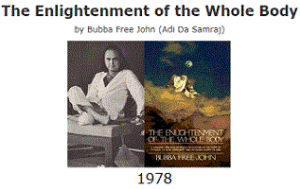
The following is from The Enlightenment of the Whole Body, Adi Da Samraj
GROWTH AND SACRIFICE IN THE SEVEN STAGES OF ETERNAL LIFE
“The greatest of human cultures have at their source a single, extraordinary individual, a God-Man who restored to the world the Divine Law of Life and communicated the personal and social principles for harmonious, sacred living. Gautama, Krishna, Moses, Jesus, Mohammed, and many other Awakened Teachers have performed this cultural sacrifice for Man. In our own time, Bubba Free John has performed a similar service by establishing the unique culture of the Way of Divine Ignorance. In the six years since beginning his formal Teaching Work, Bubba has considered and demonstrated the Lawful form of every kind of human action. He has accounted for every stage of human life, from birth through death. And he has accounted for every stage of religio-spiritual adaptation, from the ordinary self-possessed, self-divided state of Man to the most perfect Enlightenment or Sacrifice of Man into God.
“These are the seven stages of Eternal Life:
1. The stage of vital-physical adaptation, corresponding to the awakening of the root of the abdominal organs at the base of the body and generally occupying the first seven years of life.
2. The stage of emotional and primitively sexual, or relationally polarized, adaptation, corresponding to the awakening of the sexual center and occupying the second seven years of life.
3. The stage of the development of the thinking mind and the will, and of the integration of the vital-physical, emotional-sexual, and mental-intentional functions. This stage corresponds to the awakening of the navel and solar plexus, and it generally occupies the third seven-year period of life.
In the first three stages, the individual is incarnating, physically, emotionally, and mentally, as a human body-mind in the world. The Bodily Current of Life is naturally polarized from crown to toe, or from the subtle range of the being downward and outward into earthly life. And attention naturally moves with the Life-Current into the experiential and relational functions of the centers below the heart.
4. The stage of psychic adaptation, corresponding to the awakening of the feeling dimension of the heart, and the subtle mechanisms in the throat and the lower rear of the brain. The centers above the heart are awakened via the spontaneous placing of attention in the internal Life-Current of the body-mind, and the repolarization of the Life-Current and attention itself toe to crown, rather than crown to toe (which is the polarization of the Life-Current previous to the fourth stage of life). This fourth stage, and all the later stages, cannot be conceived within fixed periods of time. The duration of the higher stages of life depends entirely upon the individual’s qualities and his or her spiritual practice of self-transcendence.
5. The stage of higher mental (mystical and superconscious) adaptation, corresponding to the awakening of the brain core and the higher functions of the brain-mind via the fixed establishment of attention and the internal Life-Current in the brain core (“third eye” or “ajna chakra”).
6. The stage of transcendental intuitive adaptation, corresponding to the Awakening of the Free soul at the root of Consciousness in the heart, and culminating in the State traditionally known as “Self-Realization”. Attention, or mind, dissolves in Divine Ignorance, or unqualified Consciousness, at the heart.
7. The stage of the Translation of Man into God, corresponding to the Sacrifice of the whole and entire body-mind into Infinite Conscious Life, and culminating in Divine Translation of the Free soul into the Identity and Life of the Divine Person. In “Self-Realization” in the sixth stage, Consciousness abides as Divine Ignorance in the root of the heart, excluding awareness of body, mind, and world. The seventh stage begins with the further Awakening Bubba describes as “open eyes” in which Consciousness is released into perfect Identification-Communion with the Divine Person, or Inherence in the Current of Radiance that Pervades all bodies, minds, and worlds. The bodily Life-Current, liberated from bondage to the mind’s tendencies to experience and knowledge in the body-mind, is released into the All-Pervading Radiance via the upper terminal of the brain (above the brain core) and in all directions to Infinity. Thus, in this stage, Transcendental Ignorance and Infinite Radiance become the single Intensity of God-Realized Bliss, until the devotee is Translated, even bodily, beyond all the dimensions of the Realm of Nature, high and low, into the Divine Domain that is that Very Bliss.
“Realization of the seven stages of Eternal Life involves two processes:
1. The ‘vertical’ structural growth, or progressive awakening of the functions of body and mind; and
2. The conscious sacrifice of the whole and entire body-mind, and of all the experiential evidence of growth, through heartfelt love, happiness, or unobstructed feeling and free attention under all conditions.
“The process of sacrifice, founded in Consciousness, is senior to the process of functional awakening, which is founded in the Realm of Nature, or the bodily and mental modifications of Consciousness.
“This ‘map’ of human development and self-transcendence not only expresses a new Vision of God and of the ultimate spiritual potential of Man. It also offers a new understanding of the human being. We do not truly realize our humanity until the fourth stage of life—but, as Bubba indicates in his talks and essays, very few men and women have ever entered stably into the fourth or fully human stage of life.
“The passage into the fourth stage of life signifies the mastery of body, emotions, sexuality, will, and the thinking mind by the psychic, feeling heart. It does not imply the annihilation of the ego. The functional ego, or independent self-sense, is never annihilated in this Way of Life. It is a necessary function of the whole body, like a muscle or a thought. We cannot mature without having acquired the sense of autonomous functional existence, and we can never act without that function.
“However, the autonomous ego-sense must be illumined and transcended through the power of love. The heart must awaken and mature in the feeling and intuition of God, until the soul Realizes its Transcendental Unity and Perfect Communion with the Divine Person. Even then the functional ego persists, since the ego is nothing more than the body-mind itself, until the entire body-mind drops away in perfect psycho-physical death, or Divine Translation, in the seventh stage of life.”
Excerpt from The Enlightenment of the Whole Body, Adi Da Samraj (Bubba Free John), pp. 185-8.
Laughing Man Magazine, Vol4, NO1, 1982, pp. 4-5
THE SYMBOLS
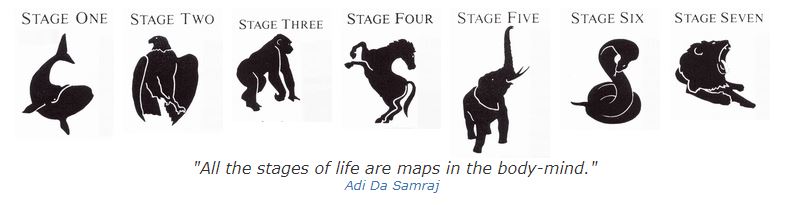
1. The Whale is primarily a body symbol. On the one hand, the whale captures the human individual’s fishlike existence, first as a sperm in the seminal fluid, and then as a fetus in the amniotic fluid of the womb. As such it is an image of the vast potential of the human being. On the other hand, it is a symbol of the human being’s status as a seeker ploughing through the ocean of conditional or finite existence. Seeking is the primordial water or source of conventional human life. In this regard, the whale symbolizes the relative unconsciousness or spiritual immaturity in the first stage of life, whose theme is the integration of bodily functions.
2. Traditionally, the human psyche has been represented as a bird. The Eagle, therefore, symbolizes the human individual’s psychic nature or emotional life. Being a sharp-eyed bird, it is specifically a representation of the spiritual aspirant’s beginning practice of “seeing”, which is the conversion from self-possession to God-Communion in all circumstances. This is also implicit in the fact that the Eagle is a fighting bird: A great struggle is necessary to break with conventional existence and mature into true spiritual practice.
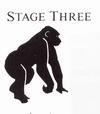
3. The Gorilla conveys a sense of great strength and peacefulness. In this sense, it symbolizes the overall functional integration achieved in the third stage of life. Thus, the gorilla represents the force of the will in a state of equanimity. It is suggestive of peaceful, loving independence.
4. The Horse is first and foremost a symbol of speed—the rising Life-Force conclusively turned away from all lower functions through the awakening of the psychic heart. The profound self-sacrifice involved in this practice is indicated by the backward tilt of the Horse’s head. The Horse is also a symbol for the restraint of the unruly senses, whose activity is brought under the domination of the heart turned to God.
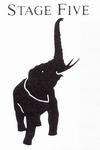
5. The Elephant is a symbol of massive, “muscular” strength and sheer endurance—Yogic force. The raised trunk indicates the powerful ascending force of the Life-Current or Kundalini Shakti. In Indian iconography, this archetypal energy is represented by the pot-bellied Ganesha, the esoteric symbol of the yogic practitioner par excellence.
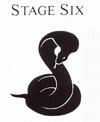
6. The Serpent stands for the power associated with the seven force-centers (chakras) of the human body-mind. The Serpent’s inclined head and tongue point to the right side of the “chest” symbolizing the sixth stage “fall into the Heart”, the transcendence of the seven primary structures of the body-mind through world-excluding Self-Realization.
7. The symbol of the Lion is almost self-explanatory. As Lord of all beasts, the Lion symbolizes perfect mastery over the body-mind, or Unconditional God-Realization. His yawn indicates the natural ease of Sahaj Samadhi, or the native, effortless intuition of God in and as all arising phenomena. The Lion-hearted seventh stage Realizer, who is free of stress, abides permanently in the Blissfulness of the Radiant Transcendental Being.
See “Laughing Man” Magazine, Vol 4, Nos 1 and 4, 1983.
Further study: The Seven Stages of Life – on the Beezone
Education, or My Way of Schooling in the Seven Stages of Life – Look at the Sunlight on the Water
The First Three Stages of Life – The Dawn Horse Testament