|

Enlightenment and the Transformation of Man
Selections from talks and essays on the spiritual process
and God-Realizaiton
Da Free John, 1983
CHAPTER 4
THE SEVEN STAGES OF LIFE
The ultimate import of our human birth is to Realize
the Truth of existence. This, however, is only possible by
observing, understanding, and transcending oneself-a process
of gradual maturation. Master Da Free John's "Seven Stages
of Life" prove a valuable key to such radical
self-understanding. But in order to appreciate the great
practical value of this model, one must drop the role of the
passive outside observer and allow oneself to be penetrated
by the argument underlying this schema, This means one must
experience the way of life outlined by the seven-stage
model, in the culture of selftranscendence shared by
practitioners of Master Da Free John's Way of Radical
Understanding.
We can know or Realize what is only through
selfunderstanding that becomes not merely self-information
but self-transcendence. Therefore, we must first become
capable (through self-understanding and self-transcendence)
of selfsubmission and free participation in what is prior to
our own selfcontraction.
I do not merely propose the idea of God, or soul, or
Transcendental Being. Such propositions cannot be rightly
believed or presumed by the separate and separative ego.
Therefore, the ideas of religion that occupy egos and the
egoic culture of self-abstracted scientism are themselves
false views, representing a poignant and inevitably
frustrated longing for love, release, and ultimate
Happiness. On the contrary, I propose self-observation, true
self-understanding, and perfect self-transcendence. And if
the Way of self-transcendence is magnified as the fullness
of participatory capability, then what is will be discovered
to be Divine, unbound, eternal, Transcendental
Happiness.
The Dreaded Gom-Boo, or the Imaginary
Disease That Religion Seeks to Cure, p. 93
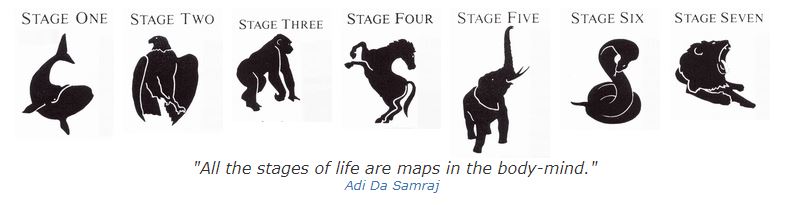
The unique model of the seven stages of life provides
a framework which allows one to understand and rightly
appraise the process of psycho-physical and spiritual
growth. It also clarifies the spiritual implications of all
the individual and collective expressions of human
experience and knowledge.
In practical terms, the seven stages of life can be
viewed as a spiritual school offering seven lessons about
self-transcendence.
Truth is in the sacrifice
of the whole and entire body-mind, via gradual stages of
more and more responsible action, or action as
Love-Communion with the Living God, prior to all
self-reference. Therefore, the seven stages of life are not
truly stages of the accumulation of experience. They are
degrees of a single or ultimate sacrifice, in which what
would otherwise be accumulated is surrendered, through
Love.
The Enlightenment of the Whole Body,
p. 188
Stage One (Birth to 7)
The first stage of life, occupying the years from
conception and birth to age seven, is the stage of the human
individual's vital-physical adaptation to the world into
which he or she is born. In this first stage the being
learns "simple" skills like focusing with the eyes, grasping
and manipulating objects, walking, talking, assimilating and
converting food and breath into energy, controlling bladder
and bowels, relating to his fellow beings, and toward the
end of this stage, somewhat more abstract thinking.
Stage Two (Years 7-14)
The second stage of life is the stage of the development,
integration, and coordination of the emotional-sexual or
feeling dimension of the being with the gross physical. This
coincides with the development of the glandular and hormonal
systems of the body. Also, the young personality grows in
the awareness of himself or herself as a social being,
sharing life in an expanded sphere of relations. Just as in
the first stage one learns about and becomes responsible for
the assimilation and elimination of elemental food, in the
second stage one must likewise learn about, adapt to, and
engage a new dimension of sustenance or food.
In the second stage there appears the potential of full
relational feeling and the necessity for responsibility for
the communication of life-force and sympathy with its vital
processes. Thus, the individual develops an expanded bodily
life through the extension of feeling, and he also becomes
sexually aware, even very early in life.
The Way That I Teach, p.
111
However, genital sexuality is not rightly engaged in the
second stage of life. Instead, sexuality is developed as a
matter of emotion and energy in relationship with others. At
the end of this phase, the growing individual is a fully
mobile ego who, providing that no serious maladaptation has
occurred, is a strongly self-centered but educable
person.
The second phase of life is the time of the development
of the etheric or emotional-sexual life, of polarization to
etheric life, of feeling alive and flowering, as the
primitive physical sense (which once was the primary goad to
living adaptation) begins to submit itself to awareness of
the greater world of energy relations, the living world
wherein solidity gives way to animation and rapid changes.
It is the time of the development of sexual polarization (or
sexual character) and sensitivity, and of emotional life
based on the forces contained in sexual differentiation.
Emotion and physical energy of every kind, including
sexuality, are simultaneously awakened as parts of the same
process.
The Way That I Teach, p.
111
The development of sexual maturity depends on the
ability to enter into a mature emotional relationship with
others. Most people fail to make this transition into
emotional-sexual maturity while in their youth.
Consequently, unless they embark on a conscious course of
self-transcendence later in life, their
psychological-spiritual growth remains stunted. As Master Da
Free John observes:
In this second stage
[the individual] should develop a more sophisticated
awareness of energy and healthfulness, of breathing and of
bringing energy to others. The morality of love itself finds
its seed form in the second stage.
The Way That I Teach, p.
111
If the awakening sexual energy is not subsumed by
love, then in later stages of life the individual's
development is obstructed by emotional-sexual
neuroses.
"Sexual communion," or the yoga of sexual love, is of
course a responsibility incumbent on mature individuals who
have successfully passed through the first three, or lower
vital, stages of life and who have awakened to the feeling
dimension of the heart, or the fourth stage of life
(described below).
Stage Three (Years 15-21)
The third stage of life is the stage of the development
of the thinking mind and the will and of the integration of
the vital-physical, emotional-sexual, and mental-intentional
functions. The underlying theme of this phase is
mental-intentional adaptation to life and the integration of
the functions awakened, skills acquired, and the lessons
learned in the first two stages. This stage marks the
transition to truly human autonomy wherein the first two
stages of life are adapted to a practical and analytical
intelligence and an informed will or intention, and the
individual gains responsibility for and control over his
vital life.
When the second stage is essentially mature, generally
from twelve to fourteen years of age, the individual should
be acknowledged, even by his parents, to be "unparented," to
be essentially responsible for himself (or herself), but
within the context of a total educational or cultural
structure that will guide him in his adolescent development.
From this time on, he is to adapt to life from the point of
view of intentional responsibility, until he is capable of
being an integrated human being in the common world of human
functions and human relations. Thus, in the third stage, the
mind as intention and will must be integrated with the whole
complex of feeling and activity that are an ordinary human
life. It is in this stage that the individual must learn
what the matter of life is all about, what relations are all
about, what sexuality is all about (without indulgence of
the sexual functions), and it is also in this stage that he
actually begins to practice moral responsibility for the
relational context of human life.
The Way That I Teach, p.
112
When the process of maturation of will and intention is
complete, the individual will have a clear self-image and be
capable of relating functionally to the world.
The third stage of life is mature when the individual
enjoys integrated responsibility for the whole of the living
being (physical, emotional-sexual, and mental). Thus, he is
in that case able to be present as a clear will and as love
under all the otherwise frustrating or pleasurable
conditions of lower experience. Those who seek to begin
spiritual life must be mature in this sense in order to move
on to higher maturity.
The Enlightenment of the Whole Body,
p. 196
Stage Four
The third stage is not an end in itself, or the
completion of potential human growth. Indeed, it only marks
the awakening of selfconscious intelligence and a movement
toward personal and individualistic survival motives. Man in
the third stage of life is not yet truly human. He only
brings individual force and form to the vital and elemental
experience and world. He tempers and also extends the frenzy
of feeding and sexing by submitting these to the processes
of the verbal and analytical mind. Man in the third stage of
life is characterized by the frenzy of mind, the frenzy of
problems and solutions.
The truly human being appears only in the fourth stage of
life, wherein the vital, elemental, emotional-sexual, and
lower mental functions come into the summary and unifying
dominion of the heart, the psyche of the whole bodily being.
Such is the awakened moral and spiritual disposition, in
which Truth becomes the Principle in consciousness, and
higher structural growth becomes the benign, nonproblematic
possibility. Thus, the Law in the truly human realm is
sacrifice as the individual, whole, and entire human
body-mind, through love, founded in prior intuition of the
Divine Reality. The human sacrifice is the spiritual
practice of love and intuition of the Real under all
conditions of experience and higher growth.
Love of the Two-Armed Form, p.
75
And,
The first three stages may generally be associated with
the first twenty-one years of life (three periods of seven
years), but the last four (which grow beyond the limits of
the grosser elements and functions) may not truly be
considered in terms of limits of time, whether brief or
long. Each stage develops as a process of adaptation (or
readaptation) to a specific, functional point of view
relative to the totality of experience.
The fourth stage, and all the later stages, cannot be
conceived within fixed periods of time. The duration of the
higher stages of life depends entirely upon the individual's
qualities and his or her spiritual practice of
self-transcendence.
The Enlightenment of the Whote Body,
pp. 186, 192
The realization of the physical, emotional, mental, and
moral responsibilities of the first three stages of life
provides the necessary foundation for the testing and
transformation that inevitably accompany true spiritual
life. Without that basis one might come to enjoy yogic and
mystical experiences, for example, but remain unable to
exercise real intelligence, freedom, and love under the most
ordinary of human circumstances.
However, to mature through and beyond the mechanics of
the first three stages of life is not a casual, conventional
matter of "growing older and wiser." Rather, the
individual's entrance into the fourth stage of life begins
with the awakening of the "psychic heart," which is marked
by a clear sensitivity to the Life-Current, In this stage,
the Divine Presence or Life-Force is felt to exist
independent of, or senior to, the body-mind. By cultivating
a conscious relationship to this Presence, the spiritual
practitioner begins to demonstrate and enjoy the spiritual
qualities of faith, love, and surrender. Thus, devotional
surrender to the Living Reality is the essential feature of
the fourth stage of life. The individual is obliged to
persist beyond religious conventions and traditions, as
Master Da himself emphasizes, by means of "continuous and
concentrated self-devotion via heartfelt feeling-attention
to the Ultimate Reality."'
Stage Five
The fifth stage is associated with the mystical aspect of
spirituality. The individual's attention is withdrawn from
the theatre of outerdirected experience and inverted upon
the inner or subjective realm of experience, disclosing the
"subtle physiology" of the brain-mind. The mystical ascent
through the psychic centers of the body-mind is conditioned
by the nervous system. Experience in this stage reaches its
peak in the state of "conditional nirvikalpa
samadhi,"2 or formless ecstasy. At
this apex of the fifth stage, the individual has transcended
his fascination with mental forms and images. Master Da
comments further.
1. Da Free John, Nirvanasara, p.
188.
2. For a detailed explanation of this
culminating experience of conventional Yoga, refer
to
chapter 8 (pp. 90ff.).
In the fifth stage of life, yogic mysticism raises
attention into the extremities of subtle experience-or the
heavens of ascended knowledge. But Liberation in God is not
Realized at that stage or by such means. In order for the
Life-Current to cross the Divide between the body-mind and
Infinity, the gesture of attention and the illusion of an
independent conscious self must be utterly Dissolved in the
true Self.
The highest extreme of the ascent of attention is called
"nirvikalpa samadhi," or total Absorption of
self-consciousness in Radiant Transcendental Consciousness.
But, in fact, the seed of differentiated self remains in
such ascended Absorption of attention. Attention is yet
extended outside the heart, or the root of
self-consciousness, as a gesture toward an independent
Object, and, therefore, such "samadhi" is not only
temporary, but it remains a form of subject-object
Contemplation.
The Enlightenment of the Whole Body,
pp. 422-23
Stage Six
Through further spiritual growth, by means of the
transcendence of the ego that has been disclosed in the
experiences of the first five stages of life, the spiritual
practitioner no longer presumes any illusion of independent
psycho-physical existence, though still not freed from the
primary ego-contraction (as the exclusive self-essence). The
sixth stage of life, wherein self and attention are
sacrificed in Truth, leads not to the annihilation of the
self, but rather to awakening as the Self. Master Da Free
John explains:
The sixth stage of life is the last of the progressive
stages previous to Transcendental Awakening. It is the basic
stage in which the transition is made from terrestrial and
cosmic conceptions of the Divine or Real Being to
conceptions of the Ultimate as the Transcendental Reality
and Condition and Identity of all apparent beings and
conditions. And the process of self-sacrifice is thus
transformed from an effort that serves the development of
knowledge and experience in the planes of the
psycho-physical personality to a direct effort of utter
self-transcendence.
Nirvanasara, p. 189
And:
In the sixth stage of life, the body-mind is simply
relaxed into the Life-Current, and attention (the root or
base of the mind) is inverted, away from gross and subtle
states and objects of the body-mind, and toward its own
Root, the ultimate Root of the ego-self, which is the
"Witness" Consciousness (when attention is active) and also
simple Consciousness (prior to objects and self-definition).
The final result of this is conditional Self-Realization or
the intuition of Radiant Transcendental Being via the
exclusive self-essence (inverted away from all objects).
The Bodily Sacrifice of Attention, p.
30
When the heart-root is penetrated, there is a
corresponding feeling-association in the living body. Thus,
the devotee points to a place slightly to the right of the
median of the chest, and slightly below the level of the
nipple. That place epitomizes the "I"-sense, the whole
bodily person. And it is the region wherein the "I"-sense of
the complex body-mind is utterly transcended.
The Enlightenment of the Whole Body,
p. 389
Stage Seven
During the first six stages of life, the various
aspects of human potential are awakened and tested to the
point of real maturity. But the complete sacrifice of the
whole body-being into the Radiant Transcendental Being is
realized in the seventh stage of life. The transcendental
Self which was realized in the sixth stage is no longer
pitted against the phenomenal world. The Self no longer
seeks to remain concentrated in the heart-root, exclusive of
all objects. The "eyes" of the heart open. The liberated
"individual" now Realizes everything to be a modification of
the Radiant Transcendental Being. The world is recognized as
continuously arising in the Ultimate Being, which is
coessential with the Self. Master Da Free John
explains:
The significance of the seventh stage is that we are
Transfigured in the perfect awakening of the heart, or
absolute responsibility for the sense of independent
existence, even as the body. We realize responsibility for
the subjective ego in the early stages of development, but
we become fully responsible for the body itself as the ego
or "soul" in the sixth stage of life, in the stage of
Self-realization, or jnana samadhi, which matures into Sahaj
Samadhi. In that freedom the whole body-being becomes a
sacrifice, and the body itself as ego is released into the
Infinite. This sacrifice leads to the ultimate Translation
of the whole body-being into the Divine Radiance, beyond all
ordinary human destinies.
The Way That I Teach, p.
126
Thus, Master Da summarizes the samadhis of the seventh
stage as follows:
In the seventh stage of life there is native or radical
intuitive identification with Radiant Transcendental Being,
the Identity of all beings (or subjects) and the Condition
of all conditions (or objects). This intuitive
identification (or Radical Self-Abiding) is directly
Realized, entirely apart from any dissociative act of
inversion. And, while so Abiding, if any conditions arise,
or if any states of body-mind arise, they are simply
recognized in the Radiant Transcendental Being (as
transparent or nonbinding modifications of Itself). Such is
Sahaj Samadhi, and it is inherently free of any apparent
implications, limitations, or binding power of phenomenal
conditions. If no conditions arise to the notice, there is
simply Radiant Transcendental Being. Such is Bhava Samadhi,
about Which nothing sufficient can be said, and there is not
Anyone, Anything, or Anywhere beyond It to be Realized.
The Bodily Sacrifice of Attention, p.
30
Once fully Realized, the seventh stage of life becomes
the perpetually Enlightened foundation of existence, even
beyond death and in any future lifetimes. The gross
body-mind is progressively Transfigured in Divine Radiance,
and the subtle or higher mind becomes the vehicle of
Transformation, wherein that Radiance manifests
extraordinary powers and faculties (such as psychic and
healing capacities, genius, longevity, etc.) as spontaneous
expressions of Divine Self-Abiding. Ultimately, this
continuous God-Realization leads to Divine Translation, or
conversion of the individuated being beyond all phenomenal
appearances into the "Divine Domain" of Radiant
Life-Consciousness.
The seven stages of life thus mark the natural or
structurally inevitable evolutionary development of human
existence from ordinary egoic birth to the ultimate stages
of God-Realization.
|