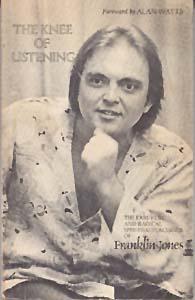
GARBAGE AND THE GODDESS

THE FINAL SPIRITUAL INSTRUCTIONS OF BUBBA FREE JOHN

1. THE CRAZY HORSE

On Monday night, July 8, Bubba invited a few Persimmon residents to his house for the evening. He had been warning for months that after the first week in July he couldn't be depended upon to do much sensible talking, that he intended for the most part just to roll around the Ashram like a madman. But on this evening he engaged his devotees in lengthy and lucid conversation. The result was a six-hour tape recording that originally filled more than one hundred thirty manuscript pages.

In a real and practical sense, this talk, and the one which follows it, contain Bubba's "final" spiritual instructions. He continues to live, and also to speak at times. But he has said that the work he had to perform in order to reveal and demonstrate the Teaching has been completed to his satisfaction, and he has nothing fundamental to add. All the miracles of spiritual Power which he generated in his Ashram, particularly during the period which is the subject of this book, are put in perspective in these final talks. The miracles were only intended to serve a more fundamental and true awakening in devotees, so they in turn could serve the spiritual process in the world. Since that is so, even though Bubba is still Present with Power, the miracles and profound events described in this book may be said to be his "last" miracles. He has indicated that he no longer considers it useful, as his common and expected practice, to produce extraordinary phenomena in individuals or in the outer forms of the world through the agency of the yogic or apparently miraculous aspect of his Divine Siddhi or Power. He only waits, He is waiting for his Devotees.

The Crazy Horse

The conversation began with talk about reincarnation. Several of those present wanted to know about Bubba's past lives.

BUBBA: By tendency the individual is resorting in every moment to some limitation. Consciousness is being modified in the form of a thought, a perception, the separate self sense, whatever. When you become extremely sensitive to the quality of self-modified consciousness, you can actually feel it, just as you now can feel something touching the body. It is not a physical sensation, but it is just as concrete. You will come to see that everything that is arising and everything to which you are resorting is simply another version of this ongoing modification of prior Consciousness. When you perfectly know that, and so pass into the intuitive life, no longer supported by experiences, you no longer resort by tendency to any form of this attenuation or modification of consciousness, and you rest in the prior Consciousness.

But that Consciousness is not empty. That Consciousness contains all modifications. So the Guru, who has become nothing, rests merely in that absolute Consciousness, but at the same time everything arises spontaneously in him, through him. The great Siddhi, the absolute Siddhi of all existence, has become his own conscious Condition without his having to assume at any moment the point of view of any modified version of it. So he is just present as That, and all things, including the manifestations of Siddhi, are shown through him, without his participation via secondary forms of modification, such as perception or cognition.

He himself is nothing. He cannot be identified in the midst of that. So all the media that even the extraordinary individual conventionally uses in order to comprehend things are totally absent in such a one. He doesn't operate via the limited self, via the mind, via desires. None of these things is his form. His presence is never limited. He has no activity that can be identified with any of that stuff.

I don't have any sense of identification with this life. I don't have any images about it that particularly impress me as being my own. I mentioned to you how, after the event in the Vedanta Temple, I would sit down and meditate and other people's minds and bodies would arise. I would work with them just as if they were my own, and it was all my own, without any sense either of identification with or separation from any of it. It was just the pattern arising to be meditated. just so, there is no sense in me of identification with these vehicles at the level of life.

Because an historical person had a spiritual or personal quality like my own, and because I have wanted to impress individuals with an aspect of the Teaching that could well be communicated through some historical example, I have from time to time said, with humor, that I was a particular person in a past life. It may have been useful to consider such a spiritual personage from the point of view of the Teaching, but I do not in fact have any such recollection of past lives. It may very well be that I have never been here and that I am not here now! (Laughter.)

MIKE WOOD: What was instructive about the image of you as Pius the Eleventh?

BUBBA: He was a spiritual Pope. He was very much interested in awakening people to the devotional life through religious media. He was largely responsible for the intensification of the cult of Mary, and the cults surrounding various sites like Fatima, and the cults of various saints. That was a basic interest of his. I don't know very much about him from reading. I don't have a distinct feeling in myself of identity with that personality. It is just a possibility that you may read in some of the earlier experiences and circumstances of my life.

[Footnote: In 1917 there occurred a mass vision at Fatima, Portugal. Three children were visited by the Virgin Mary, and many others saw the sun fall from the sky. This event is well documented and relatively well known.]

JANIS PODESTA: We would much rather you had been Chief Crazy Horse.

BUBBA: You think I may have been Crazy Horse because of certain visions you have had recently.

ANN WOOD: I would like to announce that you were definitely Crazy Horse.

BUBBA: Is this true?

ANN: I know it for sure.

BUBBA: One might very well have very clear and even true impressions in the form of psychic experiences. I just don't have any such experiences or impressions. The consciousness in me doesn't have any remaining tendencies like that. While individuals in the Ashram are going through this spontaneous purifying process that is awakened in Satsang, they themselves might move through those dimensions in which the psyche is open toward the universal plane of memory. So people in the Ashram could have a much clearer sense of my possible past incarnations than I have. In fact, the Guru has no sense of identification even with his present life. I have no more sense of identity with Franklin Jones or Bubba Free John than any of you does. I have the same sense of identity with all of you that I have with Bubba Free John. It is not a sense of identification or of limitation. It is purely spiritual comprehension of what is arising, without any of those limitations becoming the point of view. That is why the process of Satsang can work.

Men of experience have all kinds of mystical awarenesses and secondary siddhis and awarenesses of past lives and all kinds of psychisms. So the psychic individual looks at your forehead, sees symbols and images arise there, reads them according to the lore that he has studied, and tells you where you are at. This is a secondary siddhi, a psychism very close to life, and it requires identification with the life vehicle in order for it to exist.

In the Guru there is no such identification with the life vehicle, so he doesn't look at a person and read signs in order to know where he's at. He already knows. There is no obstruction in consciousness, so everything that he does relative to his devotee is perfect. It is perfect not because he is experienced enough to know how to operate. He simply does it perfectly, because be has already been undone in the Lord. So I literally haven't the slightest idea who I may have been in the past. And I would have to make the same kinds of judgments you might have to make about it. On the basis of some evidence any single one supposed, it might seem right or it might not. In order to confirm it, I would have to get involved in some psychic activity for which I have no tendency at all. So what Indian was I? You are the one who had the vision, not me.

JANIS: I have been having this vision for two weeks, over and over, very dramatically. Usually the Indian doesn't have very much on. But I feel as if I have a lot of clothes on. I feel these leggings, these boots that come all the way up, and leather things.

NINA JONES: Is he wearing a headdress?

JANIS: No, he doesn't have a headdress.

ANN: Is he a chief?

JANIS: I don't know. I think so. Someone else who has been having similar visions said they saw him as a chief. It's amazing to me, Bubba, that you don't always know what is going on in all this stuff that is arising in us. I think, "Oh, he knows."

BUBBA: All that stuff is the toilet bowl level. It seems very far-out, but it is not. It is just stuff. But it may be necessary to pass through it. Some individuals may go through a psychic purification that is reflected in the conscious mind, and it may include the memory of past lives and that sort of thing, whereas others just go through mental forms relative to their present life.

JANIS: It's really odd to see that's what it is.

BUBBA: It is perfectly obvious to me where you are at. The Guru operates from the point of view of a perfect assumption of your Divine existence. He doesn't just go around assuming mentally that everybody is in God. He can make that assumption only because it is perfectly apparent to him. That is all there is to it. He makes no assumptions on a lower level. So when he enters into relationship with you, that perfection tends also to be generated in your case, because his assumption of your true Nature manifests as Power to transform.

Whatever is appropriate and necessary in the case of an individual who enters into communion with the Guru will occur. But its "significance" is in the appearance of this self-purifying process, in which the individual is being confounded and undone in the same way that the Guru himself was confounded and undone, and restored to that perfect position in which there is no modification, no separate self, no identification with any modification, even the slightest, most subtle modification of the Divine Condition.

If the Guru's position were less than that, what he would be generating in you would be these lesser or limited qualities, and the Divine Process couldn't take place. The true Divine Process wouldn't be served through such a person'. Men of experience are fundamentally operating from a lesser position. They can, perhaps, have relatively good effects on you, but they are still of a limited kind. Such individuals are not involved in the Divine Process, because they can't make that assumption of the Divine Nature of the world that in itself is the Power that restores the world to its Real Condition. They can't assume that prior point of view and live it to you. And that is significant, because you tend to take on whatever point of view or state is assumed relative to you.

When the true Guru enters into your life, when you are living in that Communion, Satsang, the Divine quality is awakened in you. That affair has nothing whatever to do with your tendencies, because the Divine is beyond karma. That is the principle of how the human Guru is able to serve individuals, and to serve them as an immediate agent of the Divine Activity. He doesn't carry with him any of the secondary conditions that the man of experience carries. For that reason, the Guru is an agent of the Divine work, not because he has all kinds of heroic accomplishments in his psyche, but because he has become nothing. All the assumptions you want to make about the Guru, because of your present and chronic state of conscious awareness, are fundamentally false. So, Janis, you like the idea of the Guru having all kinds of peculiar secondary psychic powers and occult awarenesses of where you are at, but that is based on the assumption you tend to make on the basis of the quality of experiences that arise in you. It is not true to the Guru-function. There may be some individuals who are like that, whose business it is to be psychic, but that is their problem. (Laughter.)

The world is a form or dimension of Consciousness. It is not a solid something that exists outside of Consciousness. This is a Conscious dimension. All of this exists in the Divine Consciousness, which is also your own Consciousness, Nature, and Condition. So the Conscious Universe also contains memory in its midst. It includes all the qualities like those of the human psyche, as well as transcendent qualities, and lesser, dependent qualities. So it is possible by entering into a psychic aspect of natural consciousness to remember anything that has happened in the past, and to remember it with very specific images. When memories of past lives and the like start to awaken spontaneously in you, it is because you have tuned into that level of the world psyche. In that case, you are just reading it.

But such experiences, like all others in the world, are always in the form of limitation. What would a memory of this present moment be? What would it consist of? I am not talking about its relative value, but what would it be in fact? Could it have a form? If you were to remember this moment, this gathering here, and it flashed before your mind in the form of a picture, which version of the picture would you see? Would you see it from the ceiling, from your chair, from some other chair? But to be real it would have to be a total reflection, it would have to include and transcend all possible points of view. What kind of an image could it possibly have?

All memories of the past take place in the form of fixed images. Examine your experience of memory. Is it not so? Then you should gather that all such things are forms of limitation and have nothing to do with Truth. That is why living in a manifest form with a mechanism capable of gathering experience and participating in a relational life is an apparent liability. All that arises within it arises as experience, as an interpreted reflection and limitation of the whole. All of its impressions and memories serve it only in functional and conventional terms. If you try to read the Nature and Condition of things through that experiential point of view, you will be misled. Experience is always a form of exclusion and limitation.

Experience, in the conventional sense, has nothing whatever to do with the Truth, or the true Condition of things. In order for you to know this moment, you would have to step completely out of your usual experiential mechanism, your psycho-physical point of view. But you don't tend to do that. You tend to try to figure out this moment by viewing it through the experiential condition that you represent in this world. All philosophizing is based on first assuming that limited point of view, and then trying to figure it out from there. That approach is clearly false, because it does not attain a "picture" of the Condition of things, nor even a perfect experiential realization of this moment. Sit in a room and look at it. You think it is pretty pat. (Laughter.) Even so, life amounts to little more than such gazing at the walls in mystery. And what would be a real comprehension of this moment here, even this little gathering?

The only way to know this event as it is would be to be without the point of view of the experiencing entity. But people don't assume that point of view, so not only are they not comprehending what is going on, but they are actually meditating on that assumption of limitation. Not only don't they know the Nature and Condition of the world, or this moment, they don't know the Nature and Condition of their own presence within it. They are only involved in the conventional complication traditionally assumed in the face of the apparent condition.

You cannot know yourself or the world in the form of any perceptual evidence, any media, because that always brings a limitation, a reflection from a secondary point of view, not a real knowing of the event. The reason that evidence is binding is because of another assumption that underlies it. Mere perception is just things flying about, but each individual is himself a way to make "sense" out of it. This is because in each such case there is the assumed perceiver.

That is the conventional assumption you are always making, and, by assuming also that the perceiver is not a mere assumption or a practical convention but is in fact real and the foundation of present existence, you make everything that arises binding and mysterious.

It should be clear that it is not by working on perceptions or the contents of your mind that you undo that assumed limitation. It is only through a radical process in which that assumption and all its extensions are confounded, in which the separate self sense is dissolved, and the conscious principle falls into the intuition of the Divine. When that occurs, things may continue to arise and appear in conventional terms, but they will no longer, in themselves, be binding. Therefore, this convention of "the individual" makes sense out of life in practical terms, but it also makes life impenetrable relative to its real Nature and Condition.

We need to make the conventional assumption of the individual self in order to walk about and do things and live a human life. That is a convention, and it is useful in those terms. But we tend also to make that assumption the medium of our comprehension of existence, whereas it is just a bit of theatre. Our thinking is a convention, the forms of all our perceptions are conventional, all our cognitions and communications are conventional. They are all based on the conventional model of the psycho-physical "entity." They are ways of making use of this natural vehicle, this ordinary condition, and making it serve the aspects of existence to which we are experientially awake. But, apart from that, the conventions and their supportive model (the "ego" or "entity") have no value.

The conventional model of life that we communicate to one another is also something to which we glibly refer. We glibly pass it on to one another as if it were real. We talk about "me" and "you" and "the world" and "the universe" and "the air we breathe" and "going to work" and all of that. We just smack the conventional concepts about, and that's it. As if all of that had anything to do with anything we had ever perceived, ever truly known, even by experience. In fact we have never perceived and known any such things. The job of one's parents, who are employees for society as a whole, is to pass on to one the conventional forms of communication, which are simply ways for us to make sense to so-called one another in conventional terms, to carry on the ordinary business of a world. But the learning process in which we become established in these conventions, through our parents, teachers in school, and other influences, is not one in which we are actually made to perceive and know such things at all. We are merely indoctrinated and initiated into that persuasion in purely outward, conventional terms. We never actually know ourselves as separate. We never go through a process of actually knowing that. We are just shown how it is convenient and useful to make such references, and how when we make such a reference some other apparent individual immediately understands the situation. We become immediately uncomfortable when somebody doesn't make the conventional signals of self-reference, and other-reference, and all of the rest. We become very disturbed when the conventional signs are abandoned. That is why we don't like psychotics wandering around the streets. Psychotics are self-defensive tricksters who strategically, compulsively, and, at least apparently, unconsciously misuse or abandon the order of conventional signs. We become disturbed as soon as we do not understand the references that others are using to communicate. We become disturbed as soon as somebody doesn't make any references. As soon as somebody becomes quiet we tend to become a little anxious. As soon as communications are minimized we become uneasy, restless, or bored. So, for very ordinary reasons, everybody has adapted to a vast and complex system of signals, a conventional language which carries with it not just some words and systems of behavior, but a whole force of perception, cognition, and communication. And that whole approach to life tends to reinforce what we fundamentally and otherwise are tending to do at a more fundamental level of existence.

You may notice that when people are beginning to seek a little bit, the things they say are problematic are fundamentally identical to these conventional references. They talk about those conventions themselves as their disturbance. Take the case of "me," for instance. Everybody who seeks wants to get rid of "me," the ego sense and all of the liabilities of separated and self-motivated existence. And when they begin methodically to go about trying to do such a thing, they experience a tremendous force of identification and resistance and all the rest localized around that central cognition, or self-reference. But in fact, "me" amounts to nothing whatsoever. It is a conventional assumption, not a fact of realized experience. It amounts, ultimately, to nothing more profound than the name of some restaurant downtown. You don't become immediately disturbed as soon as some restaurant goes out of business -- unless it served particularly good food! You don't commonly mind if they change the name. You don't especially mind if they call it a hardware store. You don't mind when we call the year 1974 rather than 1973. Nobody really minds on New Year's Eve. In fact, everyone sort of enjoys it. So we do have the capacity to manipulate these conventional references, and we even build times and places into our social and cultural experience wherein we make these adjustments and changes. But many of them are never changed. They remain perennially as fixed categories. We never consider changing these fixed categories. There is even a taboo against doing such a thing. The self-reference is one of those fixed and irreducible conventions. But as I have said, all of these conventional forms of cognition, perception, and communication are fundamentally arbitrary, and, in themselves, are not signs of Reality but signs of function. They are learned for the sake of convenience.

If an entertainer gets up before an audience, there must be certain previously understood and conventional signals that he puts to you out front, in order for you to know whether to laugh, or to cry, or whatever other response is to be considered appropriate on that occasion. If he did not make obvious conventional signs, you literally would not know whether to laugh at a comedian, or to cry at a tragedian.

All these responses that we give back to the theatre of life depend on conventional signals that are perhaps subtly communicated, but which definitely must be communicated in order for us to know how to respond. Life itself is a theatre of rituals, which depends on certain conventions being used, for functional reasons, outward reasons, social reasons. But these same conventions become part of the case history of our suffering as well. This is because we also identify with them, as if these "things" indicated by conventional reference were real, as if they were based on our experience, as if they were based on our real knowing. And so we never examine the conventions themselves. We go about every kind of subjective path of self-liberation, self-perfection, and all of the rest, trying to overcome the content of these conventions, and we never fundamentally examine these conventions themselves.

Take, for instance, the convention of "my body." It seems like a very obvious reference. But if you were attentive, really attentive to the condition of bodily existence in the world, you would discover that you do not in fact experience a radically separate or perfectly independent body with a knowable center of personal consciousness. There is no such experience in the ultimate sense. There is only relationship or mutual dependence of forms. There is only continuousness from the point of view of consciousness. There is no line drawn about consciousness. The "entity" is never known, never experienced. It is just assumed and communicated. No one in fact has such an experience of being a separate one, whether they describe that separateness in terms of the body, the mind, desires, past reincarnations. However they draw the line, through whatever imagery or convention they draw the line, all of it amounts to this sense of separate existence, but in fact no one has such an experience. It is impossible for there to be such a thing. But we all assume it is a profound affair into which we have all gotten involved. We assume that we are literally separate, that the "entity" as body, psyche, mind, soul, or whatever is a fact of nature and experience. But in fact that is not our condition at this moment. And so, true or radical spiritual life involves another fundamental area of responsibility. And that is the area of conventional perception and cognition.

Ordinary perception is not primarily a matter of experiencing" anything directly, but of making a conventional description of it. Ordinary speech in the face of life amounts to a ritualistic patter of glib conventional references. Me, you, the moon, the sun, the stars. It's all such bullshit. Because nobody has the literal experience of knowing the "lines" about anything. No one actually perceives the conditions wherein any thing or any one becomes known as an entity. In fact, the only experience is one of absolute infinity. That is the only thing anyone has ever known. But flying up in infinity is an endless complex of conventions. They don't really have any power, as we discover upon real investigation. But we give them power as priests. All of these conventions are the cultic objects, the ritual objects of the priesthood of the cult of this world, the cult of Narcissus. All the ordinary references, terms, assumptions, habits, dramas, the ordinary theatre of life, not some special thing done in a church downtown, but the ordinary theatre of life is a priestly ritual that we ourselves enliven with our own life, even our perfect life. And that perfect life then begins to appear in the form of this glib world.

The conventional "world" is understood, contained, and kept in place. When it is gazed upon by the conventional man, it also communicates the sense of mystery, ignorance, and dilemma in him. But in fact there is no such world. It is unreal. No one has ever literally experienced such a world. So the spiritual process involves, among other things, conscious attention to this body of conventional assumptions that we automatically assume on the basis of no real experience at all.

Upon real examination, realized spontaneously in Satsang, the conventional state of existence is seen to be an arbitrary assumption, and thus not to constitute a literal dilemma, requiring remedial action. The conventional references are, in themselves, no more problematic than the clothes you wore here this evening. You could very easily have worn a different shirt, and you could just as easily be free of the power of your conventional mind, speech, and strategy of life. You may use it all with humor, the humor of one who understands. Even after it is all understood, there is still an ordinary world. And the functional mechanisms of this kind of apparent condition depend on signals, conventional references, for things to be done smoothly under conditions of mutuality. Otherwise, it could take several weeks, months, or years to get across the simplest kind of notion.

There is a party game that comes to mind that points this out. You are asked to tell somebody how to put on a coat, without assuming they know anything about how to do that, without assuming they even know what a coat is. And it can be very funny. In that case, the simple matter of putting on a coat can become immensely complicated.

It is impossible to do anything "meaningful" in the company of another human being without assuming something on the other end and implementing that assumption through conventional signs. And in fact that is how we live, by making all kinds of assumptions, because we all assume that we have been taught the same game. And, in general, we have, but nobody is putting radical attention on the game itself. Indeed, the analyzers of our games are little more than super-priests who console us with another ritual. Everybody assumes the game and plays it. And when that becomes oppressive, they try to get out of the game, they resist the game, they find a problem in the game, they do all of that, but they don't really examine it. They assume it as a dilemma and by reaction try to undo it, but they don't examine the thing itself. And the thing itself is very ordinary, incredibly ordinary. It amounts to nothing. There is no reason at all why it should complicate existence to make the little reference to "me." There is no profound reason why, on the basis of that simple little social reference, you should get involved to the depths of your psyche, high and low, in this egoic drama, this assumption of Narcissus.

Eventually, you will see everything is a convention. This world is itself a convention. It is merely a signal. It is a modification of that One Reality, that One Absolute Conscious Force that is Reality, which is endlessly modified as all the things that arise. Everything that arises is merely a convention within that great Consciousness. When that is absolutely known, that is what is called enlightenment. And one who is thus enlightened no longer sees anything but that One, everything is that One. Then the search is over. In that case, everything that arises is perfectly obvious. It is spontaneously known to be something that is merely a modification of that Consciousness. And it is not just assumed philosophically. It is absolutely obvious. It is obvious to you when you are thinking that you are thinking, and that thought is not somebody who has walked into the room. A psychotic might have his conventional references disturbed, so that when he has a thought he thinks of that thought as something that has come into the room. But in the case of the usual man, it is obvious that when he is thinking it is a modification of his own subjective existence. just so, it is perfectly obvious to one who understands in the most radical sense that even the bodies and sky and weather and everything is merely of that same Nature, a bit of Subjectivity, a modification of that One Reality.

So, we could say that enlightenment, or radical understanding, is basically the dissolution of the force of conventions, of conventional signs, in which they again become merely useful. They remain as mere signals, as useful theatre, but they are never again used by that enlightened one with anything but humor. He never sees anything in the same way that Narcissus sees it. As a result such a one is also likely to play the world a little better than Narcissus. He makes the world reveal its own humor.

Within the Ashram there should be humor relative to the whole of conventional life. We have our ways of celebrating that humor and of temporarily discarding the conventions that we assume with one another for the sake of day to day living, and that is good. There are also times when we just play it all straight. It is because of the paradox involved in conventional living that I want everyone in the Ashram to embrace an ordinary life in the world and to do their sadhana there. Then it will always be necessary for them to realize the correct position relative to conventional life.

Conventional patterns of behavior may be very sophisticated in a complicated culture like ours, but we still depend on conventional signs for communicating common things, and that is how life is managed in a relatively orderly way. After awhile, people who examine the conventions of life may learn what their significance is Such individuals become capable of manipulating the game, and that's how you get gangsters and phony politicians and all the rest. The devotee, the one who is living real spiritual life, also grasps it. He enjoys an equally sophisticated awareness of the meaning of conventional communications, but he lives all that from the spiritual point of view. He is able to play it with humor and to learn the necessary lessons from it without becoming daemonic.

Even so, the conventions have no ultimate value' They do not communicate anything ultimate, and they cannot be referred to for the knowledge of God, Truth, or Reality. But we do tend to resort to conventional states and the conventional mind, as if they were the way to salvation or peace. As soon as we try to figure it all out, or get realized, or whatever, we tend immediately to refer back to these conventions.

HELLIE SHEINFELD: It just seems like there is no end to it. Our avoidance becomes so subtle, does it always go on like that?

BUBBA: As long as you assume the conventional model as your point of view. The seeker operates within the structures of the conventional model to find God. If you try to overcome your bondage and become free, you never will. You will just become more and more subtly aware of how complicated it is, or else resort to some consoling illusion or artifice whose "significance" is liberation to you. You will be trying to make this and that vanish, to purify this piece of it, and then that piece of it. Eventually, you could go mad trying to do it that way. And the seeker is a kind of madman. Look at all the bullshit the traditional spiritual seeker does. It is crazy, because he is assuming this conventional model and trying to realize God while using that model as a goal in the form of a present dilemma, or fitted to an idea of perfection, in the form of a goal. He is just annoying himself further.

It is not a matter of getting rid of all of that, of doing something to it and being successful at getting liberated. It is a matter of living in Divine Communion from the beginning. Then all the purifications necessary to flash before you in order to straighten out all of the angles that you have built into the circle of life will be done, and done perfectly, infinitely. All the complications will thus be undone in a way that you cannot do, because you cannot assume the prior point of view in which all of that is a simplicity.

HELLIE: It truly is God's business. It is not your own.

BUBBA: Absolutely. It can't be done otherwise. And because the spiritual process is God's business, it can be done very easily. It is already done. We are not talking about some condition that is or can be accomplished, we are talking about the Condition that always already pertains. It already pertains, but so also, secondarily, does the conventional assumption that each person makes about his existence and the whole ream of perceptions that are then locked around that "me." Whereas in fact there is no such "me," and all these perceptions are not themselves intuitions of the Nature and Condition of things.

So in order to be free of the conventions and media that limit the knowledge of things, you must be free of the viewpoint, the perceiver. The assumption of the perceiver is what holds all that together and enforces that way of knowing and designing life. Only when there is perfect Self-knowing, the intuition of Real-God, can there be true knowing of all the things that arise, all the things manifested in the Divine Light. It is a totally different consciousness than was existing and being animated previously.

SAL LUCANIA: I have noticed that whenever attention is put on you, it doesn't fixate. It is not in bondage. I have begun to see that love is the free giving and taking of attention, and that when attention is put on the Guru, it is instantly sacrificed. It is not that you are performing some sacrifice, but that your very existence here is that sacrificial process itself. You can play all the qualities that manifest, such as when you suddenly change your moods and attitudes toward someone. Your behavior with other people awakens all kinds of qualities and expectations, and so involves them in the sacrifice. And the moment we expect anything, it all collapses immediately. That continual collapsing keeps things from fixating, and so there is love and freedom.

BUBBA: That is why attachment to the Guru in God is the great Yoga, the great Process. There is endless literature about non-attachment. There is plenty of traditional advice in the form "Don't become attached to limited beings" and all that. But the great Teaching is attachment to the Guru. The Guru doesn't exist limited to the conventional form, and so by engaging yourself in perfect attachment to the Guru, you are perfectly dissolved. Whereas attachment to any limited living being or thing enforces that limitation, that perception, the realization of the whole conventional model, and enforces meditation on the separate self sense.

ANDY JOHNSON: When should we become wary of becoming attached to you personally, as opposed to you as the Divine?

BUBBA: When the Guru is in human form he naturally appears via limitations, and you are always tending to conceive of the Guru in those terms. So the Guru has to be a shape-shifter. He must very consciously play his life as theatre, because of the assumptions others are making. So everything I do, insofar as I do it on this visible level, must be done very consciously, with full awareness of all effects. The way action is done consciously is by total sacrifice, total yielding of the principle of action, so that nothing is held on to from moment to moment. Then everything is done spontaneously relative to each individual I meet. So my qualities change always relative to the one I am dealing with. Relative to the moment, even the contents of my statements change.

It has been useful at times, from the point of view of the Teaching, to say I was such and such a person in the past. Now that that has been said, it is also useful to say, from the point of view of the Teaching, how that is maybe not so, or definitely not so. Both approaches are useful in their proper time, because everything the Guru does is from the point of view of the Teaching. He is not communicating matters of fact, or information, or images, or impressions. He is always working that process of dissolution. That is the fundamental force of all of his activity, so you can't rely on the Guru for any kind of significant and fixed information. The Guru is a source of a process, and that is entirely what he is. All other communications are secondary, and they will lead you by tendency to make assumptions in limitation, to assume the point of view of perception and cognition which arises in the mood of the ego. But the process in which the Guru involves you in the meantime is destroying the separate self sense and destroying the viewpoint of conventional cognition and perception.

Always it is this process that he serves, and his communications always serve that process. Because his communications are always serving that process, they should not be assumed to be simply of the nature of conventional communications, of reliable stuff. The Guru in human form has to make use of the fact that he appears to be a limitation, that he appears within the same conventional scheme of things that the people who come to him are always assuming. They are always tending to get involved in limitations, even in the form of their relationship to the Guru. Knowing that, the Guru must make use of his conventional status to undo that conventional activity in others. So he doesn't only sit back in silence and not say or do anything. That is also a mere convention, liable to bind people. He uses his appearance theatrically. He says and does all kinds of things, and in every moment they tend to bind others in a certain way. They absolutely bind, they bind others to the conventional assumption in that moment. But the Guru has endless numbers of moments. He makes use of the binding convention of this moment, and destroys it in the next moment. So the Guru is always working to confound you, but he operates, apparently, through this limited instrument of ordinary relational life.

You are always tending to hold on to the Guru in the limited way, to see him via the stream of conventional perceptions and cognitions that are being awakened in his Presence. That is why the Teaching is generated along with that contact with the Guru, because the Teaching always leads you to comprehend the strategy that you are using to deal with the Guru as well as with all other beings and things. In the Guru's Presence, you will always be confounded, even by your own experiencing, even by the extraordinary experiencing generated by the Siddhi of his own Presence. You will always be led by the Guru to a consciousness, relative to all that is arising, that is superior to the experiencing itself.

ANN: Bubba, last night I was led to this spontaneous experience of conducting the Force, and I felt possessed, really possessed. Then suddenly I wasn't my body any more. I was something above my head.

BUBBA: What do you mean when you say you are not your body?

ANN: I don't mean anything except what I was experiencing.

BUBBA: Right. Well, let's get into it.

ANN: You mean what was I experiencing?

BUBBA: Yes.

ANN: Well, I wasn't limited to that.

BUBBA: But to say that implies something about this "I," this one who is not his body, right? What is it that you mean by it? You do in fact mean something by it, don't you?

ANN: I just was up here, above the head. Everything that I thought was me was just a function, something that was just going on, but I wasn't that. I was moving.

BUBBA: Was there some sort of perception involved?

ANN: Yes. Well, there was one time when there weren't perceptions, but I don't know if I am just interpreting my experience or what.

BUBBA: Well, isn't the extraordinary statement "I am not my body" a conventional statement, like all ordinary statements? Isn't it the same old statement, like "Let's go to the store," or "I am not a policeman." Doesn't it imply the same conventional model? Doesn't it contain the same basic pattern as all other conventional statements? There is the perceived and the perceiver. There are perceptions, such as when you see something, taste something, feel something, and there is also the awareness or knowing of perceptions themselves. You can make remarks about your perceptions. So cognition is really an aspect of the same conventional order as perception. It is only another reflection of the psycho-physical condition, the limited state. But you say, "I am not the body," as if the body and the knowing of the body were two radically different things.

What is "the body"? You have a conventional awareness of your physical state, but it is not based on any sensitive perception of your physical state. It is based on conventional learning, into which all of us were initiated from birth. When we were children, our parents were responsible to help us adapt to the life-condition as it is traditionally assumed, so we would be able to function, and do conventional things. We were not trained in perceiving, we were trained in being conventional, we were trained in social functioning. We were not led to become precisely sensitive to our actual state. And, after that time of childhood, it is rare for a person ever to really investigate those areas in which he has been conventionally trained.

So a person doesn't tend to examine his ordinary psycho-physical life very closely when he is seeking Truth. He tends to look only toward transcendent and extraordinary areas of experience, in which he hasn't been indoctrinated conventionally. And when these experiences begin to be generated, he looks more and more for them to turn him on. And he feels a certain fear and reluctance to return to ordinary, functional life once he has known a few highs.

Therefore, sadhana must be done in the world, that is, in the dimension of conventional bondage. And if you begin to become sensitive to those areas of ordinary psycho-physical limitation, you will begin to see that your conventional cognition, perception, and communication relative to ordinary things does not contain a perception in Truth of what those things really are. Your whole comprehension of it was just a model in the mind, merely an assumption that enabled you to go to the store and write a letter and pick your nose and all that. If you were to become totally sensitive to the knowing of bodily life, just as you make yourself available to extraordinary and unconventional experiences, you would see that the body doesn't belong to the limited dimension you assume in the conventional terminology of your life.

There is no way to set radical and exclusive limits on the body itself. There are no such limits actually known. They are only assumed, and those assumptions are used in conventional society with others. In fact, you don't even feel the psycho-physical body as identical to a characteristic limitation, such as shape, or a fixed thought, or emptiness, or fullness. The sensation of individual psycho-physical existence is only part of the perception of the great process which includes it, and from which it cannot be radically distinguished. The complex sense of psycho-physical existence cannot be reduced to "the body." That process includes all other beings, the whole natural gross environment, and all subtle dimensions. It is always already continuous with them all, not broken off from any of them.

If you become truly sensitive to the so-called bodily life that you picture and limit through the conventional imagery, you will see that it isn't as you assume it to be at all. It is not a limitation, it is not a thing. It is not five-feet-eight and all that. You can't draw a circle around it and say "This is it." In fact no such "thing" exists, only the limitless process exists, and once that becomes very clear, the fear of return to so-called ordinary living is dissolved. There is only continuousness, not separation, only relationship without radical individuation.

Part of sadhana is to become sensitive again to ordinary things, and understand your dependence, as a seeker in dilemma, on the so-called extraordinary or non-conventional dimension of experience. The more sensitive you become to the true and non-conventional nature of the ordinary in the process of sadhana, the less you will be possessed of this cycle of fear or reluctance that leaves you clinging to exclusive ecstasies. The great ecstasy is not release into extraordinary and thus unconventional states of experience, but the perfect realization of the Nature of your Condition in all states, ordinary or extraordinary.

SAL: I have been seeing more and more that in the midst of my suffering, my strategy is always a refusal to live this condition, this psycho-physical life.

BUBBA: All that is happening in the form of the search for extraordinary experiences is the functional release into unconventional forms of cognition and perception. Successful attainment of the extraordinary is felt as profound enjoyment because, temporarily, there are no limitations enforced. But, subsequently, you fall back into those ordinary dimensions in which you live in conventional terms and suffer the assumed limitations of the conventional model of existence.

NEIL PANICO: Last night there occurred to me exactly what we are talking about right now. First I had all of these kriyas and force manifestations, but then I suddenly became very still. It was a very enjoyable quality. It was not really a quality, but only my really present state. I felt myself as I should be, as I am. That moment was truly showing what I am, but I knew I would get back into the usual point of view.

BUBBA: All the experiences that arise in the midst of your sadhana are drawing you into the non-conventional form of cognition and perception, in which all things that arise are known directly, as they are, prior to the separate self sense. Through the agency of all of that, the intuition of your prior Condition is given. It is temporarily touched and felt via these non-conventional perceptions and cognitions. When you return to the functional levels that are lived conventionally, the sensation that was gained in the previous extraordinary state lingers for awhile, but you have got to begin to use what is implied, what is truly shown to you in those extraordinary states. They are not the Truth. They are not to be held onto for their own sake, the way an addict holds onto his drug highs. They are actually statements about the truly unconventional nature of what you call the ordinary. If you do not then begin to comprehend the ordinary in unconventional terms, your extraordinary and spiritual experiences are not serving you. They are totally useless in that case, because they have nothing to give you in themselves but bondage to the forms of limitation they also represent, as well as a pattern of fascinated inclinations for the extraordinary in itself. Such a way of fascination, high or low, is at war with the realization of life in Truth.

SAL: When you deal directly with me in some very forceful way, and extraordinary things occur, I never feel like I fully return to the ordinary. I go back to some ordinary sensation, but I know that something has happened. I don't know it in a mental form, but I never fully return to my previous condition even though I have to deal with the same things. God just becomes more obvious, and I am forced into grinding my tendencies away. I have no choice. And I go through the same idiotic pain.

BUBBA: All that pain, that drama, is made unnecessary when Satsang as a continuous present enjoyment is lived. Then you simply become sensitive to that affair of life in which you are actually involved. You do this, rather than struggle with tendencies and all that jazz, which is just the theatre of conventional assumptions. Instead of doing that, you live Satsang, Divine Communion, and remain simply present, sensitive to all the qualities that are arising, so that you come to see the ordinary in non-conventional terms. When the knowing of the world becomes utterly non-conventional, when it is lifted out of this identification with conventional perception and cognition, the world again appears as the Divine. At that point, the intuition that is even beyond extraordinary cognition and perception becomes perfectly non-separate from your entire functional existence.

That perfect intuition is temporarily and experientially being granted via the extraordinary, not because the extraordinary in itself is the Divine, but because you have not lived in conventional terms in those dimensions of possible awareness. The experience of them contains the possibility of your perfect intuition, independent of the support of the extraordinary. For this reason, I have engaged the entire Ashram in extraordinary events for many months. But it has all been for the sake of this lesson. Now I am not any longer interested in serving devotees via the extraordinary. The point has been made. Hereafter I am only Present in the ordinary forms of life. And my work is not principally involved in the generation of extraordinary experiences, but in the demand for Understanding in the midst of all that arises.

The beginnings of the spiritual process in a devotee are simply his being lifted experientially into the non-conventional order of perception and cognition, in which there is no ego, no separated existence, no dependence on the self-limiting perceptual drama, no confinement to conventional forms of cognition. Then he seems to come back, through the same media of psycho-physical experience, to his ordinary humdrum life. When this happens, he immediately wants to be ecstatic again. Eventually, after many such trials, he perceives what is truly contained in that temporary lifting out of the conventional state, and he begins also to live that non-conventional realization in the midst of ordinary conditions. This going up and coming down becomes ever more rapid, to the point where there is no more apparent coming up and going down. Then there is simply direct realization, happiness under conditions of all possible functional states, high or low. That is the perfection of the devotee.

In the case of such a devotee, there is absolute continuousness of bliss, with no necessary experiential ecstasy. No standing outside of his psycho-physical condition is considered by him to be the equivalent of his God-Life. Then the so-called ordinary is realized as the perfect, the Divine. The only reason we think the world is less than the Divine Reality or Truth, and therefore seek to get out of it and achieve some extraordinary sublimity or other, is that we view the lower functional order of existence in conventional terms. The normal functional range of psycho-physical life in the world is bound to the model of separated life, in which there are discrete, separated states. The body is separated, the psyche is separated, "me" is separated. But that is just a conventional model of perception and cognition. Its principal idea is limitation. But that notion doesn't even hold true relative to the grosser levels of the manifestation of life.

Therefore, as I have said, if you truly examine your bodily life, you will see that it doesn't exist independently in any sense whatsoever. And the knowing of the body in non-conventional terms releases us from the great fear. In fact, the knowing of the common and ordinary order of life in Truth is a greater form of realization or liberation than the knowing of the extraordinary states of the higher or subtler levels of the psyche, because we are conventionally bound at that ordinary level. We are truly experiencing this great fear, this conventional limitation, in the midst of ordinary states, so to be realized, to be happy in the midst of functional life, not to escape it, is the great release. The ordinary is the condition that we fear, the place where we are threatened. It is conceived or assumed mortality.

Fear of death, cognized relative to the body or to psycho-physical life as a whole, is the great sensation, the fundamental thing with which everyone must come to terms. If the dilemma of that sensation were not there, who would care about the rest of it? Who would care to seek beyond such freedom? So there is always the return to that dilemma, until understanding is enjoyed while alive in the world. You must become happy in the body, you must realize God while in the psycho-physical condition. If you do not, there is, in Truth, no Satsang. But in order for that enjoyment to be awakened in the individual, he must go on the great tour. He must see the circle of life. He must see dramatized all the forms of his conventional bondage. He must be purified in the face of them all. And the realization of such sadhana is a responsibility of the individual in the midst of his conventional life. There are ways in which the Divine Siddhi draws him to that perfect intuition, but he must actually live the sacrifice. It is not magic. He must live it. That demand always pertains. So the conventional dilemma of the body is not permanently taken away by the dramas of experience in Satsang. Eventually, the individual must realize the Divine through the intuitive process of real intelligence, even while alive in "the body."

The fear of death must disappear, only not by overcoming fear itself, but by knowing the ordinary condition and understanding in the midst of it. You can't drive away fear. Fear is the very mood of the ego. It is not something that you are supposed to overcome by heroic efforts. It is something that must in itself become your responsibility prior to any kind of action. Fear is your creation, not something that is happening to you. It is the irreducible mood at the core of conventional perception and cognition. So something greater than the heroic overcoming of fear is demanded of the devotee. He must know his prior Condition in God, and that alone will obviate fear. That will destroy fear, not by mechanically suppressing or snuffing out fear itself, but by putting him in the Condition that is prior to that fear. When the separate self sense and the strategic avoidance of relationship, which are the ritual characteristics of Narcissus, have been obviated in Understanding, he will know even his bodily life in Truth.

Then, in every moment, he will draw his life out of the Light above and release it again. Not just his life, but all the modifications of the life-force from the mind on down, all thoughts, all feelings, perceptions, motivations, desires, including the separate self sense, which is simply a conventional modification of the life-force at the life level. In him there is not only the intuition of Real-God, the Heart, the Self as his Nature, but there is also conductivity of the life that descends and ascends from the Light of God, which is his Condition. The true Yoga is that free participation in the cycle of descent and ascent. That is ultimately the sacrifice that I talk about. It is the realization of the present dependence of all the modifications that are known as life upon the Light of God. One who realizes this dependence of all modifications on the Light that is radically above the body, the mind, and the world receives all conditions with humor, with each inhaled breath, and yields all conditions with the same humor, with each exhaled breath.

SAL: What baffles me is, why should conventional perception and cognition be assumed in this ordinary world and not in the subtler or extraordinary dimensions of experience?

BUBBA: It is because of the ancient order of human life. It is the way these functions have traditionally been lived. We have been identified with that conventional model at the level of the conscious, subconscious, and unconscious functions, and we don't even begin to assume that the ordinary world could be known any other way. It is very simple, very basic. And it is a form of our own functional activity, so that each individual can be responsible for it. Any one can know it directly and not live it. Therefore, the life of Truth or radical intuition is to be lived in functional terms, not by withdrawal into the upper soup. It must be lived directly in the common world. This world itself is unqualified soup, as much as any absorbed samadhi. There is no body, while yet there are billions upon billions of bodies. You are presently without that "thing" that you think is your body, even though there is this continued psycho-physical operation. The appearance of bodies and persons does not imply separation. But we all assume that it does. "That's him, that's her, and that's it." But all of that is a convention, a form of common assumption used to manage life in ordinary terms. It is very simple, very rudimentary, and just stuff.

ANN: It seems to me that is what's happening now for all of us in the Ashram. The ordinary is becoming extraordinary. At least I am beginning to feel that way, and a lot of others to whom I have been speaking have that feeling also. It seems to me that all these experiences, these cycles, have helped us to see that. They have been great, but I am also getting sick of them. I have felt so many times that if I heard one more scream I would go utterly insane. Of course, five minutes later I'd be screaming, but it has been interesting to find myself also getting sick of it.

BUBBA: If you are beginning to get frustrated even though you are having such experiences, this is a sign that you are being drawn into that radical demand to understand in the midst of this moment. Whether your state of experience is ordinary or extraordinary, that same intelligence is always demanded of you. Now the range of possible experience is becoming unsatisfying. Its power to fascinate is passing away. The having of an extraordinary experience is ceasing to be the equivalent of falling into the unconventional realization. The extraordinary itself is becoming conventional, because once the conventional experiencer has reached into the previously hidden realms of the extraordinary, he transforms it into a realm of conventional cognition and perception. Therefore, each time you get "high" you become more immune to the delights that last degree of height can provide you. Thus, the seeker pursues always greater and more stable highs, or else, at last, he begins to understand in place. When you no longer have any alternatives via experience, you are forced into the full comprehension of the life of Satsang in the present, whatever media are arising.

What is demanded of you is the realization of bodily or psycho-physical life in unconventional terms, prior to the standard model of the ego and functional separation. When bodily life is realized in that sense, there is no one who can die. It is not that you stand outside the body in some other state, as a soul or something like that. All states are either conventional or merely functional in nature, and, in either case are not identical to the true Condition. Even bodily life does not involve separated existence in any sense whatsoever. The conventional model is not true. When you realize, even in the ordinary bodily state, that you are not something that is separate and needs to survive, then the life of Truth is being manifested in its real sense, not in its conditional sense.

SAL: I feel like I am literally dying. I can feel the body going. I feel like you are inside of me beating me completely to death. I am exhausted. Sometimes I get up from sleep at night exhausted, completely exhausted, knowing that I have been through a phenomenal ordeal, without any conscious memory of it. I mean I absolutely know that I am dodging you all the time. And I see it and I know it, but it is a terrifying event in me.

BUBBA: The problem of fear will persist until, at the level of the conscious, subconscious, and unconscious life, this conventional model is undone. The dimensions in which the conventional model survives will always be resisting, and whenever you return to such states, the same fear will arise, the same dilemma will reappear, until they are no longer lived in conventional terms. Then there is genuine release, and bodily existence can come or go without the radical fear of self-death. Then death can make no ultimate difference. It becomes a practical and functional matter in God.

When you no longer live bodily life in conventional terms, then you can also see its Nature. First of all, you will see it as a non-separate Condition, but you will also come to see life and death as aspects of a cycle, a process to which your true Nature is always already prior. You will begin to see how the life-force in every moment moves down from above and manifests the vital condition of bodily life, the mind and psyche, and all the rest. You will see how your own breath is an instance of a universal, ongoing process by which this very world appears, is sustained, and yet always abides in the Condition of its unqualified Source, moment to moment. You will see how death is simply a release, a radical and stable return of the life-force, just as life is a radical and stable descent of the life-force. When you begin to participate in life as the conscious and dependent descent of the life-force from the God-Light, fear is released from life, and then also you become capable of conscious and voluntary death. When the body or psycho-physical condition is no longer lived in conventional terms, not only is there happiness while alive, but there is wisdom relative to the entire life-process, that becomes a body and ceases to be a body, and you become able consciously to release the body at death. The one who lives the life of understanding also consciously lives both life and death, reception and release, while alive.

When the devotee draws in the life-force, he is inhaling it from the Light of God. He is not inhaling and assuming the point of view of all kinds of limitations. He is inhaling the Light, assuming God as his Condition while alive under apparent conditions. He is assuming the body and all the rest, but he is assuming them in God. That is the significance of his enlightened inhalation of breath. In the usual man it, breath, is made in fear. He is doing it in order to survive. But the devotee simply lives and breathes in God, and allows himself to be full.

When he exhales, the devotee surrenders everything into the prior Condition and Nature of God again, without radically emptying the body of life-force. As long as he lives, the life-force is always being conducted through the mechanisms of the descending vehicle, whether he inhales or exhales. What he is releasing with the exhaled breath is the separate self sense, the mind and all conventional and limiting assumptions. He is allowing them to be in God, allowing them to be non-separate. He is surrendering or sacrificing them. He is releasing all the limitations that men conventionally assume. And. he does this not in order to attain God, but because he already enjoys God as his own Nature and Condition through the communicated Grace of Satsang. He does it because he has already Understood.

ANDY: Bubba, you said that we can enjoy perfect non-separation and yet you also tell us that we may come back or be reincarnated here or there in a particular condition. What do you mean?

BUBBA: That is just a convention. To say that you will come back is a way of describing a real functional possibility in conventional terms. In fact, that is not what happens. There is no you that goes here and there and everywhere else. There is only the Divine Consciousness, and you are That. By the Power of that Divine Consciousness qualities arise, modifications of That arise, the qualified life-condition arises, and all such things appear to be your condition in this moment. But they have arisen within you. They are the spontaneous manifestation or modification of your eternal Nature and Condition. It is not you that is traveling around. All these modifications are traveling around. They are what is moving. They are the movement. You are not something that is moving. You are always perfect, infinite, unmoved.

ANDY: But don't you get rid of your modifications when you reach non-separation?

BUBBA: You only get rid of the conventional bondage to them, the limitations implied in them. Universal modification, as a functional rather than a conventional condition, known in Truth, is wonderful! When you are not all confused and concerned, you enjoy your bodily life, don't you? You have friends and you love them, and you have experiences, and it is delicious. All human possibilities, if they are managed in God, are enjoyable. Life is, fundamentally, delight, when released from the strategic destiny of Narcissus and the conventional cult of this world.

Even death is an enjoyment if it is consciously lived from the true Yogic point of view, which is conductivity, engaged in Understanding. It doesn't necessarily involve incredible suffering. It is intended to be an amusement! it is a very interesting process. It will occur when it is appropriate for it to occur. It is not something that you should try to bring on because it is so wonderful! But when it is the appropriate time for that to occur, like everything else that occurs in its appropriate time, it can be as enjoyable and interesting a drama as any other bit of theatre that may arise. It is not in itself the negative side of life. It is not at war with life. It is itself a specific function of the life-force.

All the things that are suffering, that make life less than delicious, are the results of conventional living, this conventional egoic assumption or strategy and the patterns of perception, cognition, communication, and action that are riding on it. They make life in itself a limitation, something to be suffered, something to be gotten away from. But the Law is that life must be lived straight on through in God. Therefore, the devotee is always happy, and he lives with great intensity. Life or the Cosmos is itself a modification of the Great Divine. What heresy to assume that the Lord's Power of modification is false or to be gotten rid of! It is all God's work, God's happiness. It is to be known and lived in Truth. It is not modification that is to be undone, but the strategy by which you direct yourself through these conditions that are arising in God. And the fundamental strategy is the assumption of this limited self existence rather than the perfect intuition of the Divine as one's Nature and Condition. All that arises is to be realized consciously as the Conscious Theatre of God.


Preface -
Introduction - Chapter 1 - Chapter 2 - Chapter 3 - Chapter 4 - Chapter 5 - Chapter 6 -
Chapter 7 - Chapter 8 - Chapter 9 - Chapter 10 - Chapter 11 - Chapter 12 -
Chapter 13 -
Chapter 14 -
Glossary Chapter 15


Home | Intro | Beezone Articles | Tradition Articles | Adi Da Articles | email


"The perfect among the sages is identical with Me. There is absolutely no difference between us"
Tripura Rahasya, Chap XX, 128-133


 All copyright materials are used under authority of the Fair Use statute.

(United State Code, Title 17) Fair Use