Beezone Articles

Tradition Articles..

Adi Da Articles

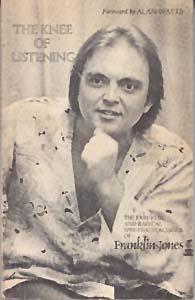
THE KNEE OF LISTENING

The Life and Understanding

of

Franklin Jones

Copyright 1971 By Franklin Jones

All rights reserved


 Chapter 20: The Wisdom of Understanding

The following is a collection of essays and brief observations, all of which have been written since September, 1970 and the summary events I have described in my autobiography. They are the product of a daily unfolding in consciousness of the wisdom of understanding. They are written from the point of view of radical knowledge, radical understanding. Thus, they amount to a description of real life as opposed to the life of seeking in all its forms.

This is the intelligence that exceeds and is free of the great search. It is the knowledge available to us in real consciousness. As these essays developed over time, the writing expressed this radical understanding in relation to many different levels of experience. The constant point of view is understanding and radical consciousness, but the form and matter of the expression is continually modified by different levels of perception.

Thus, these writings pass between different degrees and levels of dilemma, different chakras or levels of being, different questions and self-perceptions, and different dimensions in which life identifies itself as physical, vital, emotional, psychic, mental, spiritual, and unqualifiedly real. The wisdom of understanding is never exhausted, but it is always already complete. Its goal is not reality. Its conscious foundation is reality. And thus the wisdom of understanding is as endless as the permutations of experience.

These writings, therefore, do not encompass the totality of the wisdom of understanding. But I have hoped to make them extensive and as comprehensive as possible, to the degree that understanding itself, which is the foundation of it all, right find a radical communication. Therefore, read theme: for the sake of understanding, and you will know the wisdom of it.


"Yoga is the restraining of the mind-stuff from taking various forms." This statement, by which Patanjali defines the basic purpose and effect of yoga, the science or technique of self-realization, is the core of all spiritual practice and experience. Those who have deeply felt the control which mental tendencies and the whole system of desires that commands repetition of experiences of all kinds exercise over life have also sought to control this mechanism and realize themselves apart from identification with the mind.

However, that which is most desirable from this point of view is also most destructive when pursued with revolutionary intensity. Salvation or liberation may in fact be that which is experienced and enjoyed when the mind is no longer in control over conscious life, but to seek to control the mind, to prevent its modifications in order to know that which is not mind or which is prior to the mind is a false activity, a reaction, a manifestation of the problem itself. Thus, those who pursue this goal, consciously or unconsciously, by virtue of the various spiritual and religious means take a negative position in relation to the mind. They abstract consciousness from mind and pursue a path of effort, control, emptying, resistance and self-abstraction that only brings them to various experiences and degrees of passivity or emptiness. The willful control or abstraction of the mind is a pursuit artificially created by the situation of mental bondage. And those who thus resist, dissolve, abuse, calm and otherwise manipulate the mind in order to achieve a pure state prior to the mind are merely making assumptions based on the analysis of what was originally only an artificial, unreal state. Thus, the path of religious and spiritual life is very difficult, an up and down battle with our own desires,our own self-imagery. Such efforts are desperate and lifelong games of power with life-forces that act like steam under pressure.

It is my experience and contention that both the indulgence of experience through desire and its control and prevention via the effects of religion and spiritual techniques are poles of a single problem, the life-problem or doublebind of desire and freedom. The libertine and the saint are children of the same dilemma. The counter-efforts of religion and spirituality are ultimately as uncreative as the radical exercise of desire which the libertine evolves. At best they possess only a temporary and remedial value. What is necessary for life is neither its exploitation nor its absolute transcendence, but a creative realization. Everything else is an abandonment of life by an exclusive emphasis, either of desire or its opposite, which is only another form of desire. And the average life is only a confused mixture of the two efforts.

Creative life is in life itself. It is not warfare, since it does not assume the concept or experience of dilemma to be its real and primary datum. Thus, I have stressed that understanding is the key to real life, creative life, and not any sort of willful intention in reaction to life. As long as some form of the idea of separation, the dilemma, remains the primary recognition we will be moved to exclusive effort, belief and association with the contraries to our sins.

Only reality itself is the ground of creative life, and reality is the heart of real understanding. To understand is to be freely in life, already free of the dilemma which is the ground of religion and technique.

To oppose the mind, even intelligently, as done by the yogis, is to assume a non-mind or transcendent self-nature as the goal. But, apart from understanding or realization, that goal is unreal. It is merely supposed in reaction to mind considered as false. The "Self" of yoga is an uncreative state prior to life. This is not to say that the great yogis do not enjoy what is real. It is that their path, which they recommend to those who are suffering, is as unreal as their original dilemma, and it implies an activity and a goal that does not take its stand radically in life.

At any moment, I am the form of my mind. I resist identifying with the activity of my desires only when I am acutely aware of a dilemma, an effect of self-exploitation which I can no longer wholly avow and accept. Only then do I begin to assume a self-concept that is apart from mind.

But I am still entertaining a self-image. Whereas before I identified with my desires, now I identify with a non-desire state, the one who witnesses desire. Thus, even the "Self" of yoga or the "spirit" of religion is a mere self-image, a function of the mind. Knowing this, I can understand the futility and falseness of my spiritual position, just as before I recognized the necessary suffering involved in the exploitation of desire, the forceful repetition of experience.

There is, then, no real alternative to "mind" or life. Only a creative, continually real and free realization is true. And it cannot involve mental control as its basic, central motivation, nor the idea of dilemma or separateness that provokes it.

The real, creative life is founded in such understanding. It no longer separates itself from mind or experience, nor does it identify itself with a present desire or complex life as a necessary function.

The life of understanding first of all sees the effort and idea of separation to be unreal. It recognizes radical relationship to be real. This is the ground of real intelligence. And this understanding, which is no longer apart from relationship, is thus already real, already grounded in reality or life. Reality is its core, its motivation.

Thus, reality itself, not counter-effort and the idea of separation, is the source of creative life. Reality itself exercises natural, creative control over experience and accumulated desire. It is not exclusive or separative but always already free and present, not resistive and passing into elsewhere.

There is no real exhaustion, no real enervation. The energy of life is not ours. Its source is universal. Creative life takes advantage of the physics of reality, of universal life. This is our only refuge. When we abide radically in reality, in understanding, we no longer pursue the exhaustive route of desire or the counter, uncreative effort of absolute transformation and transcendence. We are already real. Thus, understanding alone is the ground of true creative life in the face of any consequence, any effect, any change, any death.

I assert this in opposition to all religion, all spirituality. Reality as a radical perception is prior to all dilemmas, concepts, paths and techniques. Reality alone is the source of creative, personal existence, even as it is already the source of all present things. All other paths are the refusal of reality, the refusal of relationship, the abandonment of life. The libertine and the liberated saint are fixed in a motionless effect of unreality, an exploitation of-the contrary. At least this is how their image functions in the mind of a seeker who beholds them. We are already in that which we must realize. And true realization is not apart from life itself, the context of energy and activity.

Creative life is active, functional, relational. Its constant, radical premise is that which always already is. And that reality is not an object, a goal or a dilemma but an uncontradicted nature known only to radical understanding.

Creative life is not a way out but is always already free of the dilemma. Thus, it is in life, actively realizing or bringing forth the form of life. And reality is a form, not an object or goal. When the dilemma is understood, the separative movement dissolves. Then also the "objects" which were before pursued as "reality," that is, the "Self" or "heaven" or etc., are perceived as unreal, a revolutionary reaction. Instead reality is known as a present form which includes all of the functions of self or mind, etc. All things are in this form and creative as it. It is the free play of creative energy itself on all the mutual levels of existence. The form is unqualified relationship. Not the object of relationship perceived by the functional "I," but the "I" and its objects, the mutual form. That is reality. Thus, neither the "I" nor its objects are exclusively reality. And realization is not a radical activity of self in relation to experience. It is not to be the "Self" or some divine quantity over against the present experience. It is to be no longer confused by an exclusive assertion of the absoluteness of self or of experience. Thus, the libertine asserts the necessity of his objects via his desires. And the saint asserts the necessity of his true "self" apart from his desires. But in truth the form of reality itself is the only reality, and within it self and object are functions that have no absolute, separate value.

It should be clear, then, that realization is a present, ongoing activity. It is not a once and for all exclusive state. It is simply real, creative life that has not abandoned or identified with any absolute function. Reality is fully capable of life. The indication of this is the fact of existence, the universe or world itself. Creativity is the real fact. The indication of this is the multiplication of existences. The real standpoint of free life, then, is life itself realize in understanding. And thus we will not be moved toward apparent exhaustion or transcendence, both of which are only possible and apparent effects of certain kinds of exclusive exploitation. The truth of life is not in these polar possibilities or any possibility but life itself in its real form.

To this end, this present recognition, which rests on no accumulation of experience, holy or unholy, we must resort to understanding. Understanding is a creative activity that must be realized now and moment to moment in relationship. It is not to be identified with any state or any degree of accumulated purity. Real consciousness, the free and realized state, is just understanding, which is itself no longer reparative but in reality. It already enjoys the form of reality. Understanding is just this primary knowledge, this creative, free viewpoint. Out of this you may create conditions that are apparently more enjoyable or beautiful or whatever than your present ones. But you will not have become more real, more free or more liberated than in any moment of understanding.

To grasp this and to exercise the creative play it makes possible is the core and substance of real life. And it has nothing at last to do with religion and spirituality. All religions and all paths may at last be the same, as the great prophets have argued, but real life is distinctly free of all of them, all their gods and goals and states. Just as the Zen masters burned the wooden images of the Buddha for heat, the real man will abandon all his religion and spirituality in the fire of real energy, the creative force of life.

And do not think that I am suggesting "understanding" to be a kind of sudden enlightenment in the Zen sense. It is free of such required perceptions, such "experiences." There is nothing peculiar about real consciousness. not a perception of self or world or any object, but it is the free creative viewpoint. Reality is what is, not what is known, acquired, attained or distinguished. This is real life, even in death, for there is no opposition to creativity anywhere, except it seems to be where there is no primary understanding.


Experience is void. It is without form,. without qualification, without limitation or center. Memory is form, qualification, limitation, and the implication of subject or person. The infinite, the true, the unqualified, the real is always already known, but there is a functional confusion imposed by the memory of experience as images, sensations, reactions, feelings, etc. with boundaries, and a center. Memory is itself a symbol of reality with the real force of life hidden in the mystery of its form.

Thus, various teachings prescribe a path whereby the mind is emptied, suppressed, controlled, unburdened, etc. But such a path is endless, never finally epitomized or exhausted. To follow it is to be involved in warfare based on the assumption of mystery, limitation and exclusive personality. All paths are means of interpreting the symbol which is the functional mind or memory with all its forms and planes. Thus, the phenomena of all paths are manifestations of the formal mind. By these means reality itself is always not yet, always the goal of striving. And thus it appears symbolically and experientially as an exclusive peace whose very formlessness is itself a mysterious symbol. But I assert that reality is not properly the goal of striving but the source and foundation and motivation of real creative life. Thus, I abandon all paths, all mental techniques, all religions and spiritual fascinations. I adhere radically to the form of reality. By this understanding, the whole effort and strife of warfare with limited formal awareness is overcome. The dilemma is dissolved by prior truth.

There is great discussion among spiritual seekers about whether God or reality is with or without form. The final word appears to be that both notions are true, manifestations of different levels of conscious awareness. But these controversies are founded in the functional mind. As if we ever experienced real limitation even in the perception of the world! The limitation known as "form" is merely a mental symbolization which prevents direct awareness. But in fact even the world, the source of forms, is void, unqualified, implying no separate self or object. In reality form is inclusive and thus unqualified. But in memory form is exclusive, limited, implying subject and object in opposition. Clearly then, all methods of overcoming the mind and its effects are an endless, self-creative dilemma. Paths are already bound to their illusions. There is no realization apart from understanding, from radical adherence to the form of reality. Radical understanding is the only real and true life. And to it consciousness is always already free, unqualified and present. It is natural and simple, the-foundation of creative existence moment to moment rather than an abstracted, symbolic state that is always prior to mind and thus prior to experience. Real consciousness is experience and thus prior to but not different from the mind.

Traditional teaching recommends either attachment to God or attention to Self-knowledge. Thus, consciousness is made attentive to the exclusive forms of primary object or subject. By a process of understanding I seek to obviate such motives. By virtue of understanding it becomes clear that reality is not exclusively enclosed or epitomized in any object or subject but is always and only manifesting as their inclusive form. Thus, rather than concentration in any exclusive form, I affirm understanding as not separate from reality. Understanding asserts no exclusive awareness or concentration. It is unqualified, direct, void, in which objects do not "stand out" to consciousness, nor do they imply a separated subject.

Life that is real, founded in understanding, bears no peculiar state, no special abilities or visionary capabilities that are necessarily coincident with and the result of such understanding. It is simply creative life without fear or answer or question, but direct and unqualified.


Religion and spirituality are a call to the "Witness" that is the source, the reality and the truth. The "Witness" is the "God" of religion and the "Self" of spiritual philosophy.

But the call to the Witness is made by men, or by a state of knowledge that has adapted to the form of ordinary humanity. The call is always made to those who suffer, who do not know. Thus the call is a cure for ignorance and misdirection. The call and the dilemma are inseparable, and, just so, the call and the dilemma are the structure wherein the Witness is intuited and pursued.

In fact there is no Witness. Even the "I" and "me," "you," "it," even the "Thou" have no exclusive reality. All of these are functions, moments within a great process. And only that process itself, as a whole, is reality. There is no stability, no sufficiency, no epitome in the unique form of anything. Every manifestation is a moment inseparable from the force and consciousness of the whole.

When understanding replaces the dilemma in the heart of life, then there is no longer any possible attraction to the call to the Witness. That call is seen to be an extension of the dilemma and not a function of reality. Real understanding is an unmoved sublimity since it is no longer separate from the whole or separate from anything. And this non-separation is a matter of consciousness, of depth, not of vision or thought. Thus, it is not "satori" or some developed and psychic state. Nor is it a matter of feeling the same as, equal to what one perceives, etc. It is a creative state in which the dilemma, the motivating idea of separation has been eliminated. That is it entirely.

To such understanding, such unqualified real life, there is no recourse, no resort, no liberation, no Witness. There is no exclusive alternative to life or consciousness or relationship itself. There is simply the removal of the dilemma through understanding, and with it goes all fascination, all exclusive motivation, all identification with what is separate and supported only by its limited capsule of energy. Reality or understanding knows there is no Witness, no other, no self, no limited and separate identity. Indeed, the state of Witness is the dilemma. In reality there is the process itself, and I am never at any moment different from the manifestation itself. There is no prior consciousness, no spirit, no Self, no God. All distinctions are communications in dilemma. And the truth is not that there are no functional operative and relational distinctions or roles, etc., but that the force of conscious and creative life that always, already exists does not identify with them. Conscious life is free of the identification with contradiction or separation.

From the viewpoint of real understanding all things can be described quite differently than from past fixations in dilemma and the great search. There is no entity anywhere and no Witness, great or small, to any entity. There is no God, no Self, no Universe, but only reality, the unqualified bliss of creative presence. To give it a name prior to understanding, or to pursue it as a goal is to abandon it entirely. That which is the Witness is true, but that which is pursued as the "Witness" is death itself.


The avoidance of relationship is the key process in consciousness. It is the root cause of all suffering, ignorance and misadventure. Relationship or union is not, however, the truth over against the pattern of avoidance. Indeed, the sense of relationship as "me" or "I" over against it, that, It, That, and all the objective references, including the references to the primary other, such as You, He and Thou, is the most fundamental effect and creation of the activity of avoidance.

The primary activity of avoidance of relationship is the root source of the implication of self and object. It is the means whereby this perception is created and enforced. When crucial insight is regained through enquiry, the creative work of understanding, it becomes clear how the entire enterprise of ordinary consciousness, even in its most evolved forms, is a trap, an exclusive double-bind wherein life becomes interiorized within an artificial perception and activity. It is not that, properly reformed and controlled, the usual form of conscious life attains to the highest. This is not so because the most primary, indeed, primitive activity of the usual life is avidly at work manufacturing a form of perception that is its very bondage. The one who would reform himself is already the one who is creating the dilemma.

The avoidance of relationship, whatever its causes in a real cosmology, history or physics, is what men ordinarily consider to be-perception. The activity of perceiving something, anything, by any means, whether via sense experience, memory, or other mental process is the very activity that creates the primary form wherein we cause our suffering.

Until the avoidance of relationship has been fully comprehended in the direct process of understanding, there is no activity, no experience, no moment in time or space wherein we do not manufacture the causes and effects of bondage and falsity. The avoidance of relationship creates by implication the sense of "I" as the limited capsule of life and the recognition of "other" as the universe or force wherein the self is contained, confronted, surrounded, manipulated and trapped.

Our most prior situation is one without qualification. It is creative, whole, full, undaunted, without center or bounds. However, without perfect understanding, this is merely an idea, a symbol. Indeed, the idea of "God" or "Self" or "Brahman," etc., is a reflection in the mind of this prior reality. But the paths of religion and spirituality point to such objects or goals without emphasizing the necessity of prior understanding for the actual attainment. Instead, they take the absence of understanding, which is a combination of faith or aspiration and ignorance or "sin," etc., as. the primitive data wherein the path is created. Thus life becomes means and effort toward salvation or liberation. It becomes a kind of counter-effort or deconditioning, wherein life effects are removed by a kind of piecework process. And the individual is called to value and seek the event of his deconditioning, the moment of emptiness and stability.

In the ways of the East this emptiness, the removal of all effects, the pure Self, is valued as the primary state. In the West, the tendency is to value a point in time wherein a certain relationship will be epitomized, and all effects will be within the creative province of the unqualified God. But nowhere, East or West, is it taught that all such paths and their goals are extensions of the very activity that is itself the dilemma. If it were taught, there would be no paths, no goals, no religions and no spiritual phenomenology.

Thus, to make real life possible, we must begin with understanding, not with a description of the goal, the opposite of suffering, not with a description of the path, the way out of suffering, not with a cosmology, which can only be true and real if produced and' received in perfect understanding, and not with any analysis of the human mechanism, which, apart from perfect understanding, cannot be truly known but always remains confused with the dilemma itself.

Prior to understanding there is no value whatsoever in talking about "God," or "Self," the way and its means, the structure and phenomena of the original universe, or the instrumental entity who is related to all of these. These are fruitless notions since, prior to understanding, they are merely extensions of the form of the dilemma, and, when understanding is attained, these fall away and dissolve in the humor of reality. Thus, it is necessary to understand. And understanding is a matter of observing experience and the patterns of our lives.

I will try to state it plainly, from my own experience. When the pattern and contents, mentality and moment to moment activity of our lives is observed, it becomes clear that the primary symptom of all suffering is separation, being separate, limited, a self-exhausting capsule of potential energy, and an activity operating to effect such a state. All suffering is an effected enclosure, emptiness, unconsciousness and death. And, over against this, the suffering individual perceives the universe in mystery, as a vast container of living potentiality and desirable force whose essential objectivity prevents both union and the manifestation of its essential nature.

Suffering is separation and separativeness. And suffering is the primary fact for individual life. The problem of life for all men is how to realize life under the conditions of suffering,. How to remain active, creative, relatively and at least temporarily fearless, optimistic and effective? The problem of life is the problem of humor and creativity.

And the way of life, whether in the case of the ordinary man in his medium solution, or in the case of the great seeker, is all of the intentional means of surmounting, overcoming, transcending and perhaps finally reversing the milieu of life as suffering. Death is the primary symbol encountered in all of the Quests of humanity.

But understanding includes more than this recognition of suffering. For it becomes clear that all our events manifest not merely the element of separation, but that all of our activities, down to the most primitive mechanics of consciousness, are in fact a deliberate creation of separation or suffering itself.

This is where understanding abandons the path of the great solutions. For suffering in this sense has been recognized by all of the great teachings in the world. But, in the past, suffering itself, described in the cosmologies of Buddhism and Vedanta, or in the symbols of Judeo-Christian history, has been conceived objectively, reduced to experience itself. Thus, the great paths have directed men to a solution to suffering, which is the whole apparatus of liberation or salvation, including its cosmology, its philosophy or theology, its means and techniques, its goals and its significant phenomena.

But understanding does not root itself in the primacy of suffering or sin. It does not identify suffering with any irreducible necessity. It simply observes the content of experience with radical adherence, and does not react with any of the provisional assertions that characterize the great search.

Thus, understanding moves into the cognition of suffering itself. And it becomes clear that separation is a primary activity in consciousness that not only controls perception and activity but creates them. When such understanding arises, then suffering is viewed in an entirely new way. Its importance ceases to be in terms of that from which

it separates, whether such is called God or universe or reality, etc. And it also ceases to be in terms of that which it separates, whether such is called soul or self or ego, etc. Rather, the importance of suffering is realized to be in terms of the activity of separation itself.

This is of utmost importance. All of the great paths, which are reactions to suffering conceived as primary and irreducible, concern themselves with the phenomena and results of-suffering. That is, they evolve the pattern of their activities out of the primary assertion of that from which separation takes place, be it "God," "Self," "Brahman" or etc., and that which is separated, be it the "soul," or "self," or "ego," or etc., and the process of finally overcoming this asserted dilemma is one in which that which is separated moves by various efforts within and without itself to an ever more inclusive union or identity with that from which it is separated.

But, in contrast to all of the revolutionary paths of mankind, real understanding is a radical, unqualified process that makes no resorts beyond itself. Thus, it does not react to the preliminary and formal recognition of its own analysis. Understanding is not a temporary activity that must be abandoned as soon as the implications of its own discoveries become forceful. Understanding is a radical activity, identical to reality, that admits no alternatives or resorts. This is clearly so, because understanding is equally able to contemplate even its own arguments, and the processes of great seeking are as impotent before it as the middling confusion which we first encounter in the process of self-knowledge.

Thus, there is no force prior to understanding. All that is encountered in the phenomena of life and consciousness is its proper field. Therefore, once it has known the evidence of suffering, and then also known the falsity of the alternatives, the paths out of the suffering, understanding still continues.

And what has been realized to this point? First, that separation or suffering is primary to the whole of life experience. And, second, that the alternative or counter response to suffering is simply that, a counter-effort, and thus false because it is founded in and inseparable from the continuous creation of suffering.

This is the most intense and crucial moment in understanding, for it is at this point that all, indeed all of the usual and even extraordinary activities that have been adapted to life have become unnecessary and, at last, impossible. At this point, conscious life becomes truly radical understanding, and it begins to evolve on a totally new basis. It is at this point that understanding begins to take on an intentional force. It is at this point that the form of enquiry I have described becomes the primary activity of conscious life.

Understanding has now come to recognize the fact and activity of our dilemma. And it has seen and radically abandoned the alternative means with all of its categories, entities and phenomena. A life in this condition can no longer abandon itself unconsciously, without understanding, to the patterns of self-indulgence and avoidance that characterize ordinary life. Neither can it adapt itself to any means or consolation whereby these patterns and their results are weakened, dissolved or transcended. Such a life cannot identify itself in any of the phenomena of sin or sainthood.

Yet it is not in a double-bind, unable to move. Indeed, it recognizes that sin and sainthood are in fact the manifestations of the double-bind which reflects our dilemma. Now understanding begins to enjoy its essential and radical freedom. And it begins to act on the basis of its own realization.

Thus enquiry begins with intensity. Enquiry is not a method, a technique to which understanding adapts itself. It is the process of understanding itself, evolved out of the intuition of its own force and form. Enquiry is founded in the perception of reality, not the phenomena of suffering. For understanding has at this point recognized the process of avoidance to be the primary activity of consciousness and the root of suffering. Thus, enquiry is simply the further investigation of life, the real observation of life. It is not adapted in order to pursue a certain deliberate goal, form, or solution. It is a radical activity, that is, not a resort, a recourse, a counter or preventive technique. It is an activity that knows no recourse, that has no possible resorts. It is the manifestation of understanding, which knows nothing in life apart from its own discovery, which is the content of life itself.

Thus, understanding continues as enquiry. The approach to life becomes radical, intense, unqualified. And life becomes naturally, by virtue of its intensity, its unqualified, living force, controlled, centered, direct, and creatively simple. And the enquiry is simply questioning in the depth of our living form: "Avoiding relationship?" And at each moment of enquiry the knot of life dissolves and the fixation and solidity of energy at every focal point of our living being falls out into an infinite perimeter, so that we begin to experience ourselves as an unqualified form.

The enquiry continues moment to moment, in the arbitrary mental and personal events of daily life and in the periods of formal exercise that are real meditation. Until the form of life that formerly was suffering, analyzed as ignorance, soul-adventure, sin, flight from God, and all the rest has been epitomized and replaced by unqualified understanding, the enjoyment which is reality itself.


Experiencing, or reacting to phenomena, and seeking are the only two things being done. The differences between individual lives are created by the degree to which either experiencing or seeking is the primary effort in distinction from the other. The libertine is the primary evolution of the way of experience, and the saint is the primary evolution of the way of seeking. The ordinary man, who neither experiences nor seeks in an intense, exclusive manner is merely confused, unreal, mediocre and finally baffled. The libertine and the saint are merely unreal.

My life has been an exploitation of these ways. I have known the extreme enjoyment of the libertine and the saint. And I have known the most ordinary, medium life. But there is also understanding, which is reality, and by it I recognize every form of suffering.

In this book I have had to confront a most difficult means of instruction. I have had to demonstrate my way of life in order to assert the objectivity of phenomena which neither I nor any man ordinarily would support. But, in the end, I have had to argue against the very things I have proven in my life, in order to speak the truth.

My own path began in despair. The precious religion of my youth was stolen from me by the very ones who gave it to me. Thus, I was moved to search the paths of religion and spirituality in order to ascertain whether the phenomena, the miracles, the experiences and advocations of the great paths were factual. And I found them to be so. What is called Kundalini Shakti, the universal conscious force that inspires and fills all religion and yoga and spiritual philosophy is an objective reality. Those experiences are factual and depend on no illusions in the sense of such subjective forces as belief to create or maintain them. The Kundalini or mother-Force is part of the evidence universe, as objective as any form of energy, and as external to us as the functional phenomena employed by libertines and businessmen. But, in the end, I was forced to abandon all of the sublimity. The phenomena called "spiritual" as well as those called "sinful" are all part of a spectrum which includes the whole range of experience and seeking. Reality itself is the only matter that makes a difference in the adventure of life, and it stands critically above all our efforts and all our discoveries.

Both the search for spiritual realization and the exploitation of life on a sensual level are traps. The search for experience as well as the search for liberation from the bondage to experience is all the same activity, born out of the absence of understanding, the uncreative movement that is not reality.

I have written this in the form of autobiography because my own life is perhaps the best instruction I can offer. The mere assertion of understanding is not sufficient to create understanding in the hearer. The hearer must be allowed a creative recognition. Otherwise the symbols wherein his life is trapped will not dissolve. Therefore, I have displayed my life as much as I have had patience and perspective to illustrate it. I hope it has been fruitful for you. But know this. I do not stand for spiritual efforts of any kind. Nor on some middle ground between excess and effort. There is no virtue in the endless reaction to life, nor in the exclusive enjoyment of any effect. Only understanding, only reality itself is the truth of all events. Therefore, understand. Abide in understanding as radical truth, and then never again become enamored and fascinated by any way at all. Then you will abandon the symbols of the way as freely as a child his toys. To the man who understands there is no exclusive power in any of the ultimates of life, and he will maintain his radical humor and freedom in the face of divine beings as well as the most disgusting elements of ordinary life

To this there is no way at all. It is not an attainment but a natural activity. It is creative life, perfected by no exercise, dependent on no experience, no circumstance, no force or presence. It is our only and present capability, wherein we live not as little capsules of life seeking union with what is outside or true, but as already free, including all things in the force of our being, already unlimited by any distractions, entities or functions. We are already real, and reality is understanding.


Anything that I can experience as an object, any distinct entity or force at all is not outside or apart from me. To think so is to believe the primary implication of that experience, which is that there is "me" limited by "that." And thus I am already involved in a dilemma wherein I can only communicate with "that" through efforts of desire, union and transcendence. But objective experience is itself the activity of unreality. It is the process of the avoidance of relationship. Wherever I experience in this way I am primarily, in the deepest level of conscious life, acting to avoid relationship, enforcing the implied dilemma of "me" and "that." But understanding, which is direct enquiry into the process of the avoidance of relationship, is already free of this entire dilemma. And it already enjoys what is not this dilemma. It is the enjoyment which is reality itself, that which already is, prior to the dilemma and the implications of the form of experience. And that enjoyment sees no "me" and no "that." It is not forced to assume the interior position implied by the external fact. Therefore, it does not move from the center outward into the universe of things that is separate from itself. It is already apart from "me" and "that." It intuitively knows the universal life.

This was the meaning of my first great experience at the Ashram. The "me" was removed in the instant of awareness that "me" was only an artificial entity and activity motivated in fear and separation to find a stable form of existence. But in that instant of vision the point of reference was dissolved, and I saw that I was not an entity that needed to struggle to survive, but there was only a process being lived. I was not in that process or identifiable with it. The game and the pilgrimage were over. The very thing that had motivated me to India and which still trapped me there for another two years was disappeared in the sudden awareness of reality. In that moment, and now continually in the instant activity of understanding, there is only reality. There is no implication of me or anything outside me, no dilemma, no trap, no path, no remedial action, no search, no fascination, and no exclusive motivation. There is this constant awareness of the absence of bounds and centers. It is not that I have become God or one with some Spirit that acts on many planes of created life. Even these are fragments of the ideas of separation. The universal entity is only another center, another exclusive and bounded force that acts on what is outside it. It is simply that there is no center, no entity, no bounds, no dilemma. There is only this tacit understanding, creatively enacted moment to moment, in which there is no experienced self or other but only unqualified and joyful freedom even in the midst of life. On such grounds I deny the value of all paths, all experiences, all resorts, not only for my own apparent life but for all men. Therefore, I teach no paths, I point to no entity, no resort, no means at all. After abandoning all such things from our interest, I assert only present understanding as radical Truth.

And I invite anyone who is motivated to any ends, be they in the direction of ordinary, habitual desires, or in the form of spiritual practice, even where such desires and practices have become fruitful with all the evidence of enjoyment, ease or great powers and visions, to approach all of this with understanding, with the enquiry: "Avoiding relationship?" If they will only do this, their entire adventure will reveal its hidden form, the tiny interior tension that supports it all will easily unloose, and all the parts of conscious life will fall away. The center will dissolve and the barriers that enforced distinctions will dissolve. What remains is reality, unqualified, unsupported. And that truth carries not the slightest implication of our ordinary path. Then there is the event of real life, where all the puny nonsense and trouble is forever gone.


Self indulgence is the avoidance of relationship. It is a form of seeking, and it fixes us in unreality. Its product is the apparent loss of health, of well-being and energy. And the consciousness it formulates is separative, divided, obsessed, confused and partial, walled in mystery and compulsive mentality. But the opposite is its like.

The effort of deconditioning, of purification and deliverance apart from or prior to understanding is also estrangement, search and a fixation in unreality. Apart from radical understanding there is only these things, all of the manufacturing of experience and seeking. But where there is radical understanding there is none of this. There is peace, joy, truth, reality, love, creativity, enjoyment, knowledge, clarity, intelligence, wisdom, freedom, power, sensitivity, ability and every other kind of effortless virtue. But there is only understanding. Apart from understanding, even these are the avoidance of relationship, the illusory powers of suffering.


Reality is present bliss. Reality is my motive, and the sole cause of my insistence that all paths, techniques matters of ultimate progress and evolution toward the true are in fact unreal and unnecessary. All of them are the avoidance of reality, and reality is the form of relationship. Above all, they are the avoidance and destruction (in experience) of present bliss, the already real, free and full.


Enquiry or understanding is knowledge in its fullest sense, prior to mind, emotion, vital and physical existence. Thus, it also realizes the control and creative fulfilment of these in the form of reality. In the East it has been said that "sadhana" or spiritual practice can be based in any one of several of the levels of our being. Thus, there are the separate but eventually inclusive paths of knowledge, devotion, selfless action and physical discipline.

But all of these are already included in the form of enquiry or understanding. And that inclusiveness is not "synthetic," a complex activity in the manner of such as Sri Aurobindo. It is a prior inclusiveness, a singular form of attention and realization that bears effects in every level of being without requiring any separate attention to their forms. Understanding is a most prior activity of reality itself and not of the separated entity in his forms. Thus, its creative effects are also universal. Thus also, the qualities of reality, which are unqualified bliss and conscious being, are not the goals of understanding or reality but its present nature.


There are some for whom liberation is their freedom. Therefore, they are all the time away, concentrated in those processes which remove the obstacles. There are some for whom salvation is their freedom. Therefore, they are all the time apart, concentrated in that relationship which undermines all harm. But there are also some for whom their freedom is that which they already are. Therefore, they are always already here, whose presence is love.


It tends to be the case that the thing men affirm themselves to be is different from that which they are actively being. Therefore, the business and creative activity of life is the activity of knowing about what we are being. This rather than any search toward or affirmation of what we otherwise and ultimately may or must be. Thus, it is to live already free, radically related, unqualifiedly alive, without boundaries or center but only situations or forms, only manifesting, which is unqualified energy in relationship, which is love.


The mood of the great search is a concern for lawfulness, what already is, apart from our presence and activity. It is either a grim or comic self-manipulation. The mood of reality is an unqualified consciousness, which is present, creative, expansive activity without prior necessity of an ultimate kind. It is always the form of humor.

The attitude which is the great search is created by a most prior error, the failure to be already real. Thus, it misinterprets all forms and processes through the superimposition of its primary symbol or mentality. The true life is not a matter of overcoming the obstacles which are these misinterpretations identified with forms and processes in life. It is rather to have already understood, and thus to be free of the prior error, the symbol or mentality which is unreality and the source of motivation to the search.


When I have lost real consciousness, then I am stuck with manifest existence and the great search, which is merely an extension of the phenomenon of joining or contact. Thus, I become aware of a revolutionary milieu of dichotomies and alternatives, in which my first decision is always whether to pursue the source of lawfulness or to exploit its form. That is, I must decide whether to be grim or comic, to become disciplined and limited to the point of regaining reality, or to exploit the forms of life for the sake of enjoyment, as if there were no necessity.

Thus, for example, the unreal, typical man is constantly deciding about food and sex. He either tries to control it or he exploits it, and the average life is an alternating cycle, fitted with the traditional psychology, wherein one or the other emphasis is temporarily but not radically applied.

For myself, I know that whenever I feel involved in such necessary decisions, and life has become a matter of problems and dichotomies, I have already lost the form of reality. Therefore, I invest no life at all in such problematic decisions, which obviously have no ultimate necessity or truth, whichever form of the decision is made. I always and only am devoted to understanding, to the present form of reality, which is real enquiry.


Just as the paths of karma yoga, bhakti yoga, jnana yoga, etc. are all manifestations of the leading tendencies in particular individuals, just so, the perceptions of God or reality as with or without form, or the truth as dualism, qualified dualism, qualified monism or qualified non-dualism, monism or non-dualism are also manifestations of a certain leading tendency or posture. All of these are perceptions of the same reality seen from the viewpoint or through the structure of a particular form of existence.

Thus, all are views of reality. All are themselves qualifications or formulations of reality. Even the nondualistic comprehension of Advaita Vedanta is an imposition, an exclusive interpretation, albeit one that is refined to an exquisite degree.

The Vedantic non-dualism is one in which the description of reality, that which already is, is interpreted via the imposition of the concept of ignorance on reality. Just as the more or less dualistic conceptions pursue the absence of ignorance via devotion, surrender, selfless service, etc., the non-dualistic pursuit moves via knowledge in its deepest sense, known through discrimination and meditation. But the ignorance which is to be removed is at least the temporary source of the form in which reality is known. The perception of separation, otherness, multiplicity, etc. is transitionally maintained as identical to the nature of that which is perceived. Thus, the universe and all objects are, to ignorance, to be transitionally accepted as "maya" or cosmic illusion. But this is not so in fact.

All of the various paths or descriptions impose the form of their ignorance upon the thing perceived. It is this imposition and not the prior experience of the universe which is the fault or problem in these descriptions. One who has followed his path to the end does not realize the radical disappearance of the manifest universe. Only the form of his ignorance is dissolved in perfect consciousness. Thereafter he knows nothing separate from reality, but the form of reality retains its radical existence, its infinite paradoxical play.

Thus, it is clear that the non-dualistic description and path is as much a symbol and a transitional viewpoint as the dualism of the bhakta. The Advaita Vedanta is also a viewpoint on reality, a limitation, a qualification, a manifestation of a tendency. Like all the rest, it is a description of that which is experienced founded in the imposition of the form of that experience. In this case, as all others, the idea of ignorance peculiar to its tendency or posture is the source of its interpretations of experience.

Thus, the non-dualistic conception is ultimately no more perfect, reduced, purified or simple than the rest. It is also a symbol, an imposition, a conditioned and transitional concept, a viewpoint on reality rather than reality itself.

Indeed, all of the classical conceptions are ultimately non-dualistic. They all recognize the primacy of the one Nature or Divine Being, its absolute inclusive form, and the necessity of a perfect or non-problematic realization of it. All paths are only transitionally unique, symbols in which the description of what is is conditioned by the form of perception which exists prior to ultimate realization, liberation or salvation. But, in any case, it is reality itself that is being indicated, intuited and pursued.

I stand in radical opposition to the great search in a2!1 its forms. The limitation which is seeking or ignorance is only prolonged and intensified by these conceptions, even though they result in secondary benefits to life that are apparently more desirable or harmonious than simple exploitation. in fact, philosophy is a practical matter of conscious life-realization. And the poetry which precedes that realization is only transitional and interesting, but not radically necessary.

Because this is so, and because I do not speak for ignorance or any peculiar viewpoint but only in the form of reality, I assert that there is no valuable description of reality prior to realization. There is only understanding now, which is itself realization, non-separation. And in that applied reality many perceptions may be attained. The form of my experience changes from hour to hour in the play of reality. At times I am a devotee, at others a pristine monolith of power, at others the primary consort of the Shakti, etc. But always it is only reality. This true existence under all conditions or temporary views is possible only where all paths are understood in reality.


The avoidance of relationship, whose very process and its consequences are the substance witnessed in understanding, is the primary act of identification and differentiation. When understanding begins to arise, the individual is consciously relieved of many patterns of avoidance, including all kinds of unlove, incapacity and obsessive habits. He becomes more relational, communicative and positive. But when understanding is attained in its radical and inclusive form, there is also a primary transformation of experience.

At first understanding promotes a healing of effectiveness and freedom within the I-that structure of awareness, where "that" signifies all forces in opposition or contact, high or low. But at last that very structure dissolves in understanding. The whole complex of identification with a "personality," an arbitrary center of memory and experience that the mind rigs up as an entity ceases. And thus also the objects seen over against that "I," because there is no concrete "I" from which to differentiate them, cease to be differentiated.

Perception and consciousness, then, are loosed and unqualified, and this unqualified consciousness remains as the known and realized form of being, even under the usual conditions of natural life. All of this is the truth of understanding, wherein identification and differentiation are seen to be the avoidance of relationship in its most prior and primary sense.


Man, like every other manifestation in reality, is a totality, non-spearate, unqualified, powerful and perfect. His life is universal life and consciousness. However, he lives as a composite of separate, limited and rival functions or as an entity identical to its lowest and mortal form. Therefore, he is devoted to exploitation, random efforts at unified creativity, and great search or ascent. He is a libertine, a hero, an artist, and a mystic. But, instead of all this, he needs to know what he is ultimately, in the realized universe, and to act on the assumption of his perfect totality. That is the higher way than suffering or search, pleasure, pain, liberation or salvation.


Understanding is at once a state and an act. It is effective and always already free. It is intensive and also instant.

Therefore, understanding is the removal of all contradictions, the already free, unqualified, real state. Everything else is seeking. That is, everything that is apart from understanding seeks understanding as its primary effect, consciously or unconsciously, whatever else may be its obvious goal. Thus, all life prior to understanding is involved in the great search.

Apart from understanding, the activity of life is separative, and separation is its primary experience and effect. And the viewpoint of every manifestation is qualified by conditioning in every area of experience wherein it is concentrated apart from understanding.

Understanding is the removal of contradiction, the realization of the unqualified viewpoint. It is not something toward which life is evolving. It is not the goal of life, nor does its realization occur in the ultimate event of life's dissolution. It is in fact the ground of life, its prior form. Therefore, neither life nor time is to be wasted in the evolution of understanding. Understanding must be radically assumed, and creative life begun, removed of its primary dilemma.

The man who understands is already free. He is not identical to any of the forms of his manifestation or their functional objects, and neither is he separate from any of them. He is unqualified reality as creative life. He enjoys the use of all his forms. He enjoys each of the qualities and forms of his being.

Understanding as enquiry is the highest principle applied to life. It realizes individual life creatively, in higher and higher degrees of inclusive and limitless power.

Understanding is blissful life. It is light and energy in action.


Whenever I seek I experience the loss of bliss, of conscious reality. Therefore, in my experimental way I have had continually to abandon every path, every method, every goal, every concept and activity to which I have been temporarily drawn. I am always forced to abandon myself solely to understanding as a radical perception and motive. Only then do I again know the form of reality and experience the continuity or circuit that links every dimension of being. Thus, I am rooted in unqualified reality and enjoy it as truth.

Therefore, I am moved to assert only understanding as radically real and true. Everything else is some form or combination of the concept and activity of-separateness. If I root myself in that very dilemma I must live unconsciously as a self-exploiter, consciously as a self-saver, or mediumistically and dependently as one who awaits the acts of his salvation.

Those who are devoted in the great search experience pleasure and pain, vision and experience of the levels of existence, and also the medium mixture of high and low. But the life of understanding is already and radically real and true. It is not coincident with any of the creative or created phenomena of the great search. Its fulness, its bliss, its knowledge, its motive, all of its attributes are as free and pure as space. The certainty beneath all of its attributes is the form of reality, which, when it is not avoided, simply stands as the structure supporting all things.

When I understand and so am free of every form of the great search I am simply and already free and full, blissful and joyous, alive, in knowledge, able to create in life free of the dilemma that always manifests as turning away.


As soon as I turn from radical understanding to any form of knowledge, motivation or activity I turn into dilemma. I become disturbed, gradually confused and in search, and I develop chronic disturbances, discomforts, compulsions, etc. When I turn again merely to understanding I enjoy the fulness and radiance and completeness of reality. The form of reality is itself the only true control of life. Everything else is a form of attack from some partial viewpoint or concentration.


Understanding is the principle and form of real consciousness. It is necessarily what it is also because of the nature of consciousness in a universe, and, in particular, because of the multi-dimensional nature of conscious life as it manifests here. I am referring specifically to the laws of motion, and especially to the law which is stated in the form: "to every force there is an equal and opposite reaction" or "for every action there is an equal and opposite reaction."

The implications and results of action bear directly on the realization of conscious life. Any pattern of life or prescription for the liberation, salvation or transformation of life involves action. Indeed, most of our activity, either on the level of exploitation and experience or that of release and realization is already a reaction, a response to a considered dilemma or undesired circumstance. Thus, from the viewpoint of free awareness, which is understanding, all action, "sinful" or "spiritual;' is unavailing because it is bound to the cause of a reflection or reaction which is the very thing it seeks to avoid. All action is pertinent only to the field of action. That is, it is confined to the cause of effects, to modifications in circumstance, not to reality, which is unqualified and free.

The "sinner" exploits experience without conscious understanding and so builds the mass of reaction which is all of the patterns and results, desirable and undesirable, that are out of his ultimate control. The spiritual man pursues the liberation from such "karma" by various processes of purification and release. But his action also recreates and reinforces the reaction of life. Thus, the seeker classically suffers the resistance of "lower" life, and he is forced at last to abandon the "lower" entirely in order to possess the permanent enjoyment of the "higher." The sinner is trapped in the exclusive field of action and the saint is trapped in the exclusive field of consciousness. Both are trapped in their exclusive field because of the law of action and reaction.

Reality or real life is already free of the double-bind of action and reaction. Clearly, it cannot be realized by action. All action is exclusive, being separate from or counter to its reaction. To act in order to accomplish freedom, truth or reality is therefore false and unavailing. Therefore, the realization which leads to understanding and real life is the apparently desperate one of the inescapability of the exclusive results of any kind of action.

It should be clear, then, why I have stressed the necessity and sufficiency of understanding as the radical path of real life. Understanding is already liberation from all paths, all "dharmas." Understanding alone is clinging to reality, the "me" of God and of the Scriptures.

The program for suffering and death and the opposite program of truth and sainthood are forms of the same bondage. And there is no more value in the fascination with religious or spiritual objects and means than the fascination with the exclusive objects and means of life. Exclusive ascent is as unavailing and false as exclusive descent. We may cure ourselves and purify ourselves of many effects through spiritual effort, but only reality itself is prior to all effects, all action and all reaction.

Understanding is real consciousness. It is the foundation of life. And the man who understands is intelligent, a master of action, a master of effects. The man who clings radically to the way of understanding is already free of the dilemma that requires exclusive ascent or exclusive descent. His freedom does not depend on the attainment of any special mode of consciousness or experience. Thus, he is creatively present, and he uses the fulness of the circuit or form of reality in order to perfect the quality of life.

The man who proceeds without understanding is bound to a dilemma and seeks understanding. He acts, and thus he is concentrated and devoted to the realization of reality through the manipulation of "karma," the field of action, of necessary effects. His methods are desperate, and the effects he enjoys are exclusive and temporary, until the time of reaction. The idea of the "return of the repressed" is a consequence of the same necessity. Apart from understanding, the radical assumption of reality, there is only the reinforcement of primary dilemma on the personal or the super-personal scale.

The one truth to be constantly known is the unqualified truth, the radical knowledge of reality. The search for it through dualistic or problematic suppositions and means, or the avoidance of it by abandonment to dualistic experience or efforts to draw on that source without consciously being it are mere suffering and dilemma. The only truth I know and affirm moment to moment is radical reality.

Whenever I become involved with teachings, paths, goals, Gurus, methods, means, concepts or anything but radical consciousness I awaken to the same suffering, agitation and necessary reactivity that is my dilemma. True knowledge or radical consciousness is the only real context of life. Everything else awakens the field of alternatives and dualistic striving where some things must be avoided and others sought, but where that which must be avoided is always coming into life and that which is sought is always yet to be realized. The only truth is radical truth with nothing added, no other content, no separate extension, no concept.

There is only radical knowledge. All paths are suffering or avoidance. There is no growth into reality but only reality. To be in the state of seeking, whatever the form, is to be in the same state of suffering. Therefore, I do not seek. I depend on no Guru because I do not assert the difference between myself and reality. Therefore, neither do I concentrate on internal sources, on sounds or lights within, on invisible states above. Nor do I seek to bring the influence of the Soul into the mind or life.

I seek no perfection at all, and therefore I am no perturbed by the imperfect. I point only to radical consciousness or reality.


This moment is the moment of reality, of union, of truth. The only truth is radical truth. Even the moment of self-indulgence, of avoidance, of separativeness is the moment of reality. Nothing needs to be done to it or you for it to be so. Nothing needs to be accomplished, purified, undone for it to be so. Nothing needs to be avoided, transcended or found for it to be so. This is the greatness of truth, of understanding, for it disarms all fear, all circumstance, all dilemma. It is always already the case.

We are never at any moment in the dilemma we fear ourselves to be. Only this radical understanding in the heart of life is the ground of real peace and joy. All else is seeking and strife and fear.

Therefore, it is not a matter that concerns us exclusively, apart from anything else. It is not an alternative to any experience. It is always already the case. This radical understanding is the only real liberation, and it alone is the truth and realization of this moment. Every motive is seeking. Every turning away is avoidance. Every turning upwards is avoidance. Every turning downwards is avoidance. Every turning towards is avoidance. All these things are seeking, for they are not abiding now in the form of reality. Thus, to turn at all is to act. And every turning will awaken the reaction of turning the opposite way in time.

The truth is radical non-avoidance moment to moment. It is to live this moment, this event without conflict, directly. Where there is understanding there is no turning, and every action turns no way at all, for there is only radical consciousness behind it, turning no way, knowing only great bliss.

The way is only radical understanding, which is free consciousness. If a man begins to understand, then he will abide in understanding, and he will not come into conflict with his moments, his motives, his actions, his reactions. He will abide now, and now, and now. And this alone, not any motive or search or effect of these, will transform the complex of his living. And that complex will never be his concern, to transform it or escape it or transcend it, for he lives in understanding and draws joy even in pleasure,

in ignorance, in failure, in suffering, pain and death. Only because he abides in understanding is he already free, already liberated from his life.

Therefore, I affirm only understanding and no state or object yet to be attained. It is not a matter of purity first or at last, nor of sanity, nor wealth, well-being, goodness or vision. All these are the imagery of search, the vanity of external peace.

Understanding is the ground of this moment, this event. Therefore, enjoy it, for you alone are the one who must live your ends and all the stages of time. The man who understands, who is always already free, is never touched by the divisions of the mind. And he alone is standing when all other beings and things have gone to rise or fall.


I do not recommend self-indulgence. It is separative. Nor do I recommend the avoidance of self-indulgence, for it is also separative. I recommend no motives at all and no active goals. I do not turn men's attention to such things at all but only to understanding, whatever motives are already active in them. Thus, the holy and profane will know the only peace, even while they are holy and profane.


The seeker is happy only in his desired condition. If he pursues pleasure, then he feels full only when embracing his objects. And if he pursues some higher, divine or spiritual goal, then he feels full only in sublime conditions, and he can tolerate only degrees of purity. In either case, the on!,.- real fulness is in understanding.


Without understanding, the pleasure-seeker avoids purity and sublime awareness in the forceful repetition of experience. And, without understanding, the holy seeker flees bad company in fear, and every counter to his purity and attainment spurs his anger and motivates his forceful ascent. But the man of understanding is not concerned with purity or pleasure. He is deep in the consciousness of understanding, and all events do not amount to a dilemma for him. He is a man of joy and pleasure, of love and knowledge, ability and help, detachment, calm, energy, clarity and force. He knows all desires are exclusive, and so he is not concentrated in desire. He knows desire is neither true nor false, and therefore he does not avoid desire. For him, desires are only events, and he knows it is fruitless and impossible to avoid circumstances. And so, even though he desires, he only understands. Therefore, he appears as any other peculiar man, except he bears a humor known only to understanding.


The ascending ones proceed in fear, as fearful as the descending ones. They live by exploiting themselves and those who follow, for they are only desirers, like the rest. There is no unique and free man in all the world, except the an who always understands. And he is impossible to find. Therefore, understand.

Through understanding and enquiry these is an end to all seeking. Understanding is no-seeking. The great peace of being, of no search, has a locus analogous to the right side of the chest. Sri Ramana Maharshi said that this was the place of the Self, and he cited references in various Scriptures in support of his assertion.

It is my experience that when there is an utter cessation of seeking, and the mind and the whole living being is not motivated to move out to various objects, high or low, then consciousness is seated in the area analogous to the right side of the chest. It is not in fact there, in the chest, but it knows every body and every life function from there. That is, if there were to be a movement out, the energy would appear to have to rise to go to the throat. and head, and to descend to go into the solar plexus and below.

Consciousness in this state of no-seeking merely observes whatever comes to it or is communicated to it from the various centers below and above. Even the motive of love that moves in the heart chakra is observed by it. It is not in any way to be identified with any chakra or creative center. It is pure and most prior consciousness. In Vedanta he is called the Witness, who neither wakes nor sleeps nor dreams. He is Siva even while knowing his consort, Shakti.

However, it is my experience that this state of noseeking is not itself the form of reality. In terms of the great search it seems to be liberation itself, the great release. So it is, and I would call it the heart of understanding, the center of all being. But reality is not noseeking as a special or exclusive state. It is unqualified. It is not merely the Witness. It is unqualified being. And when there is the manifestation of existence it is manifested as existence. But there is no dilemma. Thus, when understanding has realized itself as no-seeking in the heart it does not remain there as an exclusive concentration of the mind. When no-seeking is realized in the heart there is simply no-seeking, no concentration. One becomes the heart. All the functions of one's being become the heart. The heart becomes the constant locus of all activity. There is no separate one to concentrate in it.

Thus, one who has realized himself as no-seeking in the heart also realizes the Form of Reality, the circuit of life, the Amrita Nadi. He becomes present as that Form, which contains all things. He is free, blissful, creatively alive. Thus, he is not only no-seeking, which is freedom. He is eternally present, which is bliss and no-dilemma.


The fear of death is the beginning of understanding. Seeking is simply clinging to various concepts, goals, things, methods and paths that seem to promise release from death, from the knowledge of death, and from all suffering, which is separation and death. The man who knows there is no release from death understands. He knows that that which seeks release from death must die. Thus, his seeking comes to an end. His fear, which is resistance to death, ends. He ceases to operate as the one who must die and who seeks release from death. He abides in understanding, which is prior to the one who must die. The one who is understanding is reality, and he exists as the form of reality.

But only he can abide as understanding who knows all seeking is fruitless for what seeking actually seeks. To know that all seeking is a pursuit of the removal of death from consciousness is understanding. Fear is the most basic form of seeking. Therefore, understanding is the absence of fear.

The man who understands ceases to extend himself as the one who must die and the one who must be afraid, who must seek. The activity of understanding neither pursues nor avoids. It is simply constant understanding. It is noseeking, non-avoidance, abiding as understanding, which is conscious reality.


Trouble begins only where there is identification with the seeker. Truth is not the notion: "I am not the seeker - I am not the dying one who fears and seeks." Truth is simply the understanding of seeking. Where there is understanding there is not the contrary to anything. Therefore, the one who understands does not affirm what does not seek, what does not die or fear. Only the seeker affirms such things in order to conquer fear, search and death. Thus, religion, spirituality, philosophy, technique, salvation, liberation and all the rest.

But the man who understands simply understands and abides as understanding, the direct awareness of life moment to moment. The man who understands always is understanding, until the movement in him that extends itself as the seeker ceases to arise. Then he neither understands nor enquires but abides without dilemma as that which cannot be avoided, the form of reality.


Moment to moment we are creating and reinforcing that which must die. Moment to moment we are devoted to the escape of that one we create as ourselves from death and the consciousness of death. We pursue the loss of the consciousness that he must die by various distractions and pleasures. We pursue the removal of actual death from him by spiritual and religious action. But only understanding is prior to the creation of him and thus all of his seeking.

Where there is understanding there is no creation of him and no search. Where there is abiding in understanding there is only that which is already the case.

Fear and seeking arise only where there is no understanding. Therefore, understanding must be continuous. Radical abiding in understanding, in direct consciousness of experience moment to moment, is the way of life. Everything else that is real will come as a result of it.


The central and common focal point of the philosophical adventure of both the East and the West is the "antahkarana." The peculiar way that is common to all the Eastern solutions and the other which is common to all the Western systems is a result of the philosophical estimation of the meaning and purpose of the antahkarana, the parts of the mind.

The Eastern view typically sees it as the root of ignorance, of separateness and otherness. Thus, the basic philosophical method is applied to quieting, transcending and separating from the antahkarana in order to realize the more prior consciousness that is not mind but purely conscious being.

The Western view typically sees it as containing ignorance, as falsely conditioned or yet unevolved. But the basic philosophical method is applied to purifying, controlling, opening and perfecting the antahkarana by making it the usable medium of the higher being, God or soul.

The symbol of the East is, typically, liberation, and that of the West is perfection or salvation. The East concentrates in what is eternally prior and the West in that which is eternally possible. Thus, the East is aligned with various notions equivalent to the Hindu concept of the uncreated Self that is Brahman, One without a second. But the West is aligned with the idea of the eternal Christ who is the sign and promise of the goodness and perfectibility of existence.

The practical effort of the East is toward liberation, the unqualified knowledge of fundamental Identity. The practical effort of the West is toward salvation or union, the graceful knowledge of non-separation from the creative Source.

These two ways are equally true and justifiable from the point of view of experience. Both are consistent and complete. They are not the same, and there is no universal religion. But there are not antagonistic, except on the level of bloody politics and ecclesiastical opposition.

It is true, however, that from the point of view of understanding or reality itself both of these fundamental positions and all of their various historical mutations are unnecessary. They form the polar alternatives of the history of the great search. They are founded in dilemma. They are motivated to a goal and a solution even before they encounter the mind.

In fact, at the beginning and forever only radical understanding is necessary and real. It is totally without dilemma and it never becomes aligned with any fundamental or radical distinction. It is always and already prior to the dilemma, and thus it is not moved toward any state or goal that is prior to itself or any function or experience. It does not already see otherness and a dilemma in the mind, necessary or temporary. The antahkarana is already ok. Therefore, neither is it motivated to liberation, perfection, liberating action or perfecting action, Self-realization or union with God, Self as self or Soul as self, prior Being or eternal Christ. It is only what it already is, which is understanding, which is reality, which is always already without contradiction, without dilemma.


After examining the ways of contradiction, of action and reaction, of alternatives of seeking, it is necessary to cling radically to understanding and adapt to no path at all. Then there is no discipline, no method, no goals, no motives, no exclusively pure and purifying actions, no exclusively impure and destructive reactions. There is no concentration in any place but only the understanding of all tendencies and movements into concentration.

The life may appear the same as ever, or worse, for it is not obsessed with self-manipulation, but the relationship to the complex of self is entirely new and radical. Thus, a man proceeds in understanding alone, pursuing no higher or other state, enjoying the succession of states without exclusion. He lives without making any form or state of living or non-living his goal or motive. The understanding he already enjoys is also his only motive.

He is already free. Therefore, he is only full of humor in the face of all seekers. Neither salvation nor liberation is his goal, nor experience, nor any form of consciousness. Death is no longer his concern, nor life. All states are the conditions of truth for him. He knows no dilemma. He is a great man of pleasure. He is even a profoundly superficial man, for -ow can he be deep who knows no perimeters and no center at all? He cannot be grasped or identified. Therefore, he is not the source of fascination. Since the man of understanding cannot he found or followed his existence avails no one. Therefore, he is not important. There is only understanding.


Understanding is no-dilemma, no contradiction, no-seeking, no avoidance, no motive, no goal, no separation, no exclusion, no outstanding truth. It is not something, some state, some form of thought, some experience, some special activity. It is only the understanding of any condition. It is true knowledge at any moment. It is the cognition of suffering, experience and forms of knowledge. It is unqualified relationship at any moment. It is in the form of enquiry. It sees avoidance.

It sees relationship. It is unqualified enjoyment. Since it neither depends upon nor operates on the basis of any kind of opposition but always only understands, it is full. It is bright. It is energy. It is the foundation of creativity. It holds on to nothing and opposes nothing but is only understanding. It is the foundation of all relationship.

Everyone knows what understanding is. Everyone knows how to do it. It is only that they must begin to make understanding the radical basis of life, the one thing done, the one force of existence. They must begin to resort only to understanding an to nothing else. All things done must become no different from understanding. Where there is only understanding there is no difference, no contradiction, no separation. Reality is the same as the form of reality.


Life as seeking, as separation and exclusion, as avoidance of relationship is simply an expansion of the model of consciousness we are actively creating moment to moment. When enquiry has become profound, the man who understands sees the fundamental act constantly performed in the subtlety of consciousness. There is the assertion of "me" or separate identity and "that" or what is not "me." This very simple, seemingly necessary and innocent act of perception is really a creation, a decision. It is the primary act of separation, of avoidance, and not merely the practical marking off of boundaries. It is the model of all ordinary consciousness and perception. It is expanded, enforced, reinforced and infinitely extended in every form of consciousness, until it is seen as seeking, separativeness, avoidance of relationship and every kind of suffering.

Understanding is the primary form of consciousness, and thus to understand precludes the separative motive and creation. Thus, it also precludes the model of suffering and search, the constant creation of "me" and "that." Consciousness as understanding constantly creates after the form of understanding, which is free, unqualified, inclusive and real. Thus, the form of reality becomes the new model of creation and experience in the man of understanding.


As long as the mind tends to move attention to various areas and fix it in various patterns, follow it to its destination and enquire "Avoiding relationship?" Soon it will rest in the heart. It will settle deeply there, unmoved, in-the state of no-seeking. Then, no matter what arises, within or without, it remains conscious as no-seeking, no moving. Then enquire of it "Avoiding relationship?" And it will rise and expand, including the whole form of reality, and so become the "bright."


First there is understanding, the recognition of seeking, avoidance of relationship, suffering and unqualified relationship. Then there is enquiry, which follows the mind to ever;; place of the act of avoidance, high or low, in descent or ascent. But then understanding becomes its own radical state. Reality abides in the area of the heart, to the right side of the chest. And it simply is there and every moment, every pulse, everything that arises is confronted with the same assertion: no-seeking.

Reality is itself unmoved. And it radiates the whole form from this heart point, so that its bliss becomes the expression of our real form. Then there is no cognition, no outstanding movement apart from this unqualified state. Everything else is seeking and avoidance, but when a man has radically understood, he is no longer moved. What arises in him is confronted by reality itself: no-seeking. In the heart he knows the absolute bliss of the non-necessity to seek in any direction. Thus, whatever arises, he simply allows it to arise. He has ceased to be concerned for life and death.

His greatest service to all is to abide as reality, as no-seeking, as understanding. Thus, all men will be drawn to the heart of reality. The life he enjoys is that which is latent in him, but he does not enforce it. The pattern of avoidance founded in the model of I-that, the act of identification, separation and distinction which creates motive, motion or desire has dissolved in his knowledge.

He expresses only reality, the unqualified existence, because it is what he is.


Understanding is the nature of consciousness, the present foundation of life. Sacrifice is the unmotivated rule of the worlds, the conscious form of all action that proceeds forever in the form of reality. Such is the sum of all necessary knowledge.


When Reality works to purify and perfect the vehicle of sacrifice there is order, presence, joy, freedom and knowledge. But when the man without understanding works to purify the vehicle of ignorance there is disorder, avoidance, despair, separation, bondage and no understanding.

Where there is understanding there is the vehicle of sacrifice. Where there is no understanding there is the vehicle of ignorance. Where there is understanding there is reality. Where there is ignorance reality is sought. Where there is conscious sacrifice there is reality. Where there is no understanding there is the persistence of suffering.


There is only reality, which is conscious as understanding, which proceeds as enquiry ("Avoiding relationship?"), which constantly realizes itself as no-seeking, which is fulness and no-dilemma, which is silent, which is bright or creative force.

Every moment, the dilemma is being created after the model of experienced consciousness, I-that. Therefore, there is no end to necessary understanding and enquiry. There is no point where enquiry can be abandoned and the life devoted to some form of purification and evolution. Reality is understanding, enquiry, no-seeking, fulness, no dilemma, silence and brightness or creative force. It is always these. Therefore, the way of understanding includes and accomplishes all things. Be devoted to understanding and do not turn to seek at all.


Understanding arises in the observation of life. Thus, it is seen that all life is seeking. And all seeking is commonly rooted in suffering. And all suffering is rooted in the act of the avoidance of relationship and the resultant sense of separation. Likewise, all happiness is commonly rooted in the sense of union or non-separation.

When understanding arises the man begins to use understanding. Where he sees himself seeking or motivated to seek he enquires of himself directly: "Avoiding relationship?" By this enquiry, rooted in understanding, he founds himself in the awareness of what always already is, prior to avoidance.

Where there is no-seeking there is simply the enjoyment of reality, which is prior to avoidance. In the man of understanding, who is established in no-seeking, life is created in the conscious form of. reality, prior to all dilemmas. In him there is no-seeking, no separation, but only the enjoyment of reality.


In the seeker, the ordinary and traditional man who does not found himself radically in understanding, life is a constant, experimental exploitation of the forms of seeking. Thus, he can only seek in order to understand, and he cycles through all of the various, alternative forms of seeking, high and low. His way is endless suffering.

But the man of understanding observes the activity and motive of seeking in himself. Wherever he sees it, he does not exploit it, but instead enquires of himself, "Avoiding relationship?" Understanding has led him to know the nature, sources and effects of seeking. Therefore, wherever he finds it in himself, he enquires of himself according to his understanding.

Thus, instead of seeking, he enquires and immediately knows the unqualified state in the form of reality. Wherever seeking arises, he enquires. And where there is no-seeking there is only conscious reality. Understanding and no-seeking are, respectively:, the functional and the most prior or unqualified aspects of reality as consciousness.

Where there is no-seeking there is no differentiation, no identification, and no desire. There is only unqualified life, life without dilemma, truth itself.

Therefore, where there is seeking a man may either seek or understand. If he seeks, his path and his suffering are without end. But if he understands, he is always already free. The man who understands and uses understanding is conscious, real life, whose source is no-seeking, which is unqualified, uncontradicted, motiveless, inclusive, nonseparate and perfect.


The Shakti known to spiritual seekers is the Shakti of seeking. It provides continuous experiences and the desire for experiences, as if such things would lead to perfect truth. But the only true and real Shakti is the Shakti of understanding, which arises not where there is seeking but only where there is understanding. It is known only as no-seeking. Where the radical force of understanding has become no-seeking in the heart, the real Shakti is known as the form of reality, unqualified and non-separate.

To the seeker, Shakti is "maya," illusion or fascination. It is only part of the dilemma and the search. But to the man of understanding there is only reality, which is conscious as no-seeking in the form of reality. Thus, the real Shakti is only the form of reality known to no-seeking in the heart.

Thus, all of my Shakti yoga was only seeking and experiences, an endless fascination. But when understanding arose there was already no-dilemma and only the form of reality. Thereafter, there was no peculiar experience that was the Shakti, but only the form of reality itself was seen and enjoyed directly, without motive or goal.

"Siva-Shakti" is no-seeking and unqualified relationship as-the primary knowledge or realization of present consciousness. All the rest is seeking, suffering, and separation, whether these are known as miracles and visions or compulsive physical desires and experiences.

Where there is no-seeking there is no differentiation, no identification, no desire. There is no separation, no avoidance, and no suffering. There is no motivation. But where there is seeking there is all of these things. Where understanding arises in the midst of seeking all of these things fall away, each effect revealing its cause, until there is only the perception of what is prior to the whole enterprise of seeking. Thus, in understanding we remain established in reality and the form of reality, which is no-seeking and unqualified relationship.


There is a point of view in which we identify with mortality, and all life seems overwhelmed with suffering, charged with death. Then there is another which identifies with life in the face of death, and it is the highest development of sensitive personality. Its mood is pathos and its victory is poetry. But there is a higher view that identifies with neither life nor death, and it is charged with neither life nor death but calmly knows the law that conceals their mystery. It rests in no-seeking or reality, not in what is born or dies. This is the common realization of all saints, and I have described and known it as understanding. It abides as love, it creates true beauty and power, and it enjoys the world as the form of free sacrifice.

Every man is free to recognize these degrees of*philosophy in himself. And every man is free to turn this world according to his knowledge. I have come to plead for understanding, not for life or death. I have come to plead for a true knowledge of the world, so that it may be freed from its covering of life and death. But only you can accomplish this vision. Until then, we all stand waiting for love and a kingdom not of this world.


Ordinary meditation and practice will not make a real man, nor even one whose goodness is real. It will only manipulate him within the dilemma. The state of meditation, the act of motivated concentration and ascent, is not the form of the real and good man. Nor is the disciple in his response to the Guru the form of the real and good man. Only by present understanding,living already free, do we serve life and know it. The rest is nonsense and exploitation.


The pursuit of survival is the root activity under lying all seeking. The conscious state, no-seeking, is characterized by allowing everything to be lived. However, apart from conscious, present understanding, even the attitude of allowing everything to be lived is a form of seeking, of trying not to die. Apart from radical understanding there is only the desperate attempt not to die, and at every moment where there is not radical understanding there is the present, actual threat of death. Apart from present understanding there is only fear and the avoidance of death, and its precise activity is the complex avoidance of relationship now and now and now.

Therefore, since every moment is the moment of fearful death and the attempt to create that which shouldn't die but must die (the separate self), how can spirituality, religion, method or any other product of motivated consciousness satisfy us? Only understanding is radically apart from the cycle of death and creation of what dies. Only understanding is not motivated to seek survival, avoid death and destroy relationship, even if the apparent goal and methodology of the seeker is truth, life, freedom, goodness, love and relationship.


One can experience physical and vital well-being by removing the sources of enervation and toxicity. One can experience mental and emotional well-being, the clear and quiet mind, by analyzing the structure of mental and emotional problems. One can experience spiritual realization and enjoy the form of reality in its superconscious shape by dissolving the process of the radical avoidance of relationship. But one will not cease to suffer, seek or experience dilemma and identification with what is separate unless one abides as no-seeking in the heart. Therefore, understand and abide in every form of understanding, until understanding becomes radical activity and realizes its nature as consciousness itself.


The logic of Narcissus is not only "I-That" but "Me-That." Each is made conscious by becoming object to the other.

"I-that" is the state asserted by the seeker, and also that with which he begins.

"I-Thou" or "Me-Thou" is the form of perception resorted to by seekers for the sake of consolation and peace. "Thou" is the mantra of the seeker.


The true way is the one that is blissful now. The true teaching turns you to present bliss and does not require you to create it. All ways that turn you to paths, goals, gradual attainments and the idea of a necessary and ultimate future that is an evolutionary and revolutionary state unknown in the present are false. They are patterned after the model of separation and are only forms of seeking. Understanding is present bliss, unqualified freedom and reality, consciousness itself without motion or necessity. Bliss, which is conscious reality, is the ground of all creativity, transformation, and evolution.


For one in whom knowledge arises and consciousness

or reality remains as the point of view or foundation rather than the goal or mystery of life, every form of existence, communication, or perception is sacrifice. The law of every level of being, every body, realm or experience is conscious sacrifice. It does not involve an addition to himself. Only the seeker adds to himself and absorbs all things. It involves sacrifice. Every level of being and every body, realm or experience is voluntarily given to those dimensions themselves and those in whom consciousness lives as life. But also because life is thus a voluntary sacrifice, never held, retained or driven to survive, it never amounts to a loss or depletion in him. Only the seeker becomes empty and is driven to fulness.

Thus, the one in whom knowledge arises, the man of understanding, is constantly devoted only to two things: the constant abiding as knowledge, consciousness, reality, or no-seeking in the heart, and the constant intuition, witnessing and offering of every level of being, every body, realm and experience as sacrifice.

Such is the ground of freedom and the way of understanding. Those who also understand already live by these laws and found themselves in them without seeking or effort. Those who do not understand seek reality as a mystery, and endure life as a given dilemma in which the law of sacrifice forever turns them to death, emptiness and strife.

Those who do not sacrifice all things while abiding in reality are in turn sacrificed unwillingly upon it while grasping for the answer.


The word of those who do not understand but make philosophy out of seeking is love, peace, fulness, surrender, and hope. The word of those who understand is no-seeking, no motion, no speech.

Understanding confounds and breaks the heart of those who identify with the universal meal. Understanding is not the way for those who would be sustained. Those who are full of any kind of life are anxious for the survival of created things. But those who understand are empty and soundless.

Yet, those who understand are love. They are already peaceful, full, surrendered and not confounded. And those who do not understand pursue the knowers of truth in order to acquire their characteristics as food and power. But they do not understand the origin of things. They are always weeping and angry in the company of free men.

Thus, the man of understanding is a visible dilemma to those who do not understand. Those who seek him without understanding become grave and revert to forms of suffering. But those who understand live comfortably in his presence and are unmoved.

Those who understand acquire no stable expression, but their forms change in every circumstance. Their teaching adapts to the habit of every appearance. They adopt no visibility that persists. Since such men cannot be found, all men must turn to understanding. Thus, when truth arises, the one in whom it arises is unknown.


The spiritual seeker acts upon his instruments, environments and relationships in order to turn them to God or reality. Thus, he operates on these things with the various goals of seeking in mind. He hopes or thinks thereby to purify the sources of dilemma and eventually to perceive reality, the union with God, and so forth.

But the man is radically founded in understanding has none of the motivations of the seeker. He acts upon the instruments, environments, and relationships simply to make them lawful and not separative. His mood is the already free and whole one realized in enquiry. His operations on these things have no other goal. They are not aspects of his seeking. His present activity only expresses his wisdom and his consciousness. He sees the wholeness of things, and creates in the consciousness of radical relationship. He does not exaggerate himself as effort, nor does he allow his instruments, environments and relationships to become more or less than their simple utility and presence. He does not recreate anything into a higher thing or an instrument for a higher thing. The native actuality of undistorted things is his pleasure and the image of his prior peace. 

He does not turn anything into a symbol. Even his own person represents nothing but itself. The simplicity and actuality of things is the communication of reality. Only the seeker makes sym