The Great Way
Adi Da Samraj
Can Gurus Awaken Individuals? A Beezone Enquiry
The Guru principle or function is a very paradoxical affair. It seems from all indications that the primary function of a guru is to awaken his or her devotees into a state of enlightenment. But the full question of whether or not a Guru can enlighten individuals/devotees is more complicated and subtle than it appears. The question can be answered in both the affirmative and the negative and therefore only a Paradox remains. Turn to Me only and be entirely surrendered to Me, and (thus) Perfectly given to Me such that the Transcendental Spiritual Radiance of My Divine Avataric Person can Un-knot the search of total body-mind, and Grant the Realization (or Perfect Knowledge) of My Divine Transcendental Spiritual State as a Free Gift, Self-Evidently Shining (Priorly, and Beyond all doubt). Adi Da Samraj, “Always Already”. – The Aletheon If you read and understand the above paragraph, you would think Adi Da is saying that if you turn to Him and surrender, His transmission can Un-Knot ‘ego-contraction’ and Grant Realization. That would make the answer “Yes”, the Guru can Awaken and ‘”Grant” Realization’. This is further clarified in another talk by Adi Da where he states, Anyone who comes into contact with the Adept will in one way or another or to one degree or another experience an awakening. Of course, they may defend themselves against it. They may have it momentarily and then contract from it, but that awakening is the significance of the true Adept. The function of the Adept is not to call people back to Realize God but to grant people the Realization of God instantly. Having established you in such Realization, the Adept calls you to practice the Way of that Realization, the Way of constantly abiding in that Realization. Such abiding requires the discipline of self-transcending submission to Divine Communion. So now the clarification get sharper and qualified. Yes the Guru DOES Grant Realization but it is NOT full Realization. It is realization with a small “r”.
YES and NO It is said in the traditions that a Guru or Teacher is necessary because “Enlightenment is virtually impossible without the guidance and Grace of a God-Realized Teacher”.1 It s also said, “that which is to be Realized is in the Divine Self Position. And It is to be Realized not by appealing to something outside yourself”. “The Inner Guru, which is the very Heart and the Form of Reality, Amrita Nadi, is the same as the human Guru. The human Guru is that alive and functioning relative to you. That’s why the life of sadhana relative to the Siddha Guru is the highest form of spiritual activity, because all of the virtues of the Truth are already present. They are already present in the activity that is understanding because it is the understanding of the heart, and of real consciousness, but they are also present in the condition of sadhana itself, in the condition of Satsang, in the very condition with which you begin your sadhana, you exist in relationship to this fullness in the Form of the Guru. So the perfect devotee of the Guru experiences the perfect communication of the quality of the Guru.” The Life of Understanding Series – Week 9
There are plenty of sources that indicate the Guru can not “cause” your enlightenment. In 2008, Adi Da Samraj gave the following communication to one of his chief disciples: I cannot ’cause’ your Awakening – I Am your Awakening. You must devotionally recognize Me-and, in that recognition-response, surrendered to Me, an opening occurs such that My All-Pervading Transcendental Spiritual Self-Transmission can be your Circumstance, your Context of life, Which you perpetuate by right devotional surrender to Me. I see what you are. I look for the sign, the opening in you. I Am here. You either recognize Me, or you do not. I cannot sell it to anyone. My role is not to sell it to anyone. I Am here to Be here. As Adi Da clearly states above, the Guru “cannot ’cause’ your Awakening”. The Guru has no magic wand, no tail to grab on to, no magic bullet that can be fired that will cause “Enlightenment”. In the writings of G.V. Subbaramayya, a Telugu poet and college professor who became a devotee of Ramana Maharshi in 1933, confirms and clarifies this point. In his book, “The Power of Presence” he writes: When the delusion of the self has disappeared this alone is the Grace of the Guru. The Guru can only dispel the delusion the self (ego). But to grant Self-realization is impossible not only for the Guru but even for Iswara [God]. Now we have a paradox. The Guru Grants but does not cause Realization and this Realization is NOT OUTSIDE yourself. Yes “My Blessing Is The Giving Of Hridaya-Shakti, The Inherent “Brightness” Of The Heart Itself. And those who Truly and Fully Receive My Blessing Are Thereby Directly Awakened To Stable Identification With The Native Witness-Position Of Consciousness and To The Inherently Perfect Practice Of The Way Of The Heart.”Chapter 12 – The Dawn Horse Testament
“The Adept she is wedded to Shiva-her Force is unified with Consciousness. In her service to the Adept, she becomes the Power of Grace that enables his Realization to be of use to devotees.”
No “It is not possible for Me (or for anyone at all) to actively by the application of any conditional means at all cause people to Realize The Truth of Reality Itself.” “Perfect Dis-Illusionment” – The Aletheon – Part Eight “I can give people energy and insight into their struggle, but the struggle is theirs. It has never been given to me to replace anyone’s responsibility for that struggle.” “I am not trying to communicate to you….should just tie yourself to me or put some stickum on my big toe and hang on while I go to the Ultimate Domain, dragging you behind me! I do not communicate to you any sense that the Great Reality is in any way separate from you at this present moment. I call you to a consideration wherein you may Realize God in this moment, and on that basis I voluntarily make myself available to you.”
PARADOX This paradox was further stated by Adi Da in April 1974 in a talk, entitled, Franklin Jones is a Fictional Character: The lessons of the Guru do not necessarily illuminate. They have possibilities for those who are available, but there is not wholesale salvation. There is no grand transforming event. People can come into contact with me and have the Divine Vision, have all sorts of transforming experiences and gain nothing from it. People can live intimately day after day with me and gain nothing other than a combination of their own karmic life with another personality who is perhaps uncommon. But in itself the whole mixture does not produce Divine Illumination. So the event of the Guru or the event of Franklin Jones is a paradoxical event. It implies Divine Realization but does not guarantee it, and in itself is not more hopeful for awakening of it than a rain storm. This paradox is illuminated here: “The unique advantage given to human beings is the relationship to the Adept [SATSANG], and this is so not merely because the Adept is someone who has Realized the Truth and can tell you how to do it. It is a unique advantage because the Adept Is what he has Realized and Awakens that Realization in you instantly, merely by entering into relationship with you. This is the root of the Great Way. There is no practice, discipline, or wisdom that we might call religious or spiritual that is as great as that. It is the one Great Principle. Everything that we can call religious or spiritual develops from that Principle, that relationship. It is greater than anything we might call our philosophy or our practice or our community.” Adi Da Samraj “You must volunteer for the Great Yoga. It does not happen as you may imagine, by somebody’s falling out of the sky.” Adi Da Samraj – “The Crashing Down of My Divine Grace“ Sidney Cohen, a disciple and devotee of Ramana Maharshi (the Great twentieth century Indian Sage), asked this question to his Guru. Specifically, he asked “Can the Guru make his disciples realize the Self?”. Sri Ramana answers it in this way: “The Guru does not bring about Self-realization, but simply removes the obstacles to it. The Self is always realized. So long as you seek Self-realization the Guru is necessary. Guru is the Self. Take the Guru to be the real Self and yourself the individual. The disappearance of this sense of duality is removal of ignorance. So long as duality persists in you the Guru is necessary. Because you identify yourself with the body (and mind), you imagine the Guru to be the body. You are not the body, nor is the Guru. You are the Self and so is he. This knowledge is gained by what you call Self-realization.” In his comments on this, Cohen says, “Bhagavan does not recognize the possibility of transmitting a power to a person to make him realize the Self. In fact no such power is at all necessary. What is necessary for the cognition of the Real is not an addition but a subtraction – the removal of the sense of duality whick covers the One consciousness.” In Adi Da’s 1977 book The Way That I Teach [Chapter 14] “The Secret of Divine Translation”, he clearly states the function of the Spiritual Master. The Spiritual Master’s attention to his devotee naturally transforms the devotee into Bhava Samadhi (Only Consciousness)”. But the devotee’s attention must also rest in the Spiritual Master. You become what you meditate on. Thus, if your feeling-attention is made a sacrifice, so that it becomes absolute feeling-attention, love, or sacrifice to the Spiritual Master, then there is a perfect link between you and the Absolute or Divine Condition. By this means you are lifted out of all the conditional states of life and birth in any form. Therefore, spiritual allegiance to the Spiritual Master is the highest function of existence. It is the single advantage not only of human beings but of all beings. It is a unique function in nature. Adi Da Samraj, The Aletheon, p. 1777
Adi Da further clarifies: “The fundamental life of understanding does not begin until there is insight from the point of view of the fundamental activity and proposition of your life, which has you seeking always, but never fundamentally being transformed, because that sensation, that quality, is the principle of your seeking. No magic from without works that transformation. The Guru serves that transformation, but if you don’t become intelligent in Satsang, the genius of the Guru makes no difference whatsoever. Understanding must take place in your case. No shaktis, no philosophy, no marvelous influence is greater than that, nothing transcends that. All those experiences and occupations are just consolations, distractions from falling in upon that fundamental activity…. Perhaps consoled, occupied, distracted, but basically unhappy.” “Please understand what I am telling you. I will give you everything, but you must understand yourself. You must! Apart from that understanding, Who I am or What I bring to you make no difference. You cannot accept It. You cannot receive It.” “You will not Realize the seventh stage of life simple because I am a seventh stage God-Realizer. You will Realize according to the motive of your own attention. You will Realize according to the quality of your sadhana in My Company.” – Adi Da Samraj (Loveananda Gita) Adi Da Samraj, England, 1986
Self-Understanding It is clear that the Guru can awaken an individual who puts his or her attention on the Guru. Is this then a permanent change? Is the devotee now awakened? Of course the answer is NO, the devotee is not awakened permanently. In Breath and Name Adi Da writes (says): The Event of Truth is not in itself made as a consequence of the Spiritual Master’s act of drawing the Light down in the form of his own life-force and then arbitrarily giving the experience of his life to others. Rather, fundamentally, the Spiritual Master serves the Event of Truth by making the demand of Divine Communion, the demand for responsibility and true Understanding, so that each one who comes to the Spiritual Master through the Teaching may realize that prior Nature, Condition, Form, and Process in his or her own case. As Cohen says, all that the Guru can do is to help the disciple correct his false identification with mind, body and self. As one can see, it is clearly the responsibility of the individual to respond to understand what that response requires . The function of the Spiritually Realized Adept…does not come to an end with the arising of any particular result. The Adept-Realizer (or Guru) is the continuous and unending resource and resort of his or her devotees.
You do the Yoga. I do the rest *** I found over time, that the Way is a process of self-understanding – a process continually Served by the penetrating Insight and Compassion…’of the Guru’. I discovered that the practice…was a constant revelation of my own activity, not just one “final” moment of observation…
In a little phamplet by Kanya Samatva Suprithi called “Your Suffering Is Your Own Activity”, Kanya Samatva describes the first aspect of her process of understanding and resource to the Divine One, in the form of Adi Da Samraj (known at the time as Sri Da Kalki): In this moment I heard the Teaching for the first time. I understood the difference between one who really practices the Way of the Heart and one who entertains the concepts and ideas of Spiritual practice. I also saw that the only real alternative to my suffering stood before me – in the Form of Sri Da Kalki. In the Way of the Heart, I only had to turn to Him and call upon His Grace, apply His Teaching, and relinquish my self-made efforts. Here we have a testimony to the “process” of Spiritual Awakening in the context of the Guru and Disciple relationship. This process is a progressive one that occurs over time (could be years or lifetimes) – but it still is a process. Kanya Samatva Suprithi goes on to describe the second aspect of this process, which is Grace, or Divine Help. This Divine Help is necessary since “Understanding” or True Understanding cannot occur by our own ‘creature power’. Divine Help is absolutely necessary. Necessity of a Guru The following from Letters from Sri Ramanaasramam by Suri Nagamma will help clarify and understand this point. On 26th February, 1947 the topic of Guru Swarupam (The Guru’s Form) was discussed. “This afternoon a Tamil youth approached Bhagavan, and asked, Swamiji! Yesterday morning you told the Gujarati lady that renunciation means internal renunciation. How are we to attain it? What is internal renunciation?” Bhagavan: Internal renunciation means that all vasanas should be subdued. If you ask me, How to attain that? my reply is, it is attainable by sadhana. Question: Sadhana requires a Guru, doesn’t it? Bhagavan: Yes! A Guru is required. This point of needing Guru is also made by Tibetan Meditation master Chogyam Trungpa Rinpoche when he states: “It is absolutely necessary to have a teacher and to trust in the teacher. The teacher or vajra master is the only embodiment of the transmission of energy.” So, now the question gets a little more complicated. The question ‘Can the Guru Awaken?’ turns into “Is a Guru necessary?”. The necessity of a Guru gives the implication that a Guru can cause your enlightenment. But when we dig further into this question we find that it’s not as simple as it seems. Function of the Spiritual Master “The Spiritual Master is not only an instrument for the Teaching about this Process, but he is also an Instrument of the Life Itself. His Function is to communicate the absolute Force, the consummate Radiance, of the Real to those who are prepared. Thus, he is an Instrument of the Divine physics of evolution and ultimate Transcendence. He communicates the Force of Life in order to quicken the process of transformation in those who are prepared and who approach him properly, so that ultimately they may realize their lawful Destiny, which is sacrifice or ecstasy in God rather than any self-preserving, self-possessed destiny that they might manufacture in their fear.” In “The Whole Body of Enlightenment”, Adi Da (Da Free John) writes “The human Spiritual Master is an agent to the advantage of those in like form.” If a disciple enters into the company (not just the physical presence, but the spiritual presence of the Spiritual Master), then the “literal physics” of ones existence begins to change. Here is the key to understanding this complicated and paradoxical question. We begin to see and hear that this is not a “one time”or “do it and get it over with” deal. It is a process call Sadhana or “path” has transformative powers far beyond any possible logical or scientific explanation, yet it is absolutely true. This fundamental understanding must ultimately rest in Ignorance. Because the summation of our existence is Mystery, absolute, unqualified confrontation with what we cannot know. Any movement to ‘know’ is a contraction of mind on feeling, a feeling of fear and the action of ‘grasping’. Enlightenment is, in the end, an private and isolated matter. He makes no assumptions on a lower level. So when he enters into relationship with you, (the) perfection tends also to be generated in your case, because his assumption of your true nature manifests as power to transform. “One who lives as the function of Guru transcends, reduces, transforms, assumes, consumes, and otherwise masters the various karmas or states, subtle and gross, of his disciples in his own body. And that “body” is the whole mechanism or range of functions, usually called “bodies” in the esoteric literature. Wherever a form arises in or as the disciple, it is communicated and transformed in or as the Guru in the corresponding and appropriate function. Therefore, the relationship between Guru and disciple is the spiritual process.” “The Divine is just as fitted to this world as the human Guru….Present and functional. The Guru is a bit of business, a movement, serviceable. He can’t be denied. He presses the Divine Siddhi in upon the world. The Divine itself from the point of view of humanity is relatively passive, except thru agency, in the case of the human Guru. He is just like another guy except he has been wiped out …he’s not some great human being….He pressed himself upon the world, upon individuals…He upsets people, not on purpose but because is is ‘exposing’ the game of Narcissus. He is Light. He/She is light water falling in, falling down upon this human drama called life.”(Beezone and Adi Da’s writings) It is only by ‘hearing’, ‘seeing’, and practicing can the Spiritual Master be of help thereby entering into the sphere of his transmission to the devotee. It is only by continuing to practice that the transmission can be effective. Only by submission to the process can the Spiritual Master be of True Help to the devotee. “You do not need a Spiritual Master beyond a certain point if you only want to read books or acquire a philosophy. But to practice and enter into a spiritual practice there is no other source of help. In the case of rare individuals that Living Agency may be brought concretely, but not through the apparent agency of another human being. But such individuals are rare, but they still enter into the sphere of Help. The Help is simply given outside the agency of a grossly manifest human being. it may be given through the help of a deceased Adept, or some disincarnate source or it may be given directly from the Eternal Source Itself. But these cases are very rare.”5 The point is the ego or self-contraction cannot by its own efforts release itself from its own bondage. Destiny – Karma The Guru activates and initiates the student/individual/devotee. The Guru can’t “remove” karma’s of lifetimes. The Guru cannot permanently change the destiny of the individual, or magically change one’s life into a divinely enlightened condition. Devotee: You said that the karmas of those who have been with You before, who had been with Vivekananda, were more purified than the karmas of other people. You have also said that people who are around You in this Lifetime are purified of their karmas. Adi Da: Purified of some, yes. Devotee: If Your devotees are born after this Lifetime, would their karmas be more purified in their next lifetime as well? Devotee: Not necessarily. It depends on the individual, on what kind of practice you do in My Company. If you do real practice, at least to some significant degree, well, then, yes, there is some diminution of karmic energies. In an early talk4, Adi Da (then Bubba Free John) says: If your approach to me is wonderful and full of love and sacrifice, as it should be, then all the karma that must be seen, that must become your responsibility, can be shown to you easily. I am willing for it to be shown to you in a dream or in just a brief moment, some little circumstance that comes and goes. I am perfectly willing for you to understand that dimension that you must understand in yourself on just such an occasion. I am willing for these karmas to pass in easy ways, in dreams and simple circumstances. But if your approach is not whole, not direct, not one of service, consciously lived all the time – to the degree that you do not live such sadhana in my Company – you must suffer your karmas as they stand. They will still be awakened in you by the force of this Company that you keep with me, but they will be awakened in gross ways, as they tend to appear outwardly in your life, outwardly in the waking state. Then the process has to be very dramatic and heavy.4 Further readings:
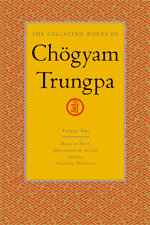
Chogyam Trungpa – The Role of a Teacher The Bardo of Birth In the Vajrayana, it is absolutely necessary to have a teacher and to trust in the teacher. The teacher or vajra master is the only embodiment of the transmission of energy.
In the The Collected Works of Chogyam Trungpa, Vol. 4 (Shambhala Press, 2004) is the first of the three volumes that present Tantric Buddhism, a subject Trungpa was reluctant to talk about in his early teaching years. He was reluctant because of the immaturity and materially based mind of the young American-mind set. In Buddhism, the role of the Guru is paramount, absolutely essential for one on the path of the Buddha. In fact the Guru is the principle by which the tradition is kept alive; the lineage. Without the Guru there is no living tradition. In the beginning stages, the Guru is not called a Guru but a spiritual friend. A spiritual friend is someone who works with the student in the manner of a ‘meeting of minds’. Trungpa describes it as the mind of the teacher expanded to include the mind of the student and vice versa. And as the student advances, the role and function of the Guru become more and more important in the development of the student, and here is where the Spiritual Friend becomes Vajra Master. “The vajra master could be quite heavy-handed; however; [s]he does not just play tricks on us whenever he finds a weak point.” “The vajra master is a human being, someone who has a karmic debt to pay as a result of the intensity of his compassion. The dharma cannot be transmitted from the sun or the moon or the stars. The dharma can only be transmitted properly from human to human. So there is a need for a [Guru] vajra master who has tremendous power – power over us, power over the cosmos, and power over himself – and who has been warned that if he misdirects his energy he will be cut down and reduced into a little piece of charcoal [burned up].” “It is extremely important to have a living vajra master, someone who personally experiences our pain and our pleasure. We have to have a sense of fear and respect that we are connecting and communicating directly with tantra.” Practice Chogyam Trungpa Rinpoche: [Without a teacher or a practice]…without having some sense of understanding the meaning of practice, there is no real communication that takes place in your understanding of buddhadharma. And it is equally important to have a great deal of devotion to your teacher, who actually embodies the symbolism or the concept of practice at the same time. Through practice, the guru has already achieved a higher degree of enlightenment. Moreover, the guru is the only person who can actually push you and who could become a heavy-handed friend, who can actually make you sit a lot and go beyond your slothfulness and laziness. If you want to boycott and all kinds of things like that, only the guru can push you to make you sit a lot and practice a lot. A cosmic guru might send theoretical blessings and encouragements through your particular antenna, and tell you all kinds of stories and messages; but, according to the practicing lineage, such things are regarded as very fishy. We can always reinterpret our own interpretations. To begin with, our own interpretation received from the antenna is not so substantial, but on top of that we can actually reinterpret it according to our liking. So it is necessary to have an earthly person, born and raised on this planet earth to begin with, who regards himself or herself as a human being who we like to share, the love and hate, sweet and sour, hot and cold, whatever you have of this particular world. This person can communicate to you man to man, so to speak, and as a mirror reflection in some sense. He also provides some sense of real, genuine communication, independent of politicking or overindulging in charitable kindness, and free from obsession with masochistic trips – somebody who is somewhat sensible and reasonable, but at same time unyielding, who is “wise” in the traditional sense; somebody who cannot be persuaded by your side of your trip, and somebody who can actually be clear about whole thing; somebody who buys your story with a pinch of salt; but at the same time is kind and friendly to a certain extent. Such a person is the teacher, who then teaches you to practice a lot, sit a lot.”
Can Gurus Awaken Individuals? However in their turning to Me, My devotees are not merely turning to an “object”, or to an “objective other”. Rather, My devotees’ turning to Me is the means whereby the contents of the reflected (or “knowing”) “self” are forgotten. In that turning to Me, there is the intrinsic entering into My “Bright” Divine Self-Condition – and that entering into My Condition is profoundly Established by My Transcendental Spiritual Self-Transmission of My “Bright” Divine State. The Aletheon – P. 709 – THE INTRINSIC SELF-EXERCISE OF PERFECT KNOWLEDGE The Realization of The Truth of Reality Itself cannot be causedbut It can (and, indeed, must) Be Given. Perfect Dis-Illusionment – The Aletheon – Part Eight The Guru assumes responsibilities and initiates changes only to the degree that the individual assumes a responsible relationship to him in that play. Then it is a transforming, liberating process. But independent of that process, it is not liberating, in such a case, it ultimately leads to more and more levels of irresponsibility. It is necessary for the individual who enters into such Communion to understand how that great relationship works. As the individual develops this practice in my Company and contacts me through all of the opportunities of this Satsang, the contents of this Narcissistic ego or karmic personality come into consciousness. As these contents arise, the individual is to practice the exercises of conductivity and the Conscious Process in daily life and meditation. That is done in direct Communion with the Divine Power, transmitted in and through and as the Adept. As these contents arise in the moment of this Company, they are purified. They are brought up by that Influence, they are lifted off, they are changed, either instantly, or through a process of trial. They are reduced, broken up, absorbed, or in one or another way eliminated by the Work of the Adept. This is literally, and not merely figuratively, so.
“As you develop your practice in My Company and contact Me …the contents of your karmic personality come into awareness. As these contents arise, practice the exercises of “conductivity” and the “conscious process” in daily life and meditation, but always in direct Communion with the Divine Power and Being Transmitted in and through and As Me, your True Heart-Master. As these contents arise in My Company, they are purified by My Spiritual Heart-Transmission. They are stimulated by My Transmission and they are lifted off, or change – either instantly, or through a process of trial or a sequence of changes. The contents of the ego, or the body-mind, or self-contraction, are reduced, broken up, and in one or another way eliminated by My Divine Work. This is literally, and not merely figuratively, so. When I spend time with you, or sit with you to Grant you My Darshan, I Magnify My Spiritual Heart-Transmission to you, and It Combines with the various contents of your conditional being. My Transmission is Self-Radiant Energy and Self-Existing Consciousness. In Satsang with Me, this is what you confront in your life and meditation. This is the character of My Divine Siddhi. And It spontaneously Works to stimulate the contents of your conditional self, in life, in meditation, and in moments of repose. That Siddhi also breaks them up and eliminates them in a process that is not possible by any other means. Ultimately these contents are eliminated by My Transmission Work, and they are returned to the Primal Energy Condition, or the Ultimate Condition of Divine Being.” The only-by-Me Revealed and Given Reality-Way of Adidam Is the seventh stage Way-from the beginning-but you are not, at the beginning, able to practice in the context of the seventh stage of life. However, you can engage a preliminary mode of practice that leads most directly to the “Perfect Practice”, if you rightly and consistently exercise the preliminary form of “Perfect Knowledge” Listening-practice from the time of your formal sacramental Initiation into that practice. The Aletheon – THE INTRINSIC SELF-EXERCISE OF PERFECT KNOWLEDGE 1. Enlightenment and the Transformation of Man. Selections from talks and essays on the spiritual process and God Realization. Editors notes p. 152. 2. Adi Da Samraj, The Parental Deity and the One to be Realized, Feb 7, 1983 3. Sidney Cohen’s book, Reflections on Talks with Sri Ramana Maharshi (1959, p.96) 4. The Dawn Horse (Vol 1 Number 2, Dec 1975), entitled “Lay It At My Feet“ 5. What Is the Conscious Process, Da Free John, unpublished talk, Oct 28, 1982. also see: The Conscious Process is the Epitome of This Way – Adi Da – 1982 More: “Any one and every one who doubts and quibbles about the necessity of a true Adept-Guru is, simply, not yet ready, willing, and able to enter the esoteric Ordeal of the advanced and the ultimate stages of life. And no mere verbal argument is sufficient to convince such doubters of the necessity of a true Adept-Guru.” – The Great Esoteric Tradition of Devotion to the Adept-Realizer “The process of Satsang is the original form of the Guru-Disciple relationship. As the intuitive stages develop in meditation Satsang becomes unnecessary. The Understanding which is then activated and alive as the Heart becomes the principle of Satsang. The religious and social order of the Guru and Disciple change form an intimate bodily association to a spiritual one. The association with the Guru or Man of Understanding is transcendentally available to all. He is the Real. He is already with them.” When I make the way of the heart clear, my listening devotees begin to understand. When they hear me, they truly understand themselves. Therefore, the inclination toward egoic “self-possession” becomes weak in my hearing devotees, and they, by self-transcendence, grow to feel me at the heart and to acknowledge me from the heart. Then I become as if transparent to them, and they begin to see the divine person in and as my company. In that seeing, they are moved beyond themselves, distracted by a “bright” heart-vision. In their forms, mankind turns about and begins to submit to me as the inherent condition or transcendental, and inherently spiritual, and necessarily divine self of all. And their submission calls upon the infinite eternal resource of who I am. In my openly ecstatic and happy response to these, my seeing devotees, the power and work and domain of who I am comes to meet them, and their realization of my agency becomes full. In this manner, I demonstrate to all my listening devotees, and to all my hearing devotees, and to all my seeing devotees that I am the heart, who is the way, the root, the doer, the source, the truth, and the self-domain of the process of spiritual, transcendental, and divine awakening. Anyone who comes into contact with the Adept will in one way or another or to one degree or another experience an awakening. Of course, they may defend themselves against it. They may have it momentarily and then contract from it, but that awakening is the significance of the true Adept. The function of the Adept is not to call people back to Realize God but to grant people the Realization of God instantly. Having established you in such Realization, the Adept calls you to practice the Way of that Realization, the Way of constantly abiding in that Realization. Such abiding requires the discipline of self-transcending submission to Divine Communion. In the popular egalitarian “culture” of the first three stages of life, the Guru and the developmental culture of the Spiritual Way are taboo, because every individual limited by the motives of the first three stages of life is at war with personal vulnerability and need. However, the real Spiritual process does not even begin until the egoic point of view of the first three stages of life is understood and the ego-surrendering and ego-transcending Motive of the fourth stage of life begins to move and change the body-mind. Spiritually Realized Adepts are the principal Sources, Resources, and Means of the esoteric Way QUESTION: Is Self-Realization possible without the help of a Guru? ANSWER: He alone can realize the Self without a Guru’s help in whose mind queries like, “Who am I?, What is the world?, Where was I before, and where shall I go? and Where is Peace?” arise from his very birth and the thought of the futility and transitoriness of the world clearly manifests and awakens keen dispassion and leads him to self-enquiry. Such men are very rare. The first obstacle, and the primary obstacle, to spiritual life is the relationship to the Guru. It is also the fundamental condition, content and source of spiritual or real life………spiritual life is a relationship, a living demand. It creates an obstacle from the very beginning. And that obstacle provokes the crisis and fundamental sacrifice that real life requires. “I cannot replace your responsibilities, and neither can you replace My Work. You think I am here to handle your responsibilities and that you are here to do My Work!” “The devotee is constantly given the intuition of the Absolute. But because he, or she, adheres to the ego and to apparent divisions of the body-being, he/she does not recognize fully the significance of his intuition of God. It is too ordinary an experience. He may feel a little relieved, a little blissful, but still he is unable to be completely given over to the translating Force of the revelation of the Spiritual Master. Therefore, his practice is a matter of growth in the Divine Company of the Spiritual Master. The initiation into Communion with God is given constantly, but it is not fully realized by the devotee. He is initiated piece by piece.” “ultimately the character of my work with people is such that these contents are eliminated. They are absorbed, broken up, eliminated, returned to the primary energy condition, and to the Ultimate Condition of Transcendental Being. And so the spiritual life of devotees in this Way is of this kind. It is lived out in this Company, in the context of this Siddhi, and in this relationship. It is necessary for devotees to hear, to understand, to practice the disciplines of conductivity and the conscious process. That is their part of this play. And my part is to be present with them, to magnify this influence in their company. And that influence inevitably does the work as I’ve described it.” The guru assumes your enlightenment. He doesn’t mechanically enlighten you, Or give you something to do to enlighten yourself. He absorbs you. “In the case of rare individuals …Agency may be given outside the agency of a grossly manifested human being, but such individuals are rare.” DEVOTEE: Does proximity to you, closeness to your body, have any relation to the intensity or the effects of Satsang? FRANKLIN: What is your experience? DEVOTEE: It doesn’t seem to have that much to do with the body. It seems more to be how much I am in felt contact with you and how open I am to you. FRANKLIN: It all depends on the quality of your relationship. Everything is its medium, because everything is it. The body seems to be a very potent source for some, whereas for others the process seems to take place mainly or only in very subtle ways. Neither one is superior to the other. A person must discover the quality of Satsang for himself. The Method of the Siddhas, CHAPTER 10, The Path of the Great Form ADEPT-REALIZERS ARE THE ROOT OF ALL ESOTERIC TRADITIONS 1. The primary force and “root” of all the esoteric traditions of humankind are the Adept-Realizers, those who actually Realize (to one or another degree) the Spiritual and Tran-scendental Nature of Reality. Adept-Realizers (in their various degrees and kinds of Realization) appear in all times and places, and they become associated with the complex social and cultural structures existing in their immediate environment. Throughout their lifetimes, both before and after their Realization, such Adepts move into the existing culture and associate with its influences. Thus, while the teaching of any Adept is, of course, an expression of his or her actual Realization, the Adept’s words also reflect and comment upon all kinds of cultural complexities and ideals. Where Adept-Realizers appear, they transform the existing culture, eliminating some aspects of traditional “religious” and Spiritual life and emphasizing others. The Spiritually Realized Adept is a motion in the midst of the stream of conventions. The tradition of Truth, the tradition of Spiritual and Transcendental Realization, is the tradition of the Adept-Realizers. Apart from the Adepts, there is no tradition of Truth. 2. In all “religious” and Spiritual traditions, a great deal is made of some key individual. There is no great Spiritual tradition that is without a person at the center of the process. How that person is interpreted through the cultural and intellectual lore of each tradition varies, but such an individual always exists. In other words, the Truth is not separable from a special human function that is perceived in the form of the Adept-Realizer, or Spiritual Master (or Guru). 3. The Adept-Realizer, or Spiritual Master, has many functions-to exemplify the Way, to argue the Way, to Bless devotees, and (thus) to interfere with the usual attitude and disposition of devotees, and to Transmit Spiritual Influence tangibly to devotees so that they will then, having understood themselves, be capable of Spiritual growth. The function of the Spiritually Realized Adept, therefore, does not come to an end with the arising of any particular result. The Adept-Realizer (or Guru) is the continuous and unending resource and resort of his or her devotees. 4. One who Functions as Adept Spiritual Master (or as a Realizer-Guru) exercises the Guru-Function only in relation to those who are his or her devotees. If the Adept addresses public society at all, he or she may also (in the public setting) assume the role of prophet-which is, essentially, an aggravation, a criticism, an undermining of the usual life. 5. Adept-Realizers of one or another degree of Spiritual development spontaneously Transmit That Which they have Realized. That Which they have Realized Transmits Itself-subtly as well as in the gross physical dimension-by what they do, by what they are, by what they feel. Thus, accordingly, Adept-Realizers Transmit their degree of Realization. Such Transmission is inevitable, and Such Transmission is an absolute Law. This is why, traditionally, it is said that the best thing anyone can do, among all the things everyone must do-and you must do many things-the best among them, the chief among them, is to spend time in the Company of an Adept-Realizer, or Spiritual Master. Everything transmits. The stones transmit, the sky transmits, the TV transmits. Since everything and everyone transmits states of existence-since life, or existence itself, is participation in transmissions of all kinds-the best thing you can do is to associate with the greatest possible Transmission. Since everything is transmission, spend time in the Company of the One Who spontaneously Transmits That Which Is Inherently Perfect and Ultimate. This is the Great Rule, the Great Law, the Ultimate Principle of the Great Tradition of humankind. 6. Devotional allegiance to the Adept-Realizer, or Spiritual Master, is the greatest function of existence and the single advantage not only of human beings but of all beings. The devotional relationship to the Spiritual Master is participation in a unique function that appears in the realm of cosmic (or conditional) Nature. Only the ego will deny the Spiritual Master. The ego wants to “do it” himself or herself. Do what exactly? Be himself or herself-separately and untouched. Since you become what you meditate on, you should meditate on, or Commune with, the Absolute-which, in the bodily (human) form of the Spiritual Master, is your greatest advantage. 7. No thought or figure or any perception arising in the mind is, in and of itself, Real (Acausal) God. No thing, no body, no moment or place is, in and of itself, Real (Acausal) God. Rather, every moment, place, thing, body, or state of mind inheres in the Divine Reality and Truth That Is Real (Acausal) God. Thus, all conditions become Reminders that draw the devotee into Divine Communion. The Spiritual Master is a Transparent Reminder of the Divine Reality, a Guide to the ecstatic Realization of the One Reality in Which all conditions arise and change and pass away. The Spiritual Master is not to be made into the merely “objectified” idol of a cult, as if the Divine Being were exclusively contained in the “objective” person and “subjective” beliefs of a particular sect. Rather, right relationship to the Spiritual Master takes the form of free devotional response to the Spiritual Master’s Radiant State. Summary of above: The primary force and root of all the esoteric traditions of humankind are the Adept-Realizers, those who actually Realize the Spiritual and Transcendental Nature of Reality. Adept-Realizers appear in all times and places, and they become associated with the complex social and cultural structures existing in their immediate environment. Apart from the Adepts, there is no tradition of Truth. There is no great Spiritual tradition that is without a person at the center of the process. The Adept-Realizer is the continuous and unending resource and resort of his or her devotees. One who Functions as Adept Spiritual Master exercises the Guru-Function only in relation to those who are his or her devotees. If the Adept addresses public society at all, he or she may also assume the role of prophet. Adept-Realizers spontaneously Transmit That Which they have Realized. That Which they have Realized Transmits Itself. Everything transmits. The best thing you can do is to associate with the greatest possible Transmission. This is the Great Rule, the Great Law, the Ultimate Principle of the Great Tradition of humankind. Only the ego will deny the Spiritual Master. The ego wants to do it himself or herself. Do what exactly? Be himself or herselfseparately and untouched. The Spiritual Master is a Transparent Reminder of the Divine Reality. A Guide to the ecstatic Realization of the One Reality in Which all conditions arise and change and pass away.
|