“You agree at an early
(age) to lie, to be this convention of self-reference and
to play your part by means of the activity of
self-contraction. You never told anybody. You got the
idea. You got the message. And you became a some kind of
assent to that agreement to be that. Those who don’t
quite agree are regarded to be whacko. They can’t fit,
you see. They don’t quite get it. You’re supposed to be
this – got it? …..I, I, I, I, I – got it? Who’s that?
SHUT UP! Do this. [clenching fist quickly and
repeatedly] Don’t ask! This, this is it. This is
what’s happening here, and that’s that.
Adi Da Samraj – 2004
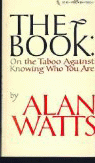
The Book
The Taboo Against Knowing Who You Are
by
Alan Watts
First published in Great Britain by Jonathan Cape Ltd 1969
PREFACE
THIS BOOK explores an unrecognized but mighty taboo—our tacit conspiracy to ignore who, or what, we really are. Briefly, the thesis is that the prevalent sensation of oneself as a separate ego enclosed in a bag of skin is a hallucination which accords neither with Western science nor with the experimental philosophy-religions of the East—in particular the central and germinal Vedanta philosophy of Hinduism.
This hallucination underlies the misuse of technology for the violent subjugation of man’s natural environment and, consequently, its eventual destruction. We are therefore in urgent need of a sense of our own existence which is in accord with the physical facts and which overcomes our feeling of alienation from the universe. For this purpose I have drawn on the insights of Vedanta, stating them, however, in a completely modern and Western style—so that this volume makes no attempt to be a textbook on or introduction to Vedanta in the ordinary sense. It is rather a cross-fertilization of Western science with an Eastern intuition.
Particular thanks are due to my wife, Mary Jane, for her careful editorial work and her comments on the manuscript. Gratitude is also due to the Bollingen Foundation for its support of a project which ncluded the writing of this book.
Sausalito, California
ALAN WATTS
January, 1966
CHAPTER ONE
INSIDE INFORMATION
JUST WHAT should a young man or woman know in order to be “in the know”? Is there, in other words, some inside information, some special taboo, some real lowdown on life and existence that most parents and teachers either don’t know or won’t tell?
In Japan it was once customary to give young people about to be married a “pillow book.” This was a small volume of wood-block prints, often colored, showing all the details of sexual intercourse. It wasn’t just that, as the Chinese say, “one picture is worth ten thousand words.” It was also that it spared parents the embarrassment of explaining these intimate matters face-to-face. But today in the West you can get such information at any newsstand. Sex is no longer a serious taboo. Teenagers sometimes know more about it than adults.
But if sex is no longer the big taboo, what is? For there is always something taboo, something repressed, unadmitted, or just glimpsed quickly out of the corner of one’s eye because a direct look is too unsettling. Taboos lie within taboos, like the skins of an onion. What, then, would be The Book which fathers might slip to their sons and mothers to their daughters, without ever admitting it openly?
In some circles there is a strong taboo on religion, even in circles where people go to church or read the Bible. Here, religion is one’s own private business. It is bad form or uncool to talk or argue about it, and very bad indeed to make a big show of piety. Yet when you get in on the inside of almost any standard-brand religion, you wonder what on earth the hush was about. Surely The Book I have in mind wouldn’t be the Bible, “the Good Book”—that fascinating anthology of ancient wisdom, history, and fable which has for so long been treated as a Sacred Cow that it might well be locked up for a century or two so that men could hear it again with clean ears. There are indeed secrets in the Bible, and some very subversive ones, but they are all so muffled up in complications, in archaic symbols and ways of thinking, that Christianity has become incredibly difficult to explain to a modern person. That is, unless you are content to water it down to being good and trying to imitate Jesus, but no one ever explains just how to do that.
To do it you must have a particular power from God known as “grace,” but all that we really know about grace is that some get it, and some don’t.
The standard-brand religions, whether Jewish, Christian, Mohammedan, Hindu, or Buddhist, are—as now practiced—like exhausted mines: very hard to dig. With some exceptions not too easily found, their ideas about man and the world, their imagery, their rites, and their notions of the good life don’t seem to fit in with the universe as we now know it, or with a human world that is changing so rapidly that much of what one learns in school is already obsolete on graduation day.
The Book I am thinking about would not be religious in the usual sense, but it would have to discuss many things with which religions have been concerned—the universe and man’s place in it, the mysterious center of experience which we call “I myself,” the problems of life and love, pain and death, and the whole question of whether existence has meaning in any sense of the word. For there is a growing apprehension that existence is a rat-race in a trap: living organisms, including people, are merely tubes which put things in at one end and let them out at the other, which both keeps them doing it and in the long run wears them out. So to keep the farce going, the tubes find ways of making new tubes, which also put things in at one end and let them out at the other.
At the input end they even develop ganglia of nerves called brains, with eyes and ears, so that they can more easily scrounge around for things to swallow. As and when they get enough to eat, they use up their surplus energy by wiggling in complicated patterns, making all sorts of noises by blowing air in and out of the input hole, and gathering together in groups to fight with other groups. In time, the tubes grow such an abundance of attached appliances that they are hardly recognizable as mere tubes, and they manage to do this in a staggering variety of forms.
There is a vague rule not to eat tubes of your own form, but in general there is serious competition as to who is going to be the top type of tube. All this seems marvelously futile, and yet, when you begin to think about it, it begins to be more marvelous than futile. Indeed, it seems extremely odd.
It is a special kind of enlightenment to have this feeling that the usual, the way things normally are, is odd—uncanny and highly improbable. G. K. Chesterton once said that it is one thing to be amazed at a gorgon or a griffin, creatures which do not exist; but it is quite another and much higher thing to be amazed at a rhinoceros or a giraffe, creatures which do exist and look as if they don’t. This feeling of universal oddity includes a basic and intense wondering about the sense of things. Why, of all possible worlds, this colossal and apparently unnecessary multitude of galaxies in a mysteriously curved space-time continuum, these myriads of differing tube-species playing frantic games of one-upmanship, these numberless ways of “doing it” from the elegant architecture of the snow crystal or the diatom to the startling magnificence of the lyrebird or the peacock?
Ludwig Wittgenstein and other modern “logical” philosophers have tried to suppress this question by saying that it has no meaning and ought not to be asked. Most philosophical problems are to be solved by getting rid of them, by coming to the point where you see that such questions as “Why this universe?” are a kind of intellectual neurosis, a misuse of words in that the question sounds sensible but is actually as meaningless as asking “Where is this universe?” when the only things that are anywhere must be somewhere inside the universe. The task of philosophy is to cure people of such nonsense. Wittgenstein, as we shall see, had a point there. Nevertheless, wonder is not a disease. Wonder, and its expression in poetry and the arts, are among the most important things which seem to distinguish men from other animals, and intelligent and sensitive people from morons.
Is there, then, some kind of a lowdown on this astounding scheme of things, something that never really gets out through the usual channels for the Answer—the historic religions and philosophies? There is. It has been said again and again, but in such a fashion that we, today, in this particular civilization do not hear it. We do not realize that it is utterly subversive, not so much in the political and moral sense, as in that it turns our ordinary view of things, our common sense, inside out and upside down. It may of course have political and moral consequences, but as yet we have no clear idea of what they may be. Hitherto this inner revolution of the mind has been confined to rather isolated individuals; it has never, to my knowledge, been widely characteristic of communities or societies. It has often been thought too dangerous for that. Hence the taboo.
But the world is in an extremely dangerous situation, and serious diseases often require the risk of a dangerous cure—like the Pasteur serum for rabies. It is not that we may simply blow up the planet with nuclear bombs, strangle ourselves with overpopulation, destroy our natural resources through poor conservation, or ruin the soil and its products with improperly understood chemicals and pesticides. Beyond all these is the possibility that civilization may be a huge technological success, but through methods that most people will find baffling, frightening, and disorienting—because, for one reason alone, the methods will keep changing. It may be like playing a game in which the rules are constantly changed without ever being made clear—a game from which one cannot withdraw without suicide, and in which one can never return to an older form of the game.
But the problem of man and technics is almost always stated in the wrong way. It is said that humanity has evolved one-sidedly, growing in technical power without any comparable growth in moral integrity, or, as some would prefer to say, without comparable progress in education and rational thinking. Yet the problem is more basic. The root of the matter is the way in which we feel and conceive ourselves as human beings, our sensation of being alive, of individual existence and identity.
We suffer from a hallucination, from a false and distorted sensation of our own existence as living organisms. Most of us have the sensation that “I myself” is a separate center of feeling and action, living inside and bounded by the physical body—a center which “confronts” an “external” world of people and things, making contact through the senses with a universe both alien and strange. Everyday figures of speech reflect this illusion. “I came into this world.” “You must face reality.” “The conquest of nature.”
This feeling of being lonely and very temporary visitors in the universe is in flat contradiction to everything known about man (and all other living organisms) in the sciences. We do not “come into” this world; we come out of it, as leaves from a tree. As the ocean “waves,” the universe “peoples.” Every individual is an expression of the whole realm of nature, a unique action of the total universe. This fact is rarely, if ever, experienced by most individuals. Even those who know it to be true in theory do not sense or feel it, but continue to be aware of themselves as isolated “egos” inside bags of skin.
The first result of this illusion is that our attitude to the world “outside” us is largely hostile. We are forever “conquering” nature, space, mountains, deserts, bacteria, and insects instead of learning to cooperate with them in a harmonious order. In America the great symbols of this conquest are the bulldozer and the rocket—the instrument that batters the hills into flat tracts for little boxes made of ticky-tacky and the great phallic projectile that blasts the sky.
(Nonetheless, we have fine architects who know how to fit houses into hills without ruining the landscape, and astronomers who know that the earth is already way out in space, and that our first need for exploring other worlds is sensitive electronic instruments which, like our eyes, will bring the most distant objects into our own brains.)
(1) The hostile attitude of conquering nature ignores the basic interdependence of all things and events—that the world beyond the skin is actually an extension of our own bodies—and will end in destroying the very environment from which we emerge and upon which our whole life depends.
The second result of feeling that we are separate minds in an alien, and mostly stupid, universe is that we have no common sense, no way of making sense of the world upon which we are agreed in common. It’s just my opinion against yours, and therefore the most aggressive and violent (and thus insensitive) propagandist makes the decisions. A muddle of conflicting opinions united by force of propaganda is the worst possible source of control for a powerful technology.
It might seem, then, that our need is for some genius to invent a new religion, a philosophy of life and a view of the world, that is plausible and generally acceptable for the late twentieth century, and through which every individual can feel that the world as a whole and his own life in particular have meaning. This, as history has shown repeatedly, is not enough. Religions are divisive and quarrelsome. They are a form of one-upmanship because they depend upon separating the “saved” from the “damned,” the true believers from the heretics, the in-group from the out-group. Even religious liberals play the game of “we’re-moretolerant- than-you.” Furthermore, as systems of doctrine, symbolism, and behavior, religions harden into institutions that must command loyalty, be defended and kept “pure,” and—because all belief is fervent hope, and thus a cover-up for doubt and uncertainty—religions must make converts. The more people who agree with us, the less nagging insecurity about our position. In the end one is committed to being a Christian or a Buddhist come what may in the form of new knowledge.
New and indigestible ideas have to be wangled into the religious tradition, however inconsistent with its original doctrines, so that the believer can still take his stand and assert, “I am first and foremost a follower of Christ/Mohammed/Buddha, or whomever.” Irrevocable commitment to any religion is not only intellectual suicide; it is positive unfaith because it closes the mind to any new vision of the world. Faith is, above all, open-ness—an act of trust in the unknown.
An ardent Jehovah’s Witness once tried to convince me that if there were a God of love, he would certainly provide mankind with a reliable and infallible textbook for the guidance of conduct. I replied that no considerate God would destroy the human mind by making it so rigid and unadaptable as to depend upon one book, the Bible, for all the answers. For the use of words, and thus of a book, is to point beyond themselves to a world of life and experience that is not mere words or even ideas. Just as money is not real, consumable wealth, books are not life. To idolize scriptures is like eating paper currency.
Therefore The Book that I would like to slip to my children would itself be slippery. It would slip them into a new domain, not of ideas alone, but of experience and feeling. It would be a temporary medicine, not a diet; a point of departure, not a perpetual point of reference. They would read it and be done with it, for if it were well and clearly written they would not have to go back to it again and again for hidden meanings or for clarification of obscure doctrines.
We do not need a new religion or a new bible. We need a new experience—a new feeling of what it is to be “I.” The lowdown (which is, of course, the secret and profound view) on life is that our normal sensation of self is a hoax or, at best, a temporary role that we are playing, or have been conned into playing—with our own tacit consent, just as every hypnotized person is basically willing to be hypnotized.
The most strongly enforced of all known taboos is the taboo against knowing who or what you really are behind the mask of your apparently separate, independent, and isolated ego. I am not thinking of Freud’s barbarous Id or Unconscious as the actual reality behind the façade of personality. Freud, as we shall see, was under the influence of a nineteenth-century fashion called “reductionism,” a curious need to put down human culture and intelligence by calling it a fluky by-product of blind and irrational forces. They worked very hard, then, to prove that grapes can grow on thornbushes.
As is so often the way, what we have suppressed and overlooked is something startlingly obvious. The difficulty is that it is so obvious and basic that one can hardly find the words for it. The Germans call it a Hintergedanke, an apprehension lying tacitly in the back of our minds which we cannot easily admit, even to ourselves. The sensation of “I” as a lonely and isolated center of being is so powerful and commonsensical, and so fundamental to our modes of speech and thought, to our laws and social institutions, that we cannot experience selfhood except as something superficial in the scheme of the universe. I seem to be a brief light that flashes but once in all the aeons of time—a rare, complicated, and all-too-delicate organism on the fringe of biological evolution, where the wave of life bursts into individual, sparkling, and multicolored drops that gleam for a moment only to vanish forever. Under such conditioning it seems impossible and even absurd to realize that myself does not reside in the drop alone, but in the whole surge of energy which ranges from the galaxies to the nuclear fields in my body. At this level of existence “I” am immeasurably old; my forms are infinite and their comings and goings are simply the pulses or vibrations of a single and eternal flow of energy.
The difficulty in realizing this to be so is that conceptual thinking cannot grasp it. It is as if the eyes were trying to look at themselves directly, or as if one were trying to describe the color of a mirror in terms of colors reflected in the mirror. Just as sight is something more than all things seen, the foundation or “ground” of our existence and our awareness cannot be understood in terms of things that are known. We are forced, therefore, to speak of it through myth—that is, through special metaphors, analogies, and images which say what it is like as distinct from what it is. At one extreme of its meaning, “myth” is fable, falsehood, or superstition. But at another, “myth” is a useful and fruitful image by which we make sense of life in somewhat the same way that we can explain electrical forces by comparing them with the behavior of water or air. Yet “myth,” in this second sense, is not to be taken literally, just as electricity is not to be confused with air or water. Thus in using myth one must take care not to confuse image with fact, which would be like climbing up the signpost instead of following the road.
Myth, then, is the form in which I try to answer when children ask me those fundamental metaphysical questions which come so readily to their minds: “Where did the world come from?” “Why did God make the world?” “Where was I before I was born?” “Where do people go when they die?” Again and again I have found that they seem to be satisfied with a simple and very ancient story, which goes something like this:
“There was never a time when the world began, because it goes round and round like a circle, and there is no place on a circle where it begins. Look at my watch, which tells the time; it goes round, and so the world repeats itself again and again. But just as the hour-hand of the watch goes up to twelve and down to six, so, too, there is day and night, waking and sleeping, living and dying, summer and winter. You can’t have any one of these without the other, because you wouldn’t be able to know what black is unless you had seen it side-by-side with white, or white unless side-by-side with black.
“In the same way, there are times when the world is, and times when it isn’t, for if the world went on and on without rest for ever and ever, it would get horribly tired of itself. It comes and it goes. Now you see it; now you don’t. So because it doesn’t get tired of itself, it always comes back again after it disappears. It’s like your breath: it goes in and out, in and out, and if you try to hold it in all the time you feel terrible. It’s also like the game of hide-and-seek, because it’s always fun to find new ways of hiding, and to seek for someone who doesn’t always hide in the same place. “God also likes to play hide-and-seek, but because there is nothing outside God, he has no one but himself to play with. But he gets over this difficulty by pretending that he is not himself. This is his way of hiding from himself. He pretends that he is you and I and all the people in the world, all the animals, all the plants, all the rocks, and all the stars. In this way he has strange and wonderful adventures, some of which are terrible and frightening. But these are just like bad dreams, for when he wakes up they will disappear.
“Now when God plays hide and pretends that he is you and I, he does it so well that it takes him a long time to remember where and how he hid himself. But that’s the whole fun of it—just what he wanted to do.
He doesn’t want to find himself too quickly, for that would spoil the game. That is why it is so difficult for you and me to find out that we are God in disguise, pretending not to be himself. But when the game has gone on long enough, all of us will wake up, stop pretending, and remember that we are all one single Self—the God who is all that there is and who lives for ever and ever.
“Of course, you must remember that God isn’t shaped like a person. People have skins and there is always something outside our skins. If there weren’t, we wouldn’t know the difference between what is inside and outside our bodies. But God has no skin and no shape because there isn’t any outside to him.

The inside and the outside of God are the same. And though I have been talking about God as ‘he’ and not ‘she,’ God isn’t a man or a woman. I didn’t say ‘it’ because we usually say ‘it’ for things that aren’t alive. “God is the Self of the world, but you can’t see God for the same reason that, without a mirror, you can’t see your own eyes, and you certainly can’t bite your own teeth or look inside your head. Your self is that cleverly hidden because it is God hiding.
“You may ask why God sometimes hides in the form of horrible people, or pretends to be people who suffer great disease and pain. Remember, first, that he isn’t really doing this to anyone but himself. Remember, too, that in almost all the stories you enjoy there have to be bad people as well as good people, for the thrill of the tale is to find out how the good people will get the better of the bad. It’s the same as when we play cards. At the beginning of the game we shuffle them all into a mess, which is like the bad things in the world, but the point of the game is to put the mess into good order, and the one who does it best is the winner. Then we shuffle the cards once more and play again, and so it goes with the world.”
This story, obviously mythical in form, is not given as a scientific description of the way things are. Based on the analogies of games and the drama, and using that much worn-out word “God” for the Player, the story claims only to be like the way things are. I use it just as astronomers use the image of inflating a black balloon with white spots on it for the galaxies, to explain the expanding universe. But to most children, and many adults, the myth is at once intelligible, simple, and fascinating. By contrast, so many other mythical explanations of the world are crude, tortuous, and unintelligible. But many people think that believing in the unintelligible propositions and symbols of their religions is the test of true faith. “I believe,” said Tertullian of Christianity, “because it is absurd.”
People who think for themselves do not accept ideas on this kind of authority. They don’t feel commanded to believe in miracles or strange doctrines as Abraham felt commanded by God to sacrifice his son Isaac. As T. George Harris put it:
The social hierarchies of the past, where some boss above you always punished any error, conditioned men to feel a chain of harsh authority reaching all the way “up there.” We don’t feel this bond in today’s egalitarian freedom. We don’t even have, since Dr. Spock, many Jehovah-like fathers in the human family. So the average unconscious no longer learns to seek forgiveness from a wrathful God above.
But, he continues—
Our generation knows a cold hell, solitary confinement in this life, without a God to damn or save it. Until man figures out the trap and hunts… “the Ultimate Ground of Being,” he has no reason at all for his existence. Empty, finite, he knows only that he will soon die. Since this life has no meaning, and he sees no future life, he is not really a person but a victim of self-extinction.(2)
“The Ultimate Ground of Being” is Paul Tillich’s decontaminated term for “God” and would also do for “the Self of the world” as I put it in my story for children. But the secret which my story slips over to the child is that the Ultimate Ground of Being is you. Not, of course, the everyday you which the Ground is assuming, or “pretending” to be, but that inmost Self which escapes inspection because it’s always the inspector. This, then, is the taboo of taboos: you’re IT!
Yet in our culture this is the touchstone of insanity, the blackest of blasphemies, and the wildest of delusions. This, we believe, is the ultimate in megalomania—an inflation of the ego to complete absurdity.
For though we cultivate the ego with one hand, we knock it down with the other. From generation to generation we kick the stuffing out of our children to teach them to “know their place” and to behave, think, and feel with proper modesty as befits one little ego among many. As my mother used to say, “You’re not the only pebble on the beach!”
Anyone in his right mind who believes that he is God should be crucified or burned at the stake, though now we take the more charitable view that no one in his right mind could believe such nonsense. Only a poor idiot could conceive himself as the omnipotent ruler of the world, and expect everyone else to fall down and worship.
But this is because we think of God as the King of the Universe, the Absolute Technocrat who personally and consciously controls every details of his cosmos—and that is not the kind of God in my story. In fact, it isn’t my story at all, for any student of the history of religions will know that it comes from ancient India, and is the mythical way of explaining the Vedanta philosophy. Vedanta is the teaching of the Upanishads, a collection of dialogues, stories, and poems, some of which go back to at least 800 B.C. Sophisticated Hindus do not think of God as a special and separate superperson who rules the world from above, like a monarch. Their God is “underneath” rather than “above” everything, and he (or it) plays the world from inside. One might say that if religion is the opium of the people, the Hindus have the inside dope.
What is more, no Hindu can realize that he is God in disguise without seeing at the same time that this is true of everyone and everything else. In the Vedanta philosophy, nothing exists except God.
There seem to be other things than God, but only because he is dreaming them up and making them his disguises to play hide-and-seek with himself. The universe of seemingly separate things is therefore real only for a while, not eternally real, for it comes and goes as the Self hides and seeks itself.
But Vedanta is much more than the idea or the belief that this is so. It is centrally and above all the experience, the immediate knowledge of its being so, and for this reason such a complete subversion of our ordinary way of seeing things. It turns the world inside out and outside in. Likewise, a saying attributed to Jesus runs:
when you make the inner as the outer
and the outer as the inner and the above as the below …
then shall you enter [the Kingdom]….
I am the Light that is above
them all, I am the All,
the All came forth from Me and the All
attained to Me. Cleave a [piece of] wood, I
am there; lift up the stone and you will
find Me there.(3)
Today the Vedanta discipline comes down to us after centuries of involvement with all the forms, attitudes, and symbols of Hindu culture in its flowering and slow demise over nearly 2,800 years, sorely wounded by Islamic fanaticism and corrupted by British puritanism. As often set forth, Vedanta rings no bell in the West, and attracts mostly the fastidiously spiritual and diaphanous kind of people for whom incarnation in a physical body is just too disgusting to be borne.(4) But it is possible to state its essentials in a present-day idiom, and when this is done without exotic trappings, Sanskrit terminology, and excessive postures of spirituality, the message is not only clear to people with no special interest in “Oriental religions”; it is also the very jolt that we need to kick ourselves out of our isolated sensation of self.
But this must not be confused with our usual ideas of the practice of “unselfishness,” which is the effort to identify with others and their needs while still under the strong illusion of being no more than a skincontained ego. Such “unselfishness” is apt to be a highly refined egotism, comparable to the in-group which plays the game of “we’remore- tolerant-than-you.” The Vedanta was not originally moralistic; it did not urge people to ape the saints without sharing their real motivations, or to ape motivations without sharing the knowledge which sparks them.
For this reason The Book I would pass to my children would contain no sermons, no shoulds and oughts. Genuine love comes from knowledge, not from a sense of duty or guilt. How would you like to be an invalid mother with a daughter who can’t marry because she feels she ought to look after you, and therefore hates you? My wish would be to tell, not how things ought to be, but how they are, and how and why we ignore them as they are. You cannot teach an ego to be anything but egotistic, even though egos have the subtlest ways of pretending to be reformed. The basic thing is therefore to dispel, by experiment and experience, the illusion of oneself as a separate ego. The consequences may not be behavior along the lines of conventional morality. It may well be as the squares said of Jesus, “Look at him! A glutton and a drinker, a friend of tax-gatherers and sinners!”
Furthermore, on seeing through the illusion of the ego, it is impossible to think of oneself as better than, or superior to, others for having done so. In every direction there is just the one Self playing its myriad games of hide-and-seek. Birds are not better than the eggs from which they have broken. Indeed, it could be said that a bird is one egg’s way of becoming other eggs. Egg is ego, and bird is the liberated Self.
There is a Hindu myth of the Self as a divine swan which laid the egg from which the world was hatched. Thus I am not even saying that you ought to break out of your shell. Sometime, somehow, you (the real you, the Self) will do it anyhow, but it is not impossible that the play of the Self will be to remain unawakened in most of its human disguises, and so bring the drama of life on earth to its close in a vast explosion. Another Hindu myth says that as time goes on, life in the world gets worse and worse, until at last the destructive aspect of the Self, the god Shiva, dances a terrible dance which consumes everything in fire. There follow, says the myth, 4,320,000 years of total peace during which the Self is just itself and does not play hide. And then the game begins again, starting off as a universe of perfect splendor which begins to deteriorate only after 1,728,000 years, and every round of the game is so designed that the forces of darkness present themselves for only one third of the time, enjoying at the end a brief but quite illusory triumph.
Today we calculate the life of this planet alone in much vaster periods, but of all ancient civilizations the Hindus had the most imaginative vision of cosmic time. Yet remember, this story of the cycles of the world’s appearance and disappearance is myth, not science, parable rather than prophecy. It is a way of illustrating the idea that the universe is like the game of hide-and-seek.
If, then, I am not saying that you ought to awaken from the egoillusion and help save the world from disaster, why The Book? Why not sit back and let things take their course? Simply that it is part of “things taking their course” that I write. As a human being it is just my nature to enjoy and share philosophy. I do this in the same way that some birds are eagles and some doves, some flowers lilies and some roses. I realize, too, that the less I preach, the more likely I am to be heard.
(1) “I do not believe that anything really worthwhile will come out of the exploration of the slag heap that constitutes the surface of the moon. . . . Nobody should imagine that the enormous financial budget of NASA implies that astronomy is now well supported.” Fred Hoyle, Galaxies, Nuclei, and Quasars. Heinemann Educational, 1966.
(2) A discussion of the views of theologian Paul Tillich in “The Battle of the Bible,” Look, Vol. XIX, No. 15. July 27, 1965. p. 19.
(3) A. Guillaumont and others (trs.), The Gospel According to Thomas. Collins, 1959. pp. 17-18, 43. A recently discovered Coptic manuscript, possibly translated from a Greek version as old as A.D. 140. The “I” and the “Me” are obvious references to the disguised Self.
(4) I said “mostly” because I am aware of some very special exceptions both here and in India.
The
Book
The Taboo Against Knowing Who You Are
by
Alan Watts
First published in Great Britain by Jonathan Cape Ltd 1969