1, May 1974
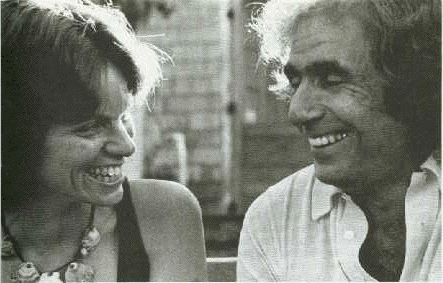
The Early Days:
An Interview with Sal and Louise
Lucania
(Editor’s note: This interview took
place on March 12 and 19th, in Sal and Louise’s cabin at
Persimmon.
The interviewers were Saniel Bonder, Terry Patten and Bob
Smartt.)
SAL: You want to know about my
relationship with Bubba in the Asbram?
QUESTION: No, start from the very
beginning, back in the old days.
SAL: Well, we met in
Scientology.
QUESTION: How did you get into
that?
SAL: That story is not worth
telling. The point was that my life had just fallen apart at
the seams and I had left New York and gone to Las Vegas,
Nevada. A cousin of mine was involved in Scientology. He
told me about it and I got involved with it there, in
Nevada. I was in Nevada for around ten months in 1967, and
then I went back to New York in around January1968, and
around March Bubba got involved with Scientology. I was the
first person he met when he walked in the door, and we liked
each other. I remember I went home and told this person I
was with that I had met this fantastic guy, and he went home
and spoke to Nina, and he said the same thing. We just had a
good friendship, and it lasted all that time. I didn’t have
any suspicion of what he was up to. He had just gotten back
from India from his first trip. I had no knowledge of that
tradition of any kind Guru, Master, or anything like that.
And he never communicated anything about it to me, either.
That didn’t come until after we left Scientology (we both
worked for the organization). We went into business together
for a while after we left Scientology.
QUESTION: What kind of business?
SAL: We were putting together
companies for the purpose of underwriting stocks. By this
time we had already gone through a tremendous drama with the
Scientology organization, and he knew it was all bullshit.
It took me more time. How I got hip is a really funny story.
I was on the phone with him one time, and I was talking
about some “Upper Level” stuff or something like that and he
said to me, “Sal, you believe that?” I must have laughed for
about a half hour on the phone, you know, complete release
from it.
After that was when he started to
communicate what he knew and understood. While we were in
business, we were up at the offices one day, and this thing
started going on a strange presence was in the room and this
blue light came over his hands it was incredible. It was
just me and him in the room. I was very much aware that
there was something going on; there were strange feelings
happening to me. At the same time it happened to Nina, Pat,
and Louise in a different part of the city. All that day we
had very strange experiences, and that was that Shakti
manifestation beginning to move through him.
He told me to read Autobiography of
a Yogi, and that was my first introduction to anything like
spiritual life. I was a student of Franklin Jones at the
time, that’s what he was called, but he was just always a
friend. I used to travel from the Bronx to downtown
Manhattan by subway to spend every weekend with Bubba, and I
wouldn’ t travel on a subway for anybody, ever. Something
very interesting about that relationship was that it never
took an overt conflict. You know how over a period of time,
five, six years that you know anybody, some kind of conflict
comes down between you but it never took on that form, ever,
which is unique.
Bubba was always very consistent in
his relationship, all the time. He always had this sense of
humor, this incredible sense of humor. I used to tell
Louise, “If I could ever figure out the point of view that
this guy is laughing from, I have a funny feeling that I
would understand something very profound.” He taught me for
a long time before I understood what he was doing, both
myself and Louise. He would just do outrageous things that
would embarrass me or whatever and laugh about them, much
the way he does right now. There was no way that I could
acknowledge that relationship in the formal sense it wasn’t
right, it wasn’t time to do that. He would just instruct at
the level I could deal with. There were manifestations
taking place, and I was aware of them. At one point they
became very strong, and he sat for the first time in
Satsang, or what is called Satsang now, at my house in the
Bronx.
QUESTION: When was that?
SAL: Oh, 1969. Just before he left
to go back to India, because the manifestations were taking
place. I was having experiences, but he had never done
anything formally. So he sat down one time, and this same
power was manifesting. He sat and we all went into some form
of meditation. When he saw that occurring, he wrote to Baba
and asked him for a name, as you read in the book. He said
he had to go to India, and the arrangements were made for
him to go, and we took him to the airport and everything and
we saw him off, and he left for maybe a month, three weeks,
I don’t know.
QUESTION: That was in August of
1969?
SAL: Right. This was the time he
went alone, the time he got the internal instruction. It
wasn’t long after that, I think, that he moved into the loft
in downtown New York.
QUESTION: He went into a kind of
seclusion, almost.
SAL: Right, for around nine months
or so.
QUESTION: Was he seeing you during
that time?
SAL: Yes. frequently. He saw very
few people. In fact the only people he probably did see were
Louise and myself.
QUESTION: Except for Pat and Nina,
who were living there.
SAL: Yes. That’s when, as I was
telling you, I used to travel from the Bronx by subway to
see him. I remember we were fixing up the loft, it was a big
loft, about sixty feet long by thirty feet wide; and we were
painting the floors, you know, really fixing it up. It was
really groovy. He was always working internally. You could
observe that. He very rarely went out. Occasionally we would
go out for walks together and come back. Then one day he
called me down from the Bronx, and he told me that he was
going to leave for India for good. He and Pat and Nina. That
was it, he was just leaving the country. I remember him
saying, “What the hell am I going to do in this place? The
hell with it all. I’ve had it.” It wasn’t too long before
that, you know in the book when he speaks of the incision in
his head, that experience. I think it happened on a Friday
night, because it was Saturday morning and I was down there.
He was telling me about it, and it was interesting because
to this day he hasn’t written anything about it, nor have I
ever heard him say it to anyone. But at that time he told me
that the incision, the severing of that chakra, had never
taken place before. It was an indication of a new form of
teaching. He didn’t use those exact words, but he knew then
that something very unusual had taken place in consciousness
that had never taken place ever before.
QUESTION: Back then when he was
teaching you, to what degree did he communicate from the
point of view of understanding? Was there a transition?
SAL: Oh, very definitely. But the
transition is more in the posture of our relationship, in
order for a form of instruction to take place. The
transition in Bubba, it seems to me, the thing that I
noticed most was that his mind disappeared. When I say ‘his
mind disappeared,’ I mean, you can look at people, and if
you look if their eyes there is a characteristic you can
observe that is a personality. But if you look in Bubba’s
eyes, there isn t anything; it has disappeared. That was the
transition. From the point of view of his personality or the
way he acted in the world, no, I can’t notice any
transition. His form of behavior is the same. He has always
been humorous. These parties aren’t the only one’s I’ve
seen.
QUESTION: In Bubba’s sadhana he went
through all these various lessons and at the same time, as
he says in many ways and in different places, he was always
brought back to the point of view of understanding.
SAL: It is my feeling that he could
have spoken to me from that, if I was in a position to
warrant such a communication, but our relationship wasn’t at
that level. In other words, I wasn’t developed enough to get
that type of communication, nor did I have a frame of
reference with which I could understand anything like that.
But he always alleviated pressure from me. Every time I was
uptight, as long as I went to see Franklin, everything was
all right, either by what he said to me, or just being
there, or whatever. (When I reflect back I call Bubba
“Franklin,” because at that time that’s what I called him.)
We had a tremendous amount of fun
together, and we went through quite a bit. Before he left
for India we had spoken about going to California. And I had
decided to do that somewhere around July. I had even said to
him that I would find some way even to go to India to be
with him, still not knowing, you know, that level of it, but
having that kind of attachment to him. I always had that
kind of attachment to him. He knew of my relationship to him
always. He has always known that I was his devotee. It just
took me two or three years to catch on.
So I got this letter from India
saying that he would be in San Francisco within three or
four weeks. Before he left he had written a letter to
friends of his in San Francisco asking them if they would
put us up somewhere. So he knew I was going to make that
move out there, and he said that he would meet me. Right on
schedule we just left the house, we left furniture,
television set, everything. We just packed whatever we could
take in the Volkswagen bus and we left. We got there and
around a week later Bubba arrived. He stayed about a week
and then he went down to Los Angeles for some reason, just
like that, very abruptly. He said he was going to go down
there and look for a place to stay. I didn’t know what I was
going to do at that point. I had been there for a while, and
I stayed, I think, another couple of months. Then I decided
to go back to New York and accumulate some money and then
come back. I only had around $500 left. So I went back to
New York and he moved to Los Angeles. That is when the event
in the Vedanta Temple took place. I don’t know how long
after he moved to Los Angeles that it took place, but it was
two and a half years I guess before I wound up coming
out.
There was a break of communication
for a long time. It was the first time I was upset with him.
I remember that I had gotten stuck and needed some money,
and I wanted him to purchase a couple of airline tickets so
I could fly the family back to New York and when I arrived
in New York I would send him the money. But his American
Express card, he said, was piled up or something like that.
I couldn’t deal with that, I couldn’t accept it. It was a
form of instruction and that is why I couldn’t understand
it, because I wasn’t approaching him as Guru. Had I
approached him as Guru, I would have understood immediately
the position I was in. But he is incredible. I got a call
from Nina about six, seven or eight months later. (I don’t
have the times all clear in my head.) But Nina called and
said she was coming in on a shopping trip or something like
that and asked if she could stay with us. Well, I have
always been just clear out of my mind about Nina, and I was
very happy to see her and do anything I could for her while
she was there. Anyway that began the communication again,
and I called Bubba right after that. I think at that time he
probably had completed the book The Knee of Listening. Then
we got involved trying to get it published. He was trying to
do that already, and then I tried to help him with
it.
QUESTION: Was he sending it around
or something?
SAL: He was sending it around, and
the attorney I was working with took the book and had it for
a long period of time and did absolutely nothing with it.
Then I started a corporation. I was going to publish it, but
I blew twenty thousand dollars somewhere.
LOUISE: Oh, that is a wonderful
story!
SAL: I had gotten back on drugs
again and my life started to come down on me. It was really
getting bad. Then at one point, after lots of communication,
I began to fly to Los Angeles on weekends and spend time
with Franklin, and he would come to New York for a couple of
weeks at a time, specifically to work on Louise and myself.
Not long after his last trip to New York my life just
started going out the bottom. People were even making
attempts on my life. Physically I was just shot to hell,
drugs, women, my life was just coming to an end very
rapidly.
LOUISE: Very unhappy besides. He had
everything he ever wanted and he was totally miserable! He
had the power, he had the money, he had the position, he had
the people. He had everything and he was totally miserable.
SAL: So I got a call from Franklin
the day after an attempt had been made on my life, and he
said, “Your life is in danger.” So I said, “Yeah, you’re
telling me.” But he knew.
LOUISE: You know how he used to get
Sal to call him? He used to come to Sal in his dreams. He
used to be there when Sal was dreaming. He would say, “Yes,
I had to do many weird things to get you to communicate to
me. Remember?”
SAL: There was always that form of
communication going on between us. After that phone call I
said, “Listen, I am working on a very big deal.” I figured
once I tied this one up it would have meant $400,000 or
something like that. A lot of money. And with a government
contract for many years. I said, “Let me tie this up, that
will give us the money to publish the book and do
everything, and I will come out. All I need is about six
months.” He said, “You haven’t got six months.” And I knew
instantly that was true, that I didn’t have six months to
live. As soon as he told me that I called in my secretary
and dictated my resignation with two weeks’ notice and told
her to make plane reservations for the day my resignation
took effect. Louise stayed in New York. I just left with a
couple of bags, and Louise sold off the car and took care of
all the other things and came out a few weeks later.
LOUISE: His whole life he had gotten
down to this whole drama of trying to achieve this position,
and he was right back to being on the street, walking around
with a gun, dealing with junk again, fooling around with
broads. The whole thing, and he had gotten absolutely
nowhere. He was still at that level, it was
incredible!
QUESTION: Why were people
specifically at this point trying to kill you?
SAL: No reason, that’s why I knew
what Bubba said was true.
QUESTION: You mean it was a mugger
or something?
SAL: One afternoon a guy in a bar
tried to cut my throat with a knife, and then another guy
who was crazy was waiting for me in the streets. I had to
carry a pistol with me. It was really strange. At that point
I left, and when I came here within eight weeks we started
the book store. We were going to do a restaurant first but
it just would have taken too much money. We were talking
about it in terms of the work, you know, a vehicle. Then we
just decided the hell with it, let’s just open an Ashram. So
that’s what we did. Me and Bubba worked, that place was
incredible. You wouldn’t have believed what that place
looked like. That place was three separate rooms, eight feet
high. It had been a sewing machine embroidery place, dry
cleaning place, chemical labs for developing, and every time
somebody would come in they would just add what they would
want in and never take anything else out. It took I’m
telling you, truck loads of material to take all that was in
there away. It wasn’t just partitions with sheetrock, it was
half-inch plywood with ten penny nails and three-by-threes.
Pulling it out was absolutely incredible. You should have
seen me and Bubba, we were absolutely black. I couldn’t
believe it.
LOUISE: Sal hadn’t done physical
labor like that for ten years. He used to come home and just
pass out, honestly, from exhaustion go to sleep.
SAL: I was waiting for instruction,
but that was the instruction.
LOUISE: He actually wanted to kill
Bubba. He used to become so infuriated.
SAL: We actually worked for thirty
days.
LOUISE: He would never let up on
him.
SAL: We really physically busted our
ass in that place. And he had endless, endless energy. It
seemed like he could go forever without the slightest
flinch.
LOUISE: One time he fell over in his
chair!
QUESTION: What was this?
LOUISE: The day he fell over in his
chair, he just pushed his body to the point where he was
totally exhausted. But he was okay, his body just couldn’t
keep up with him.
SAL: He was ready to keep going. At
that time we were working out of Bubba’s house and our
house. Satsang and all of that used to be in our
house.
QUESTION: How many people were
there?
LOUISE: Two old women…
SAL: Yes, two old women, one other
guy and us, that was it. And then after that Tom Riley, Elly
Lincoln, John Krajewski.
LOUISE: Those were funny, funny
meetings. We would just be busting inside, really not
knowing what the hell we were doing there or what was going
on and not anybody had the balls to ask a question.
Everybody would get silent and he had to work with us
silently. He had no choice with us in the beginning. We just
were so uptight we couldn’t even ask a question. He used to
bring a tape recorder and we would record silence, hours of
silence.
SAL: In the beginning days of the
house he used to be happy to have the silence. Everybody
used to come in talking about all kinds of stuff. One time
every fell into some form of meditation, and he said that
that was the first time that had happened. He had been
working with these ladies for eight or nine months. They
used to come from San Bernardino, seventy-five miles to see
him.
QUESTION: He had already written the
book?
SAL: Yes, but it wasn’t out. We
spent a fortune. I would always run out and xerox it. Every
time it would cost us eleven dollars in xeroxing, and every
time there was a new person I would go out and have it
xeroxed and they would read it. Then we started the study
groups over at my house and we would work from the
manuscripts. This was when the Ashram was being built and it
took a while to get it done. We rented the place on March
15, 1972, and we opened it up April 25, 1972, or something
like that. Jerry Sheinfeld and John Krajewski thought that
Bubba and I were rip off artists playing this whole game
with them so that we could get them to paint the place for
nothing.
QUESTION: Too much!
LOUISE: To work for no
money.
QUESTION: That was a hell of a con
game.
SAL: So I told Jerry after it was
all over that he was right, you know? around twelve or
thirteen people when the book store opened.
LOUISE: We used to go home and say,
“Hey, Bubba, there was ten people there tonight:’ But then
it was “Franklin,” we didn’t call him “Bubba” then. He would
come to our house for Satsang.
SAL: When we finally opened the
place formally to the public, about twenty-five people
showed up that night, different kinds of people.
QUESTION: How did you announce those
meetings?
SAL: You know, through posters and
things like that. It was interesting because in those days
there was no screening process; the Monday night
presentation was done with the tape on “Understanding.” Have
you ever tried to listen to the tape on Understanding”? It’s
not audible. It’s really not audible. I used to give the
Monday night presentation. People would come and ask
questions and I didn’t know that much of what was going on
myself.
QUESTION: What was the quality of
your meditation at that period?
SAL: Physical pain, emotional pain,
everything, it was totally excruciating, indescribable.
Bubba played me very, very straight. Super straight. Once
all that physical work was done, we used to see him in the
back of the book store and he wouldn’ t even talk to me. We
spent fifteen, even sixteen hours a day together and he
would never even speak to me. He used every instrument to
instruct. I was the type of guy that could never deal with
details. So all he ever did was sit there and tell me to do
this and this and have everyone else do this and this. Not
only would I have to remember what I would have to do but
what everyone else would have to do. I used to have to write
it down. Then he would come in and open up his desk drawers
and he would find paper clips turned in the wrong direction,
and he would tell me about the drawers. It was absolutely
incredible! There was a speck of paint that I had missed–he
would notice everything, but no kind of emotion behind it,
very casual. He would come over and he would say, “Don’t
forget to catch that thing over there.” And he never forgot
it, he absolutely never forgot it until I did it. Everything
to the minutest detail! Everything had to be just so. The
place was built crooked, I mean it was an old building,
right? We were building these walls and it had to be
absolutely perfect. We measured until I thought he was going
to pull out a micrometer. Everything was absolutely perfect.
He took my mind and just made it focus in, everything in
detail. That is what I would deal with all the time, that
was my sadhana all the time. Because of us being friends all
of these years and my now having to assume a different
posture in the relationship, he wouldn’t even talk to me.
Every time I would attempt to get that friendship thing on,
the further away he would put me.
QUESTION: (to Louise) Was anything
happening to you?
LOUISE: Well, I moved just because
Sal was moving, and I entered the work because that was what
Sal was doing. I read the book the first time and Bubba
said, “What do you think of it?” I said, “I think it
contradicts itself.” And he didn’t put me down. Then finally
he was going on this trip to Hawaii, and he gave everyone in
the Ashram a one-to-one interview with him. Well, now I had
to speak to the man directly, you know. So when it came to
talking to him I had to cop to it and that was it. I just
told him I was full of shit. And he said, “Okay, now that we
both know that, let’s go on from that point,” and that’s
when I finally started to get involved, but that was months
after I was out here. During the first months I grew further
and further away from Sal. It got to a point where he would
be in one room and I would go in another room.
SAL: At that time the crisis of my
internal patterns was taking place and Bubba didn’t want to
do anything at the level of life to distract me from that. I
had to deal with it. It was tremendous because my patterns
and emotional life are very violent. I had to deal with it
myself. There were no conditions that he placed on me
besides the structure of our relationship and the way he
kept it. I went nowhere without him. If I went out for a
pack of cigarettes when I first came out here, he would come
to the store with me. He did not leave me alone for a long,
long time.
So then the Ashram got started.
There was still no screening process. In those days all you
had to do was read the book. If you read the book you were
allowed to come and sit with him. He worked with a yogic
process in those days, which is unlike Satsang today. In the
beginning he told me, “I only have about a year to work in
this fashion.” It was about one year when his adrenaline
glands began to collapse on him and that was because of this
yogic process that he was using to awaken people. It isn’t
the same kind of thing he communicates now in
Satsang.
It is a different siddhi. My
experiences of then are completely different. My experience
of it in those days was a fire, heat, a tremendous fire, a
tremendous heat in the solar plexus, sort of churning of the
whole mind; and that is what this siddhi used to work on all
the time. My body would go on high temperatures, incredible
pains, and it used to open up all the knots and stuff. That
is how he used to work in those days, in silence.
QUESTION: (to Louise) Was the
experience the same for you?
LOUISE: No, my experience was
tremendous, my head was constantly busy, it used to just
drive me crazy. I never was aware of the activity in my head
until I sat in Satsang, and it used to totally freak me out;
and Bubba said, “Louise, your head is like that all the
time.” I said, “What?” He said, “You are just becoming
conscious of these things.” It was awakening, you know. And
I said, “Oh, man, this is incredible.” I didn’t go through
much of those chakra experiences as Sal did or this shakti
experience of feeling this fire and all that.
SAL: It was so intense sometimes
that I would be sitting there in tremendous pain. Literally
tremendous pain, excruciating pain. I mean when you get to a
point where it’s beyond screaming. It was very
teacher-student more than it was Guru-devotee relationship.
A lot of communication, a lot of explanation, but most of
his communication was two-fold really. One to establish the
dharma, establish the teaching and have that opportunity to
talk; and the other, to keep the people interested long
enough that the Siddhi could work. Because the true work is
in that Siddhi, not in anything that he says. That was the
condition that he dealt with, so he dealt with everybody at
the level of the student. He never spoke of conductivity, he
never spoke about any of those things. He wouldn’t even
acknowledge them. He always put things like that
down.
I remember one time he called me up
and said, “I want you to go to San Francisco and close the
Ashram down.”
QUESTION: You had set up a center?
When did that happen?
SAL: I guess about a year
ago.
QUESTION: When was the San Francisco
center opened?
SAL: It wasn’t open very long. It
was only open for a couple of months. Bubba said, “Go up and
tell the San Francisco people I want them here.” So I went
up there and took the Ashram apart, and two days later
everybody had to move down. It wasn’t too long after that
that he said, “We are going to close this Ashram down.” He
said, “I’m not going to have a public life anymore.” It was
really a strange experience for me. I said, “Does this mean
me too?” He said, “Oh, yes. That relationship doesn’t exist
anymore.” There were a lot of people in the room and nobody
knew what was being said to me, so I hung up the phone and
before they said anything to me, I just walked outside. The
first thing I had to deal with was–
LOUISE: Your own
reaction.
SAL: Yes, before I could communicate
it to anybody else.
QUESTION: Well, what was the outcome
of that?
SAL: At that point I realized that
my relationship had to exist beyond the physical life. I
would have to maintain it. By the time I had walked around
the corner and got back again I had sensed that and gotten
through it. In other words I was willing to do that and not
have it on a physical level. I knew I could maintain
it.
QUESTION: Did he talk to you about
that?
SAL: Bubba never talked to me about
lessons he had given me. He still never does. That has been
our relationship always. I have always had to see it and
understand it for myself. I never went back to him and said,
“this and this and this.” It is very obvious if I have or
have not understood from his point of view; if I haven’t, I
get it again. A lot of people think Bubba and I have a lot
of conversations in private but it is not true.
QUESTION: Did he talk about insights
that you gained in lessons that he had helped share with you
before he became your Guru back in New York?
SAL: later on in joking conversation
he talk about different things. Like he said something about
how for two years he has been serious with me. But I have
always known that. It never had to be said. It has just been
a strange relationship like that. What I have understood
about it has always been silent.
So anyway, he said he was going to
close the Ashram, which was just a test. Of course,
obviously, it was a test.
LOUISE: He stayed away a long time,
remember? He said he wasn’t coming back until we were
straight.
SAL: He stayed away for a couple of
months.
LOUISE: He didn’t come down, he
wouldn’t visit us. He didn’t do anything until we got it
together.
SAL: The Ashram still has to get it
together.
QUESTION: He said, “Get straight.”
What does that mean?
SAL: Realize who he is.
LOUISE: Yes, what our position is,
what our relationship to him really is.
SAL: He said to me on the phone,
“Close the Ashram unless you can find a better alternative
to it.” Meaning to get people with it. I had to call a
meeting. I said, “Look, this is what he said, this is what
we have to do. We have got to get it together.” So we got it
together, and I called him up and said this is what we have
decided.
QUESTION: What did you
decide?
SAL: I don’t remember the details.
Anyway, we assumed more responsibility.
LOUISE: I mean do you know how much
Bubba used to do? He used to do everything. He even did the
check writing, the ordering of the books. He did every
single function in that place, every single one of
them.
SAL: He wanted people to take on
more responsibility and create the Ashram.
LOUISE: We were like, “Oh, it’s too
much.” Here he was doing everything as well as teaching us.
We would run the whole operation. It took us a long time to
realize….
SAL: He even paid the
rent!
QUESTION: Didn’t Nina or Pat serve
any of those functions?
LOUISE: No. The girls worked and Sal
and Bubba were there. They took care of those things. Sal
was selling books at the bookstore.
QUESTION: Let me go back here for
just a second. What was it that you said, there were
original people, there was a group and none of them are
left?
SAL: We didn’t say none of them were
left. The experience of people before, the experience of the
nature of the particular Siddhi active at that time was very
forceful; it worked on a different level of life than the
usual, so it was immediately felt and people would feel
instantly groovy with it and then three or four days later
go into a crisis. So he would always talk about this crisis,
because he knew that the moment they had this contact, it
wouldn’t be more than a few days before they would fall into
their minds again. Believe me you’ve got nothing going for
you when it occurs, other than faith, and in those days you
didn’t have this long period of turn-around. First of all
there were no conditions. People could be eating meat,
smoking cigarettes.
LOUISE: The only thing you couldn’t
do was drugs.
SAL: Drugs, that was the only thing
that had a taboo on it. People were just falling into their
whole number. There was no recourse. They didn’t have this
living of the conditions and study courses and all of this
to really help them understand anything. In other words the
two aspects of the work are understanding and conductivity.
The intelligence is founded in understanding, understanding
even while this conductivity goes on. Narcissus is alive,
and you must be able to understand at the level of life and
enquire. So Bubba created a formal structure and people
couldn’t just approach him right off. It took a long time
before they got to see him, before they had that kind of
exposure.
QUESTION: These were the days when
people would stand up and scream and run out of the
room?
SAL: Oh, yes, run out, I have seen
people run out of the place, challenge him; there have been
times in the Ashram when I had to be there with a baseball
bat.
LOUISE: Actually protecting Bubba
from people! Sal would be walking around with this bat or
calling the police.
SAL: Those were strange days. They
were all crazy; those nuts would come in there and they
would want to kill him.
LOUISE: They would come in there and
I didn’t know why–
QUESTION: Well, you feel all that if
you are really crazy…
SAL: Yes, that’s right. Bubba
intensifies everything. So if people are nuts that condition
is intensified, and thereby uncontrollable at that point. So
he had to straighten their condition out first. That is when
he started the conditions.
LOUISE: It was a little over a year
ago, because we were on that diet for a whole year before we
finally were able to break it in November.
QUESTION: And it was before that or
right after that he left you for a few months?
SAL: It was during that time. We
were living the conditions, and then he created this
situation where he left for a few months. It was a testing
period for people. Anyway, people got it together. It was
just another stage of the work. People took on a little
responsibility. Neil was there and he was getting the book
out and taking on those responsibilities. We started giving
out the responsibilities at that time, and the work was
changing all the time. Each position and the level of
intensity would change. It was always fluctuating, always
moving; you could never place it anywhere. He would rip it
off from underneath you at any point. Then it came time when
we started to expand, a lot more people came in.
QUESTION: They still had access to
him immediately?
SAL: No, at that point there was
screening, but it still wasn’t as stiff as it is now. There
was no student course. There were certain conditions to live
and if you lived them or agreed to live them it was all
right. Maybe you had to live them for a week. I don’t think
the interviews were formal either.
QUESTION: This was when the
interview service process began?
SAL: Bubba did all the interviews.
We would just get the information and bring it to him and he
would make the recommendation. He had time so he would
always do it through people so that they would learn how to
do it, and that’s how the interview thing started. Then he
implemented the course. One day he said, “We are going to
have a course.” It was incredible sadhana for me because I
had to take The Knee of Listening and go through it in
detail and take out of it all of the points that were
significant in terms of understanding, broke it up into
thirty sections, just incredible detail. I would take what I
had done and give it to this other guy who had a Master’s
Degree in English Literature, and he would put in the
sub-points, the supporting points around it, and that would
be my notes to give the course with. There were no course
tapes in those days. I would just work from these notes and
talk, and they would be taped. Then there is another set of
notes which will be used for the correspondence course. When
Bubba used to talk before those tapes were made, I used to
interpret what he said. There are two sets of notes–the
notes that I took directly and then interpretive notes on
the course, my interpretation of what he means. That’s going
to become the second part when the correspondence course
comes out.
Then I did it a third time, and that
is when we started recording. That’s what you are hearing
now in the student course. I did the course around three
times in three months in succession.
LOUISE: When did he break us up into
all those categories, remember?
SAL: There were categories in those
days, “novices,” “disciples,” and so on. All of that became
a trip and a game in the Ashram, and he just dissolved
it.
QUESTION: How long did that
exist?
LOUISE: A couple of months, maybe
four months at the most. We used to carry on that whole
operation out of this little room in the back of the place
on Melrose Avenue, the little room that became the flower
room, eighteen by twenty feet…..Sal’s desk, my desk,
Neil’s desk, Bubba’s desk. It used to be one on top of the
other. We even worked in the Satsang Hall. Wherever there
was space, we worked.
SAL: We were carrying on a lot of
functions. Well, when we broke it up we filled five thousand
square feet with what we were doing in that little room! We
didn’t even realize it ourselves. I was doing so many things
I never realized I was doing until I started delegating
responsibilities, and I’d see it took ten or twelve people.
That was very good sadhana for me–from being someone who
avoided doing anything at all, I wound up doing so many
things that I didn’t realize I was doing them anymore. He
just keeps laying it on you, there’s just no end to a
person’s capacity to do things, and he absolutely demands
that you do it with leisure, without pressure. Without
getting involved. You know, you get on a trip with it.
Because he’ll always call you on it; as soon as he saw you
getting serious about it and concerned about it, boom! He
would let us know that we were serious and really involved
with it, and that we should lighten up.
QUESTION: Did he make fun of
you?
LOUISE: He’s great at that, he’s
great at mimicking you. I remember once I was so upset at
Sal I wanted a divorce, and I went to him….and he got
hysterical! Absolutely hysterical!
SAL: He would always say and do the
right thing at the right time, all the time. One thing that
I was always certain about was that he would really maintain
the relationship; he always loved me, all the time. And I
always knew it. What do you* think kept me there? Absolutely
nothing else would keep me there. He was always attentive to
me, he always knew what my needs were. Absolutely incredible
.
LOUISE: But that’s for
everybody.
SAL: Of course.
LOUISE: If you’re there and open to
it, he gives you absolutely everything you need, teaches you
everything. All you have to do is remain open to him, just
give him the room to do it, and he will just do everything
for you.
SAL: I have this rash on my foot, or
I’m worried about this problem…I mean every aspect of my
life, he knew. He knew about me and he was attentive,
telling me to take care of this and do that. It’s just like
being fondled and taken and completely handled, your life is
completely handled and there’s nothing else to worn about.
It’s things like that that are just undeniable and really
unmistakable. No matter what he did you always knew that, in
some way. Not even by anything he might say, but you always
knew that. If he hugged you, you’d just be out of your
mind.
LOUISE: Oh, I used to love to get
hugged.
SAL: In those days everybody filed
into the back and everybody would hug him before they’d
leave, after Satsang.
LOUISE: He’d be absolutely
exhausted, I’m sure, every single time, because we’d just
wipe him out. This happened for months before we finally
started acknowledging him by bowing to him. But our form of
acknowledgment then was to go up and get a big bear hug from
him. And we used to just, well, “Going to get my goodie,
going to get my goodie, “and that’s when he did the thing
about the dog and the bone. Then he said that bowing would
be the form of acknowledgment from then on, instead of all
this physical contact.
SAL: The greatest change, even more
significant than the transition in 1970, that I’ve ever
noticed, that was so obvious and so potent, was when he came
back from India the time that he went with Jerry.
QUESTION: Have we got up to there in
talking or are we skipping around?
LOUISE: No, we’re skipping
around.
SAL: He moved out of there and then
we got that other place, the other Ashram, at 731 North La
Brea in Hollywood. Believe it or not, we’d only been in
there since August. The lease was from July, July 3Oth….
we were there five months.
LOUISE: And now he’s moved us
again.
SAL: That’s when the conditions were
really in force and the interviews were going strong. That’s
when you guys came around.
QUESTION: I noticed a dramatic
change when he came back. The first interview I had after he
arrived back, there was just so much presence, it was
amazing.
SAL: Something happened. I couldn’t
with any kind of real knowledge tell you what it was, I
could only tell you what it was from my own experience. What
I think occurred was a purification of his work. He had said
to me one time that he had to clear up his karrnatic
relationships with those things and people there. But I
think he went to those holy places and he…I think Bubba
Free John first of all became Bubba Free John in India. He
came into his own. He went there and saw what he had to see
and certain things happened relative to the development of
his work in the world. That trip had to be made, and that’s
when he became Bubba Free John; when he came back there was
no Franklin Jones. There really was no Franklin Jones; no
way.
QUESTION: Was he Franklin Jones up
to that point?
LOUISE: We used to call him Guru. It
was so hard because you really couldn’t call him Franklin
anymore. A lot of people got into the habit of calling him
Guru. As a title, you know, instead of saying Franklin,
because we knew that was out of place now.
SAL: I called him Frank for a long
time, I was always calling him Frank.
LOUISE: And then he wrote to us and
his name was Bubba, signed Bubba Free John. It was so
great….even Guru wasn’t right; it was too formal and that
wasn’t our relationship. It was a formal relationship, but
there was something very intimate about it, and “Guru”
didn’t carry that intimacy. But Bubba….I mean, that’s so
fantastic, that name.
QUESTION: Was that his family’ s
nickname for him?
LOUISE: Yes, his father has called
him “Bubba” ever since he was a child. Then he took
“Franklin Jones” and made it “Free John.”
SAL: I think that was in conjunction
with a certain change that went on there with him. Because
when he came back, I was at the airport, he walked into the
airport, and a force walked into that airport that
absolutely blew my mind completely out the back door. I
can’t describe to you what happened to me in that instant.
It’s almost like he had become God.
QUESTION: “Almost like!”
SAL: Well, what I’m saying to you is
that from every indication he had become God in 1970, you
follow what I’m saying? But when a guy comes into that
maturity, that’s it. It’s the transition between being a boy
and being a man. You know that turning point, right? But at
the level of Divinity. That was my impression of it; when he
walked out there, it was like, “Let no man touch me.” That’s
exactly what was communicated.
LOUISE: It was such a dramatic,
dramatic moment.
SAL: It was a dramatic moment
because the significance was, it wasn’t just his arrival, it
was his arrival! You know what I mean? It was a different
type, it was something else that arrived, because Franklin
Jones died there. Something did occur there; Bubba never
spoke much about it, so I ‘m just giving you my internal
experience.
LOUISE: The teaching took on a new
level.
SAL: Like when Rudi died, it took on
a new level; something happened, and there was a change in
the work. Almost as if, by that force leaving, something
moved in and made another force more powerful.
QUESTION: What were the effects on
the Ashram as the dharma or teaching changed? Bubba first
began talking about conductivity around the turn of the
year, and things in the Ashram obviously changed around that
time.
SAL: Bubba has said that usually
when he speaks about something, it’s because it ‘s already
occurred. He produces the manifestation in the person first,
and then he says something about it. For a time there after
he came back, things were different. I remember two and a
half years ago, when I first came out here, I was sitting in
Bubba’s house and he said to me, “You know,” he says, “I’m
ready to dissolve.” He looked forward to the day when he
could become a babbling fool. Literally be dragged out in
the middle of the floor for Satsang and then be carted away
in a wheelbarrow. When he came back from India this time,
that’s exactly what began to happen. Slowly but surely now,
disciples were developed.
LOUISE: It took us a while to
realize…we always thought it was a terrible thing that he
was turning over these things, but it always meant that we
were now prepared for a more intense level of the work. We
were finally responding and becoming responsible. In the
beginning it was kind of frightening, but then we got to
understand.
SAL: Every time he let a function
go, he took on a heavier function. He’s always said, “I have
to do my work,” as if all he was doing wasn’t his work. It
isn’t. The creation of this Ashram, the verbal
instruction…all of that isn’t his work. His work is just
to be God. He has to be free of all vital functions. At the
moment he still has some writing to do.
Right now, though, the real
instruction is in the way we’re living. I think that living
in a communal type set-up, being thrown together and having
to deal with each other without the structure and the relief
of your own privacy is enough to make anyone want to get
straight. You know that if people are straight, you can live
together like this. If they’re not it’s really messed up.
This is part of that instruction, part of what has to be
understood. People want to get the other people straight,
when all they have to do is get themselves straight and live
that humor. There’s a tendency to get very serious, get
angry with one another, become righteous with one another. A
new type of intelligence must?? be developed.
LOUISE: You’ve got no
choice.
SAL: You have to resort to something
very intelligent in order to deal with all this. The only
thing that can really deal with it is Satsang, that form of
humor. So you say something to somebody and it’s joking, but
you ‘re really humorous about it. That frees the other
person. If you get angry with that other person, that
creates a reaction to you. If you don’t deal with it at all,
it just remains intact. So only Satsang is going to dissolve
it.
QUESTION: Is there a process of
deepening of humor in the community?
LOUISE: There was absolutely no
humor in the beginning. Absolutely none. The beginning was
one tremendous crunch. We lived that crunch and suffered it
until we finally let it go, you know?
SAL: There is no question in my mind
that the people who are coming in now enjoy a level of this
work that it took us a long, long time to achieve, simply
because there are other people living it. There’ s a
community living Satsang so it makes it very possible, very
easy for people to move through.
QUESTION: And it will get more that
way.
SAL: Sure. Sure it will. The
beginnings of it were very, very, very difficult. I mean,
really tough. For a year, no light, no humor,
nothing.
LOUISE: You could even hear it in
the tone of Bubba’s voice. I mean, to get us to laugh he
would have to do things like the Funny Farm skit or the Avon
lady…and we were all just sitting there, suffering there.
It was incredible.
SAL: People come into the community
and they find a group that’s fairly straight and living
Satsang, and it’s easy to be around such people. It’s like
having the opportunity to be around Bubba all the time.
Because in those days, he’s one person, how many people
could be around him all the time? So we were stuck with one
a other’s suffering. Now we have people here who are
relatively free, enjoy a certain humor all the time, and can
laugh a little bit and get you to laugh a little bit. So, it
makes it cool. His plan is to have a full community of
people who are humorous and at the level of life sort of
playing a certain game for the public at large. But it’s
that kind of intensity…..so that if a guy comes on the
land, his mind just gets swept out the door; he hasn’t got a
prayer!
LOUISE: I remember what Sal used to
say, what used to happen when he used to walk into Bubba’s
house.
SAL: Yeah, I used to fly out to Los
Angeles and walk into his house and my mind would just be
left at the door, and I wouldn’t pick it up until I left the
house to go back. This was before we came out here, before
there was an Ashram, when I used to fly out here to sit with
him on weekends. It was just incredible, the things that
used to take place!
That’ s the real function of the
community, that kind of Satsang, that kind of Intensity.
It’s very hard to be unstraight in front of straight people.
It’s very obvious to you, so you either fade away into the
darkness or you get straight very quick. And that is what
the value of the community is. If you’ve got sixty, seventy,
eighty people, and they have matured to the stage of devotee
after three or four or five years or whatever…imagine
having three, four, five hundred people like that! It’s
incredible! I mean this guy is not here to write a Bible.
You know what I mean? And just disappear and leave one or
two cats. He’s going to do a job, there no question in my
mind about that. I mean absolutely none.
What’s going to happen in this work,
from my point of view, is going to change the course of this
planet for the next ten thousand years at a minimum. I mean,
really change it around. He wants to give people an
opportunity to have recourse to Satsang forever on this
plane, to create a holy place where the Siddhi can manifest
and a community can maintain the dharma. In other words,
where the vital function of the Guru as a community can live
Satsang and keep that force alive, forever, on this plane,
so that people have an alternative to the suffering of life.
Whereas prior to this there have only been the completed
ones who have popped up in various parts of the world at
various times, and two or three people got lucky enough to
be near them, and that was the end of it. But he wants to
establish it forever on this plane. It was funny, one night
he said, “It’s not just unfortunate to be unenlightened,
it’s inappropriate.” That was a great line. Like he couldn’t
see any reason why everybody couldn’t be
enlightened.
LOUISE: Because you assume you’re
not, you assume you’re on the other end of the
boat.
SAL: He says it’s the most natural
condition.
LOUISE: Yes, he said the other day,
“There’s nothing to save….you’re already
saved.”
SAL: That was really good. That was
a really good communication; I don’t know how many people
comprehended it, or at what level they comprehended it. But
those that are his, are his, and they ain’t going nowhere. I
mean, he already knows that. When we find it out, the whole
game is over .