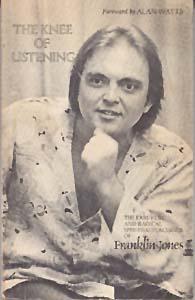
The Life and Understanding
of
Franklin Jones
Copyright 1971 By Franklin Jones
All rights reserved
Chapter 5: The Understanding on the Beach
After my experiences at the V.A. hospital I went into a period of relative seclusion to carry on my work undisturbed. Nina worked as a school teacher during this period and supported our living.
My own manner of living at that time finally established a form of practice in me that had begun in college. It was not required that I maintain a “job” of any kind, and so I was free to work as I pleased. As always, I found seclusion to be extremely vital, productive and creatively necessary for my own kind of progress.
The pattern of my days was mostly sedentary. This was partially dictated early in my life by a chronic weakness in my left side, particularly the left leg, and in certain tiny bone malformations in my lower back. I have not been noticeably disabled by this limitation, but it has led me to experience a certain tiredness and weakness in those areas if I must be very active physically. After more than thirty years of this slight disability my body has developed a counter-balance of muscular strength, and I have always been able to enjoy strong activity in swimming and other kinds of exercise. In recent years I have also learned how to manipulate and refresh the bone structure of the body, its muscular system, and the nervous system by using certain techniques of Hatha Yoga.
Thus, I spent my days in retirement, and still do for the most part. While Nina was away at work I would spend the day writing. My method was not one of any kind of intentional production. The writing of this present book, for instance, is a very intentional process. It involves a deliberate plan of productivity, the gathering of various notes and sources, chronological recollection, etc. I arise at about 7 A.M. for an hour’s meditation. Then, when I am alone, I write very deliberately and almost continually for eight hours or more.
However, in those days my method was deliberately unproductive. My intention was not to write a particular narrative I had preconceived. Rather, I deliberately and very intensively focused in the mind itself. And, as a result of several years of experiment in this direction, I remained focused there without effort, almost continuously, regardless of my peculiar external involvement.
This could perhaps be understood as a kind of “yoga” of my own creation, and it has analogies in the history of spiritual experience. But I had no separate goal in doing this. There was no other point I hoped to arrive at as a result of this concentration. I wanted to reside in the plane of consciousness at its deepest level, where all experiences, internal as well as external, were monitored. I wanted simply to become aware of what passed there.
Ordinarily we do not remain aware on the deepest level of the mind. We are either concentrated in its extensions, at the level of sense awareness or in the processes of concrete thought. Occasionally we slip into a deeper level, similar to the one to which we pass in dreams or sleep, and there we experience the day-dreams, the subliminal memories, emotions and motivations that underlie our working life. It was my purpose to remain continuously aware at this deepest focal point of the mind. That was also a point at which I often concentrated in the “bright.” It is a point deep within the head, but it monitors all the levels of consciousness, the physical body and the experiences of the sense organs, the vital centers in the lower body, the great center of being and energy in the heart, the peculiar order of subliminal imagery that perhaps moves out of some creative center analogous to the throat, and all of the passing perceptions, the images, ideas, sensations, forms, memories and super-conscious communications that are generated in the parts of the head.
In those days I spent all of my time concentrated in this witnessing function. I carried a clip board with me wherever I went. And I would write whatever perceptions were generated in consciousness. I attempted to make this writing exhaustive, so that not a single thought, image or experience would pass unrecognized. The act of writing seemed necessary to the act of becoming conscious itself. What I did not write seemed to pass away again into unconsciousness, perhaps to remain trapped there and provide matter for the hidden, unconscious form that bounded my awareness and prevented the “bright.”
Whenever I was too busily occupied to write, I would invent a catch phrase or some other mnemonic device in order. to hold the concept or perception until I could write it fully. I became so occupied in this process that Nina would have to do anything that required practical attention. She would drive the car, communicate with friends, and perform all of the usual chores within and without the household. My writing became a continuous, fascinating and absorbing occupation. And I began to fall naturally into a thread of consciousness and life that was profound, hidden, unfolding, inevitable and sublime.
I would write at any and all times, even in the evenings when Nina was at home, at the movies, parties, or during walks on the beach. I would often write late into the night, or I would awaken many times from sleep to record dreams and ideas. The same process went on during sleep, so that I remained conscious even during dreams or deep dreamless sleep.
I continued to exploit the possibilities for experience during that time, and I saw no benefits in retarding any impulses. I feared that suppression would only prevent certain necessary images or motives from releasing their energy to consciousness. I would often exploit the possibilities of sex, or become deeply drunk on wine, engage in orgies of eating, or smoke marijuana for long hours.
I became intensely aware of every movement in consciousness. I perceived every event in the world as well with an almost painful absorption. Every creature or environment I perceived became a matter of profound attention. I would write long pages of exhaustive observation on every step of a walk on the beach, or the day-long process and change of the ocean. There was page after page describing the objects and marks in the sand as I walked, detailed descriptions of rooms, mental environments, etc. So that I gradually came to a similar state in which I found myself at the point of awakening in college. I came to a point of exhaustion, not of tiredness, but of intensely inclusive awareness, where there appeared very little that remained to be perceived outside the form of consciousness itself.
As I approached that point of inclusive awareness the form of my writing also began to bear fruit. My concentration, as I said, was not purposive. It was not in order to create something intentionally on the basis of what was pre-conceived in the mind. But I was always looking and listening for that structure in consciousness itself which is chronically prior to awareness. I was waiting on the revelation of the hidden content of the mind. Not some sort of primitive event, no memory in the Freudian style or some symbolic perception which informs the content of Jungian types of introspection. These came and went. But I was attentive to the structure of consciousness itself, to the seed-logic or myth that prevented the “bright.”
As I approached that form of knowledge, which I knew from previous suggestions in my deepest experience had to be there, I would often pass through profound recollections and imagery. There were the emotional and scatological memories of childhood, and the moments of conflict in life that underlay persistent anxieties, preferences and chronic patterns. There were also times when I saw and learned the workings of what appeared to be psychic planes and worlds. I remember once for a period of days I was aware of a world that appeared to survive in our moon. It was a super- physical or astral world where beings were sent off to birth on the earth or other worlds and then their bodies were enjoyed cannibalistically by the older generation on the moon, or they were forced to work as physical and mental slaves.
I became very interested in the writings of C.G. Jung, and more than once I awakened to symbolic dreams typical of the level of consciousness he investigated. One of these coincided with a dramatic awakening that I will describe presently.
But my attention could not settle in any particular impression or event. I was always driven more deeply into tire underlying structure, and so I always remained focused in the mind itself, regardless of what passed.
Eventually, I began to recognize a structure in consciousness. It became more and more apparent, and its nature and effects revealed themselves as fundamental and inclusive of all the states and contents in life and mind. My own “myth,” the control of all patterns, the source of identity and all seeking began to stand out in the mind as a living begin.
End of chapter due to copyright restriction
For further reading go to: