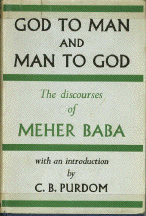
Edited by C. B. Purdom
London, Victor Gollancz LTD, 1955
1967 expanded release of
God to Man and Man to God entitled The Discourses
(Online
edition)
God
The discoures of Meher Baba
Part I
Introduction
1 –
The
New Humanity
2 – The Search for God
3 – God
– Realization
4 – Aspirants
and God Realized Beings
5 – The
State of the God Man
6 – The
Work of the God Man
7 – Avatar
8 – The Circle
9 – The way of the Masters
10 -The qualifications of the Aspirant
11 -Discipleship
12 -The formatio, function and removal of sanskaras
13 -Meditation
14 -The nature of the ego and its termination
God to Man and Man to God
The discourses of Meher Baba
Edited by C. B. Purdom
London, Victor Gollancz LTD, 1955
THE WORK OF THE GOD-MAN
GOD-REALIZATION is the endless end
of creation, and the timeless consummation and
fructification of unbinding Karma. If the self takes an
incarnation after God-realization, it is not as an ego-mind,
but as the embodiment of the universal mind; so that it is
not, like the reincarnating ego-mind, subject to the bondage
of Karma. Ordinary man takes an incarnation under the
irresistible impulsion of creation but the God-man
reincarnates by free and spontaneous arising of compassion
for those who are still in the world of illusion and
bondage. The descent of a God-realized one is fundamentally
different from the incarnation of souls in
bondage.
Free and unbinding give and
take those who have not realized
God are still in the domain of duality; their dealings of
mutual give and take create the chains of Karmic debts and
dues, from which there is no escape in duality. But the
God-man, dwelling in the consciousness of unity, has
no such chains, and is thus able
to contribute towards the emancipation of others still in
ignorance. For the God-man there is none excluded from his
own being, he sees himself in every one; he freely gives and
freely takes without creating binding for himself or
others.
Any person who accepts without
reserve the bounty which the God-man showers creates a link
that will stand until he attains the goal of freedom and
God-realization. Any person who serves the God-man, offering
his life and possessions in his service, creates a link that
will be a means of spiritual progress. Indeed, even
opposition to the work of the God-man is a beginning to the
journey that leads God-ward: while opposing the God-man, the
soul is establishing contact with him. Thus everyone who
voluntarily or involuntarily comes within the orbit of the
God-man’s activities becomes subject to a spiritual
impetus.
The work of the God-man
The work of the God-man is
fundamentally different from that of the priest. It is
characteristic of the priests of established religions to
attach importance to forms, rituals and conformity with
rules, and since they are not themselves free from
selfishness, narrowness or ignorance, they may exploit the
weak and credulous by holding before them the fear of hell
or hope of heaven. The God-man having entered for ever into
the eternal life of love, purity, universality and
understanding is concerned to bring about the unfoldment of
the spirit in all whom he helps. There are those who are
themselves in ignorance, who because they have read or
listened to the words of a God-man may out of self-delusion
or in deliberate selfishness use the same language as he and
they may try to imitate the God-man in his way of life; but
by the very nature of their spiritual limitations they
cannot imitate the God-man in understanding, bliss, or
power. If out of self-delusion or hypocrisy they pose as a
God-man, their self-delusion or pretense becomes evident in
their lives. There are those who believe themselves to be
what they are not, and think they know when they do not;
when they are sincere they are not to be blamed, though they
may become a source of danger to others, and should be
recognized for what they are. The hypocrite knows that he
does not know, and his pretense creates serious Karmic
binding for himself; though he is a source of danger to the
weak and the credulous, he cannot continue with his
deceit.
God-man can play the role of the
aspirant
In his universal work, the God-man
has infinite adaptability. he is not attached to any one
method of helping others; he does not follow rules or
precedents but is a law to himself. He can rise to any
occasion and play any necessary role without being bound by
it. A spiritual aspirant cannot act as one who has attained
perfection, since the perfect one is inimitable, but the
perfect one can for the benefit of others act as an
aspirant. One who has passed the highest academic
examination, can write alphabets for teaching children, but
children cannot do what he can do. For showing others the
way to divinity, the God-man may play the role of a devotee
of God; he may play the role of a Bhakta so that others may
know the way. He is not bound to any particular role, and
can adjust his technique to the needs of those who seek his
guidance. Whatever he does is for the good of others; for
him, there is nothing more to obtain.
Maya used to annihilate
Maya
Not only is the God-man not bound to
any technique of spiritual help, he is not bound to
conventional standards. He is beyond good and evil; but
though he may appear to be lawless, what he does is for the
good of others. He uses different methods for different
persons. lie has no self-interest or personal motive, and is
always inspired by the compassion that seeks the well-being
of others. He uses Maya to draw his disciples out of Maya,
and adopts very different workings for his spiritual task.
Nor are his methods always the same with the same person. He
may do what shocks others because it runs counter to their
expectations; this is intended for a spiritual
purpose.
The God-man may seem to be harsh
with certain persons who contact him; but onlookers do not
know the internal situation and cannot have a right
understanding of his behaviour. In fact his sternness may be
demanded by the spiritual requirements of the situation in
the interests of those to whom he is harsh. We have an
analogy in an expert swimmer who saves a drowning person. He
may have to hit the drowning man on the head to minimize the
danger in which he is likely to involve his helper. So the
sternness of the God-man is to secure the spiritual
well-being of others.
Shortening the stages of false
consciousness
The soul in bondage is caught in the
universe, and the universe is illusion; but since there is
no end to illusion he is likely to be held indefinitely
within its mazes. The God-man can help to cut short the
different stages of false consciousness by revealing the
Truth. Through illusion the soul gathers experiences of the
opposites. Where there is duality, there is a possibility of
restoring balance through the opposite. For example, the
experience of being a murderer is counterbalanced by the
experience of being murdered; and the experience of being a
king, is counterbalanced by the experience of being a
beggar. But the soul may wander from one opposite to the
other without putting an end to its false consciousness. The
God-man can help the soul to perceive the
Truth, cutting short the working of
illusion. The God-man helps the soul in bondage by sowing in
him the seed of God-realization, but every process of growth
takes time. There is, however, a qualification of this
statement to be made.
The help of the God-man is more
effective than the help that any advanced aspirant may give.
When an aspirant helps, he can take a person up only to the
point that he himself has reached; and even this limited
help becomes effective gradually, with the result that the
person who ascends through such help has to stay in the
first plane for a long time, in the second plane a long
time, and so on. When the God-man chooses to help a person,
he may take the aspirant to the seventh plane in one jump,
though in that jump the person has to traverse all the
intermediate planes.
By taking a person to the seventh
plane, the God-man makes him equal to himself, and the
person who thus attains the highest spiritual status becomes
himself a God-man. This transmission of spiritual knowledge
is comparable to the lighting of one lamp from another. The
lamp that has been lighted is as capable of giving light as
the original lamp itself; and there is no difference between
them. The God-man is like the banyan tree, which grows large
and mighty, giving shade and shelter to travellers and
protecting them from sun, rain and storm; in the fullness of
its growth its descending branches strike deep into the
ground to create in due time another full-grown banyan tree,
which also becomes not only large and mighty, but has the
same potential power to create banyan trees. The God-man
arouses the God-man latent in others.
Lord and Servant
The God-man may be said to be the
Lord and Servant of the Universe at one and the same time.
He showers spiritual bounty on all in measureless abundance,
and as one who bears the burden of all and helps them
through spiritual difficulties, he is the Servant of the
Universe. Just as he is Lord and Servant in one, so he is
the supreme lover and the matchless Beloved. The love, which
he gives or receives frees the soul from ignorance. In
giving love, he gives it to himself in other forms, and in
receiving love, he receives what has been awakened through
his own grace, showered on all. The grace of the God-man is
like rain which falls on all lands, barren and fertile, but
fructifies only in the lands that have been rendered fertile
through toil.
The discoures of Meher Baba
Chapters
1 – The New
Humanity
2 – The Search for God
3 –
God
– Realization
4 –
Aspirants
and God Realized Beings
5 –
The
State of the God Man
6 – The
Work of the God Man
7 – Avatar
8 –
9
history of the book
1967 expanded release of God to Man and
Man to God entitled The Discourses (Online
edition)