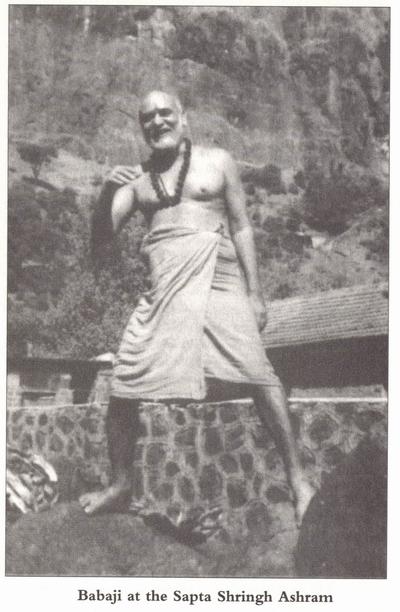
“A vessel of happiness…a beautiful
being who breathed the spiritual force in such a way that it
saturated his entire body.” – Adi Da Samraj
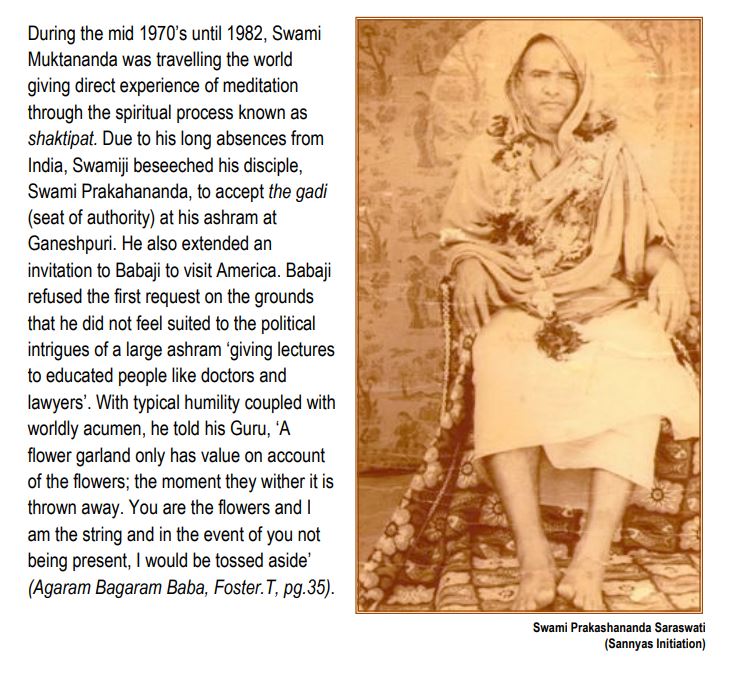
Swami Prakashananda Saraswati was born into a Brahmin family in November 1917 in Kamataka, South India, and given the name Laxmi Narayan. His mother died when he was ten and left home shortly after that. One of his earliest childhood memories was of the eighteened-armed Goddess of Sapta Shringh which he was destined to meet years later and recognize as his true mother.
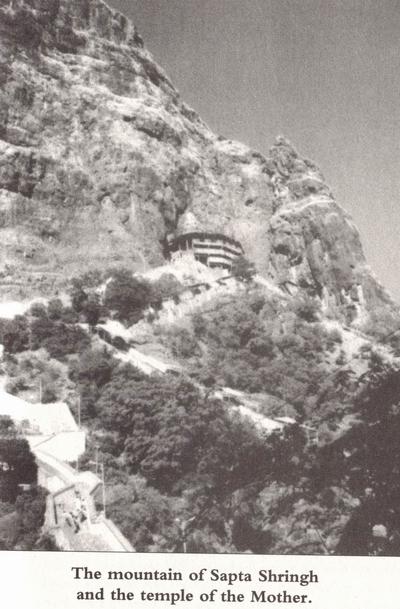
He is known as a divinely realized being. After many years of sadhana he was called, in1953 to a mountain about 40 miles north of Nasik in Maharashtra, Sapta Shringh.
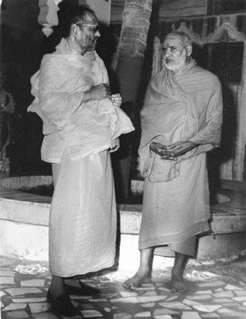
Swami Muktananda
and Prakashananda Saraswati
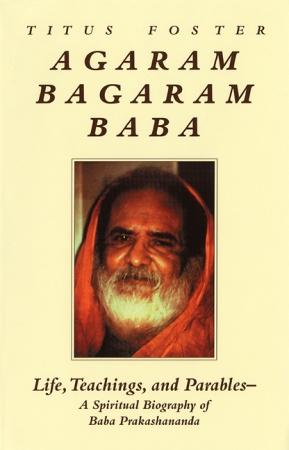
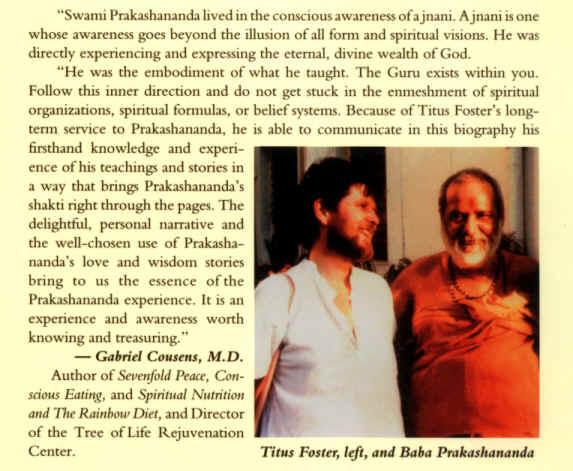
This biography tells the story of Swami Prakashananda, an Indian saint. Titus Foster met Prakashananda in Bombay in 1976 and became one of his disciples. He communicates his
knowledge and experience of the swami’s teachings and stories, exploring his style of enlightenment.
The following is from My Great Regard for My Adept-links to the Great Tradition of Mankind, and My Realization of the Great Onlyness of Me or Chapter 20 of the Knee of Listening added in 1999, by Ruchira Avatar Adi Da Samraj
XL.
Yet another devotee of Baba Muktananda, named Swami Prakashananda-Who did not Function as My Spiritual Master (and Who, like Rudi, was not a fully developed Siddha-Guru but, rather, a very much advanced fourth-to-fifth stage SiddhaYogi) once (spontaneously, in 1969) Showed Me (in His own bodily human Form) the fifth stage Signs of Spiritual Transfiguration of the physical body.
At that time (according to what I learned from Amma), Swami Prakashananda had been indicated, by Baba Muktananda, to be His principal Indian devotee and eventual institutional successor (and such was, then, generally known and presumed to be the case by Baba Muktananda’s devotees). However, at last, when (at, or shortly before, Baba Muktananda’s death, in 1982) Swami Prakashananda was formally Asked to assume the institutional successorship, He declined to accept this organizational role (ostensibly, for reasons of ill-health, and His reluctance to become a “world-traveler”- but, actually, or more to the point, because of His puritanical and conventional reaction to Baba Muktananda’s reported sexual activities*).
In any case, Swami Prakashananda and I continued to engage in occasional, and always positive, direct communication (through My devotee-representatives) in the years after Baba
Muktananda’s death, and right until Swami Prakashananda’s death, in 1988.
XLI.
Swami Prakashananda had always maintained a small Ashram, independent of the Ashrams of Baba Muktananda’s Siddha-Yoga institution-but, after Baba Muktananda’s death, Swami Prakashananda retired to His own Ashram, permanently. And, in doing so, Swami Prakashananda highlighted, and dramatized, a perennial conflict that is fundamental to religious institutions all over the world. That conflict is between, on the one hand, the traditional (and, generally, rather puritanical-and even basically exoteric) expectation of celibacy as a sign of institutionalized Sacred Authority, and, on the other hand, the equally traditional (but non-puritanical, and generally unconventional) view that there is an esoteric sexual alternative to celibacy that Sacred Authorities (including True Siddha-Gurus–or even any practitioners of Siddha Yoga) may (at least in some cases, and under some circumstances) engage.
The following is from:
My Guru known as Swami Prakashananda Saraswati (Babaji)
Dean Das, the author, is a disciple of Swami Prakashananda (Babaji). Over several years he lived with his Guru atop Sapta Shringi mountain, a 4,000 foot high mountain plateau (gadh), 40 kilometres north of Nasik City, in Maharashtra State, Western India. During the years spent with Swami Prakashananda, Dean Das was favoured with the blessing of the Guru’s full ‘grace’ (anugraha), it being the principal means of attaining to ‘SelfRealization’.
The following is from ‘He-and-She Is Me’ – Adi Da Samraj
Another devotee of Baba Muktananda, named Swami Prakashananda19 —Who did not Function as My Spiritual Master (and Who, like Rudi, was not a fully developed Siddha-Guru— but, rather, a very much advanced fourth-to-fifth stage SiddhaYogi)—once (spontaneously, in 1969) Showed Me (in His own bodily human Form) the fifth stage Signs of Spiritual Transfiguration of the physical body.
At that time (according to what I learned from Amma), Swami Prakashananda had been Indicated, by Baba Muktananda, to be His principal Indian devotee and eventual institutional successor (and such was, then, generally known and presumed to be the case by Baba Muktananda’s devotees). However, at last, when (at, I (Alone) Am The Adidam Revelation
or shortly before, Baba Muktananda’s death, in 1982) Swami Prakashananda was formally Asked to assume the institutional successorship, He declined to accept this organizational role (ostensibly, for reasons of ill-health, and His reluctance to become a “world-traveler”—but, actually, or more to the point, because of His puritanical and conventional reaction to Baba Muktananda’s reported sexual activities).
In any case, Swami Prakashananda and I continued to engage in occasional, and always positive, direct communication (through My devotee-representatives) in the years after Baba Muktananda’s death, and right until Swami Prakashananda’s death, in 1988.
XLI.
Swami Prakashananda had always maintained a small Ashram, independent of the Ashrams of Baba Muktananda’s Siddha-Yoga institution—but, after Baba Muktananda’s death, Swami Prakashananda retired to His own Ashram, permanently. And, in doing so, Swami Prakashananda highlighted, and dramatized, a perennial conflict that is fundamental to religious institutions all over the world. That conflict is between, on the one hand, the traditional (and, generally, rather puritanical—and even basically exoteric) expectation of celibacy as a sign of institutionalized Sacred Authority, and, on the other hand, the equally traditional (but non-puritanical, and generally unconventional) view that there is an esoteric sexual alternative to celibacy that Sacred Authorities (including True Siddha-Gurus—or even any practitioners of Siddha Yoga) may (at least in some cases, and under some circumstances) engage.
One of the principal Indications of Baba Muktananda’s point of view relative to this traditional conflict (or controversy)—quite apart from the question of His possible personal sexual activities— is the fact that, in 1969, Baba Muktananda formally and publicly (and in writing, by His own hand, as observed by Me, and by many others) Acknowledged Me to Be (and Called and Blessed Me to Function As) a True Siddha-Guru, and, Thus and Thereby (and entirely without requiring, or, otherwise, inviting, Me to assume any institutional—or, otherwise, institutionally “managed”— role within His own Siddha-Yoga organization), Baba Muktananda publicly Extended the Free Mantle of Siddha-Yoga Authority to Me—an evident non-celibate Siddha-Yogi (and a “Westerner”).