Talks With Ramana Maharshi | The Heart | Do Guru’s Feel Pain | Ramana’s Appearance | Chadwick’s First Darshan | Saints Turn Into Light | Somerset Maugham | Mercedes D’Acosta | Ramana’s Teaching According to Adi Da | Published from the Ashram | The Seer and The Seen | Mandukya Upanishad | Three States of Consciousness | The Five Great Elements | India and Peru | Ramana’s Will
Note:
The following explanation of the ‘Talks’ is
from S.S. Cohen from his book Reflections
on Talks with Sri Ramana Maharshi.
The Talks are a record in the form of diary of
some of the conversations which the visitors and
disciples have had with the Master on Spiritual
matters for almost exactly four years – April 1935
to May 1939. In those years it used to called “The
Journal”. Roughly half of this period it used to be
written in the Darshan Hall itself by the diarist,
or recorder, Sri M. Venkataramiah, the late Swami
Ramanananda Saraswati at the end of each particular
conversation at which he was present. Sri Bhagavan
scarcely ever answered in English, but invariable
in Tamil, which very often the diarist himself
translated into English to the questioner in the
hearing of the whole audience. But questions in
Telugu and Malaayalam, Bhagavan answered in the
same languages, and the answers in the latter
language may be said to have been lost to the
diarist, who did not understand Malayalam.
Therefore the language of this diary is of the
recorder, more often it is a paraphrase of the
Master’s answers, occasionally His very words,
rendered into English, for it is impossible to
write down afterwards all He had said, or to kep
pace with Him even if the answers were to be taken
down vertabium on the spot.
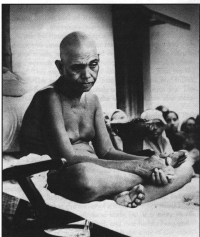
Ramana: “The jiva is said to remain in the Heart in deep sleep, and in the brain in the waking state. Heart is not the muscular cavity which propels blood. It denotes in hthe Vedas and the scriptures the centre whence the notion ‘I’ springs. Does it spring from the ball of flesh? It does not, but from somewhere within us, from the centre of our being. The ‘I’ has no location. Everything is the Self. There is nothing but the Self. So the Heart must be said to be the entire body as well as the universe, conceived as ‘I’. But to help the abhyasi we have to indicate a definite place in the universe, or the body, dor it. So this Heart is pointed out as the seat of the Self. But in truh we are everywhere; we are all that is, and there is nothing else”.
Ramana: “Atma is the Heart itself. Its manifestion is in the brain. The passage from the Heart to the brain might be considered to be through the sushumna, or nerve (nadi) with some other name. The Upanishads speak of pare leena, meaning that the sushumna or such nadis are all comprised in Para, i.e. the Atma nadi. The Yogis say that the current rising up to sahasrara (brain) ends there. That experience is not complete. For Jnana they must come to the Heart. Hridaya (Heart) is the Alpha and Omega”.
Cohen: From the Heart the body sprouts. The energy, life and consciousness, the only prime elements of the body and likewise of the universe, stream out of the Heart by the first channel, or nadi, straight to the head (Amrita Nadi) from which they run down to all parts of the body through various nadis. …Because all the nadis from the body end in the sahasrara, the Kundalini yogi, the Hatha yogi, and in fact all yogis, who practise pranayama take the sahasrara to be the terminal point of their sadhana; whereas the Dhyana yogi, also called Raja yogi, Vichara yogi, etc. adds one more state for the complete and absolute Emancipation. The last stage runs through the Para nadi, also called Amrita nadi, because, being of the purest sattva, it is extremely blissful and leads straight to the Heart.
Ramana: The Heart is not physical; it is spiritual Hridaya = hrit + ayam, which means ‘that is the Centre”. It is that from which thoughts arise, on which they subsists and where thry are resolved are the content of the mind and they shape the universe. The Heart is thus the centre of all. It is said by the Upanishads to be Brahman. Brahman is the Heart”.
Cohen: “Thoughts are (the products as well as) the contents of the mind” is significant; it make the mind not simply manas, as it is usually wrongly translated in Indian metaphysics, but the consciousness which produces, contains and perceives the thoughts, synonymous wiith the Heart or Brahman.
“Verily as space is boundless, so is the ether within the Heart. Both heaven and earth, fire and air, the sun and the moon, also the lightning and the stars, and whatever is, as well as whatever is not in the universe, all are within the vacuity (Heart)”. Chandogya Upanishad, IX, i.3)
Ramana: “How to realise the Heart? There is no one who even for a trice fails to experience the Self. He is the Self. The Self is the Heart. When asked who you are, you place your hand on the right siide of the chest and say ‘I am’; thereby you unnowingly point out the Self. The Self s thur known”.
Devotee: “Should I meditate on the right chest in order to meditate on the Heart?”
Bhagavan: “The Heart is not physical. Meditation should not be on the right or the left. It should be on the Self. Everyone knows “I am”. It is neight within nor without, neither on the right nor the left: “I am” – that is all”.
Questioner (a teacher of philosophy): “How can the world be an imagination or a though? Thought is a function of the mind. The mind is located in the brain. The brain is within the skull of a human being, who is an infinitesimal part of the universe. How then can the universe be contained in the cells of the brain?”
Bhagavan: “So long as the mind is considered to be an entity of the kind described, the doubt will persist. But what is mind? Let us consider. What is the world? It is objects spread out in space (akasha). Who comprehends it? The mind. Is not the mind which comprehands space itself space (akasha)? The space is physcial ether (bhootakasha). The mind is mental ether (manakasha) which is contained in transcendental ether (chidakasha). The mind is thur the ether principle (akashatattva) Being the principle of knowledge (jnana tatva), it is identified with ether (akasha) by metaphysics. Considering it to be ether, there will be no difficulty in reconciling the apparent contradiction in the question. Pure mind (Suddha manas) is ether (akasa). Rajas and tamas operate as gross objects, etc. Thus the whole universe is only mental”.
Talks With Ramana Maharshi | The Heart | Do Guru’s Feel Pain | Ramana’s Appearance | Chadwick’s First Darshan | Saints Turn Into Light | Somerset Maugham | Mercedes D’Acosta | Ramana’s Teaching According to Adi Da | Published from the Ashram | The Seer and The Seen | Mandukya Upanishad | Three States of Consciousness | The Five Great Elements | India and Peru | Ramana’s Will