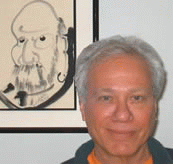
Executive Director Golden Sun Foundation for World Culture with Julia Sagebien on December 7, 2006. ....thats when (Rimpoche) said, Were
going to Nova Scotia and that was the beginning of the
Shambhala Wisdom for me that very day. He really
shifted. He said, This is going to happen. We need it to
happen and he said something interesting. He said,
North America is like the three Kalashas: Mexico, is
passion, the U.S., is aggression, and Canada, is ignorance
and ultimately we have to work with ignorance. There was a question about well what about America...and
then over the course of the month and the months to follow
we spoke about prophesies, the Shambhala prophesies and he
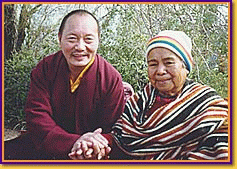
asked me to look into the native American prophesies. Grandmother Caroline and Karmapa found each other. And
they shared stories. When I went down there years later with my wife and son
we talked about the Tibetan prophesies and the Hopi
prophecies and how they are one in the same. She said come
the turn of the century, the first ten years between 2000
and 2010 there would be tremendous environmental disaster
and economic upheaval. This time is what the Hopi call the
Fifth Time or the Fifth World I believe. They
measure in time cycles and were entering into the fifth time
and will be difficult. So shortly after having that meeting with Grandmother
Caroline, I was back at Rocky Mountain Dharma Center and
this was one of my last business meetings with
Vidyadhara. One of the first things we spoke about was my trip to
Hopi Land and he got really interested and he wanted to know
all about it in great detail.He really wanted to know one
thing more than anything else. He said, When do the
Hopis think things will change? Did she give you a
date? I said, Well, she gave me an approximate date and
she said it would be somewhere in the first decade of the
new millennium, and he smiled and said, She has
it right,....
You may also be interested in when Gerald Red Elk, a
Lakota Sioux shaman, met Trungpa Rinpoche at Rocky Mountain
Dharma Center, during the Magyal Pomra Encampment in July
1984. "Gerald Red Elk talked about why he had requested to see
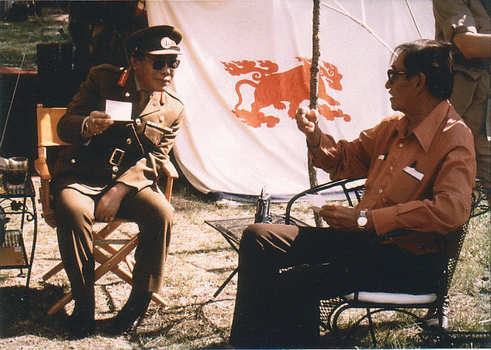
Chogyam Trungpa. He described the declining situation of his
people, as well as the changing of the cycles according to
native American tradition." read more >>>
"His Holiness expressed a desire to
meet with the Hopi Indians in Arizona." Steve Roth / As told to Don Morreale in a personal
interview 17 July 2010 There's a famous prediction attributed to Padmasambhava,
8th Century Tibetan saint: When the iron bird flies, And horses run on wheels, The Tibetan people will be scattered like ants across the
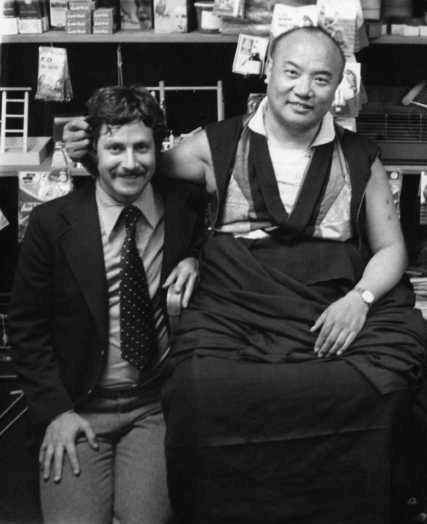
world And the Dharma will come to the land of the Red Man His Holiness with his driver, Steve Roth, 1974 I was fortunate enough to be present at the fulfillment
of this prophecy. In October, 1974, His Holiness Gyalwa
Karmapa came to Colorado at the invitation of Chögyam
Trungpa Rinpoche. I was asked to be his personal chauffeur.
His Holiness expressed a desire to meet with the Hopi
Indians in Arizona. We set about making the necessary
arrangements even renting a brand new, gold colored Cadillac
as the official vehicle for the journey. We finally left for
Arizona trailed by a caravan of cars containing His
Holiness's retinue of attendant monks and lamas, a Tibetan
translator named Achi, and around twenty-five American
Buddhist practitioners from Karma Dzong in Boulder.
Transfixed by the presence of his Holiness, I did my best to
drive mindfully. Early in the afternoon of the following day, we arrived
at a place called Second Mesa, a hlgh plateau on the Hopi
reservation. It looked like an old chocolate cake. I nosed
the Cadillac onto the dirt road that spiraled up around it,
and we slowly made our way to the top. Even though it was
October, the temperature was well over one-hundred degrees.
The place looked dusty, desolate, and poor. A man who looked
to be about eighty years old, wearing a plaid shirt, jeans
and tennis shoes, approached and greeted His Holiness. His
name, he said, was Chief Ned. There was a sweet, loving, and
gentle air about him. Through Achi the translator, His
Holiness asked: "How goes it? How are things with your
people?" 'Not too good," replied Chief Ned, "We haven't had rain
in seventy-three days." His Holiness listened with an expression of deep
compassion on his face. "I will do something for you," he
said. Then Chief Ned invited us to go down with him into a kiva
[ceremonial room] to see some sacred relics. There
was a small hole at the top of it with a rickety ladder
poking out. When he motioned for us to go down it, His
Holiness politely declined. He was a rather large and portly
man, and there was no way he could possibly fit through that
hole. He asked that the rest of us go down while he remained
up above. Down in the cool darkness, Chief Ned showed us an
eagle feather and other sacred relics. When we climbed back up into the sunlight, His Holiness
abruptly ended the visit. "Let's go," he said, and that was
that. We got into the cars and headed back down the dusty
road and out across the desert to the Hopi Cultural Center
and Motel where we were scheduled to spend the night. As we
drove, His Holiness, sitting right across from me in the
passenger seat, began chanting a puja and making sacred
mudra gestures with his hands. The desert baked and shimmered in the intense heat. I
looked out at the sky and noticed a tiny, sheeplike, fleecy
little ball of a cloud, all by itself way out there on the
horizon. I didn't give it much thought. I kept on driving,
and the Karmapa kept on chanting, and ten or fifteen minutes
went by like that before I glanced up again. Much to my
surprise, little puffballs of cloud now polka-dotted the sky
from horizon to horizon. The next time I looked, the clouds had congealed into a
solid gray mass. This was getting interesting. By the time
we reached the Hopi Cultural Center and Motel, the sky had
darkened to an ominous and foreboding black â?? not
just black, but a
classic,"Cecil-B-DeMille-Moses-and-the-Ten-Commandmentsâ?
black! We rolled into the motel parking lot. One of the
attendants opened the door for His Holiness. He got out and
walked to his motel room where another attendant stood ready
to open the door. I watched his back as he disappeared into
the room. At the very instant that the door clicked shut
behind him, there was an eruption of thunder and lightning
like I've never seen before in my life. Crash! Boom! The
most dramatic display you could imagine! And then the rain
started coming down hard. Buckets of it. Sheets and torrents
of it. It went on and on like that, splashing down on the
roof of the Cadillac with the power and intensity of a
waterfall. By that evening, word had gotten out to all the
surrounding villages that this "Indian King" had made rain.
Pretty soon a crowd had gathered around the motel. In every
face there was a look of awe and wonder towards his
Holiness, who at the moment was conducting an
Avalokiteshvara (compassion) empowerment for the assembled
crowd. We Western practitioners felt very much like
outsiders at this event. The amazing facial resemblance
between the Tibetans and the Hopi suggested an ancient bond
between the two peoples. To me, it felt like a reunion.
Ken Green Tapestry Initiative senior partner and advisor,
filmmaker, theater producer and executive director of the
Golden Sun Foundation for World Culture, studied with the
Tibetan Buddhist meditation master, Chogyam Trungpa for 16
years and was authorized by him as a Buddhist teacher and
meditation instructor. Ken is producing a documentary film
through the Tapestry Initiative called Boundless
Moment, exploring the lessons of impermanence and
potential . He is also currently producing Luminous
Emptiness a multimedia theater piece based on the
Tibetan Book of the Dead. www.goldensunfoundation.org
Ken Green, new media, film, audio/music, theater,
festival producer, production designer and artistic
director; Buddhist practitioner and mentor; and founding
director of Golden Sun Foundation for World Culture has
dedicated himself to produce cultural productions and events
that inspire wakefulness, authenticity and elegance.
Applying the teachings he received during 17 years from the
Venerable Chogyam Trungpa Rinpoche, Ken seeks out
collaborations with diverse artists, like-minded individuals
and groups to produce original works that join the wisdom of
the past with the culture of the future.. Kenneth H. Green - bio Ken Green, new media, film, audio/music, theater,
festival producer, production designer and artistic
director; Buddhist practitioner and mentor; and founding
director of Golden Sun Foundation for World Culture has
dedicated himself to produce cultural productions and events
that inspire wakefulness, authenticity and elegance.
Applying the teachings he received during 17 years from the
Venerable Chogyam Trungpa Rinpoche, Ken seeks out
collaborations with diverse artists, like-minded individuals
and groups to produce original works that join the wisdom of
the past with the culture of the future. During the past three decades, he has produced events
locally, nationally and internationally. He has focused on
the convergence of video and theater with new media
technology. In addition, Ken is a highly experienced and
dynamic administrator for the non-profit sector. He is also
a tea consultant for Teance, the premier tea purveyor of
Asian teas. Ken, a long time student and teacher of Tibetan
Buddhism, has taught Tibetan Buddhism and its application to
the arts. He is currently designing and producing a
multimedia theatrical adaptation of the Tibetan Book of the
Dead. His first major venture into filmmaking was working with
Martin Scorsese as an assistant art director for Box Car
Bertha. He went on to produce a number of documentaries,
which include The Lions Roar, a highly acclaimed and
award winning documentary on Tibetan Buddhism and
Discovering Elegance. He produced a series of art
installations with Trungpa, Rinpoche in Los Angeles, San
Francisco and Denver. Ken produced a series of educational
films for the Province of Nova Scotia and the Canadian Parks
Service, as well as a documentary on the art of Peter
Max. Ken directed and produced A Night on the Silk Road, a
multimedia concert performance of music, poetry, dance and
media projections with Kitaro; Dust to Gold, an evening of
Himalayan performances; Sacred Dances of Bhutan at the Asia
Society; and PlantAsia, a festival of Central Asian culture
at the Denver Botanic Gardens. He produced a 2005 summer
program of 44 concerts in Boulder, Colorado including world
music, dance, film, and theater, and will be producing an
International Buddhist Film and World Culture Festival in
2011, to be held in Bhutan. Green recently produced Secrets
of the World, an eight-part award winning audio
international storytelling series, with renowned
storytellers, published by Sounds True. Ken is currently producing, designing and collaborating
with world- acclaimed composer Philip Glass along with a
stellar team of CGI artists, filmmakers, traditional thangka
painters, musicians and performers on a major multimedia
theatrical adaptation of the Tibetan Book of the Dead. It
has been previewed as a work-in-progress September 2008 at
Asia Society, NYC. An upcoming series of lab/workshops
scheduled for the fall 2009 is being planned in partnership
with Naropa University, Ken was the president of Centre Productions, a Boulder
based film company. He is currently the president for
Windhorse Productions LLC, a film and new media company in
Nova Scotia and Boulder. He is the founding director and
executive director of Golden Sun Foundation for World
Culture, a not-for-profit cultural foundation whose mission
is to foster an enlightened society through sustaining and
promoting world cultural traditions and providing the
opportunities for an exchange of ideas and experiences
between the keepers of these traditions, contemporary
artists and the public. As a new media and multimedia producer/designer he spent
ten years in Nova Scotia, creating numerous interactive
programs and live mixed media events for museums, government
and corporate clients. Collaborating with the National Film
Board of Canada, Green designed and developed BARDO, an
interactive new media journey. Some of his other clients
include: Mi'kmaq Native Council of Nova Scotia, the
provincial government of Nova Scotia, Nova Scotia Power, New
Brunswick Power Company, Point LePreau, Parks Canada, The
Maritime Museum of the Atlantic, the NS Childrens
Museum and others. An early pioneer of multimedia, he designed nightclubs,
installations and organized festivals starting with the
first BE-IN in NYC with Peter Max (600,000 attendees). He
produced multimedia light shows for such notable musicians
and groups including The Grateful Dead, Jefferson Airplane,
The Doors, Country Joe and the Fish, and The Byrds. Ken founded Tendrel Technologies, a multimedia software
development company in Nova Scotia that created interactive
authoring tools for digital animators and designers. Ken served as a founding board director and
Vice-President for Nalanda Foundation, an educational
organization, in Boulder Colorado; in this capacity he was
one of the founding directors of Naropa University. He also
served 17 years as Vice-President and member of the board of
directors and as Director of Internal and Cultural Affairs
for Vajradhatu, an international not-for-profit network of
meditation and study centers, under the guidance and
direction of the renown Tibetan mediation master, Trungpa
Rinpoche. Ken was responsible for administration of all
major educational programs and centers throughout North
America. He was one of the original developers of the Rocky
Mountain Dharma Center (now called the Shambhala Mountain
Center). He collaborated on the design and implemented the
Vajradhatu advisory system used internationally to counsel
members on individual, family and livelihood issues.
Likewise, he helped design and implement the delek system, a
neighborhood focused program. This social experiment was
created to foster local identity, to be a vehicle for
exchanging ideas, and to provide feedback to the
international organization. The model was a success in
providing a powerful path for members to work closely with
each other in a caring environment. As Cultural Affairs
director, Ken designed and organized festivals, theater
performances, celebrations, museum installations, film
projects as well as administered and ran Dharma Art
programs, a Buddhist approach to the artistic process. As an ordained teacher and meditation instructor in
Tibetan Buddhism, he taught the practice, philosophy,
aesthetics and Buddhism for over fifteen years in the US,
Canada and Europe. Ken currently sits on the Board of Directors of the World
Council of Elders, a not for profit organization dedicated
to integrating authentic indigenous wisdom cultures. When not producing an event, Ken enjoys spending time
reading poetry and drinking high mountain oolong tea.
Other talks: Conversation with Kenneth Green Other talks: Conversation with Kenneth Green
The following is edited by Beezone (see
full talk) from a talk Chronicles Radio Dispatches

In their quest for technology (knowledge) the people
represented on the top line would loose their hearts and
think from their heads and not from their hearts. They are
called the two hearts or Bahannas. The different cultures of
the world are seen on the top line. On the bottom line are
the one hearts.
read
more on the Hopi prophecy


MENU
| Home
| Intro
| Beezone
Articles | Adi
Da Articles |
Tradition
Articles | All
Articles | email

"The perfect
among the sages is identical with Me. There is absolutely no
difference between us"
Tripura
Rahasya,
Chap XX,
128-133
All copyright materials are
used under authority of the Fair Use statute.
(United
State Code, Title 17)
(Fair
Use)