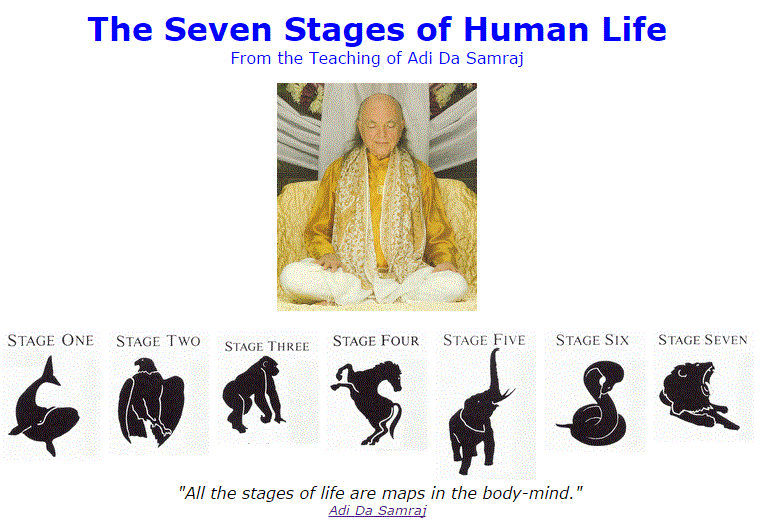
SPECIAL EDITORIAL INTRODUCTION
DISCRIMINATIVE INTELLIGENCE AND THE SEVEN STAGES OF
LIFE
The liability in the fifth stage of life is the tendency
toward belief in a fixed psychic identity, or an eternal
egoic or independent and personal consciousness. It is the
tendency toward belief in eternally extended but finite and
personal experience, founded in an experiential state of
undifferentiated unity with the causal root of the world, or
the manifest gesture of attention at the heart of the
body-mind
The Way of Translation of Man into God –
CHAPTER
7: The Enlightenment of the Whole
Body
FIFTH STAGE
The moment my head touched the pillow a large tongue
of flame sped across the spine into the interior of my head.
It appeared as if the stream of living light continuously
rushing through the spinal cord into the cranium. gathered
greater speed and volume during the hours of darkness.
Whenever 1 closed my eyes I found myself looking into a
weird circle of light, in which luminous currents swirled
and eddied, moving rapidly from side to side. The spectacle
was fascinating but awful, invested with a supernatural awe
which sometimes chilled the very marrow in my bones.
Gopi Krishna, Kundalini: The
Evolutionary Energy in Man (Boulder & London: Shambala,
1971, p. 49
This is a graphic
description of the kind of phenomena which follow in the
wake of an aroused kundalini, which characterizes the fifth
stage of life. Here the practitioner enters into the
experiential realm of higher psychic realities,
corresponding to the brain core and the higher nervous
system. In the fifth stage, attention is withdrawn from the
activities of the lower body, inverted upon the
Life-Current, and thus allowed to ascend to the brain
core.
In the mystical or yogic traditions, the brain core its
referred to as the “sixth center,” or ajna chakra, or the
“third eye.” Through exclusive and prolonged concentration
of psychic energy upon the brain core, the yogi or mystic
discovers a new “body” of fascinating, blissful experiences
wherein his nervous system and his brain are enlivened and
literally illuminated.
The great yogi Swami Ramalingam (1823-74) prayed for such
a new subtle body of light, a body that would be free of the
vicissitudes of natural things. In one of his poems he put
it thus:
I said:
shine undestroyed by wind or earth,
or sky, or fire, or water, or sun, or king of death,
or disease,
or murderous weapons, or planets or cruel deeds done
by others. “
G. Vanmakanathan, Pathway to God Trod by
Ramalinga Swamikal (Bombay: Bharatiya Vidya Bhavan, 1976) ,
P. 533
To the ordinary person, whose attention rarely moves
beyond the sphere of what Master Da Free John calls “money,
food, and sex,” Ramalingam’s request must seem
extraordinary, if not entirely fanciful. The “usual man”
knows nothing of the subtle dimensions of existence as
disclosed in the fifth stage through yogic introversion. His
idea of heaven derives entirely from the exoteric religious
understanding, which nowadays has lost all its earlier
attractiveness by virtue of the inroads made by science into
conventional religiosity. The ordinary person knows nothing
of the “heaven” of yogic esotericism, of the hierarchy of
subtle psycho-physical planes of existence, of deities and
other similar symbols of mystic experiencing.
Yet, the yogi’s inward “heaven,” which is derived from
the archaic “sky magic” of primitive shamanism, is blissful
but also nonobjective. For, the celestial abodes or levels
of existence which he so enthusiastically experiences are
simply descriptive trackings of the subtler functions of the
human brain and nervous system. What is more, they do not
confer unshakable Happiness and Realization. Their
blissfulness is transient. It can even prove fatal to the
practitioner’s further growth, because he may well succumb
to the fascination this experiential dimension obviously
holds. The temptation to fixate attention on the phenomena
and processes pertaining to the fifth stage is indeed
strong, and, as Master Da Free John warns, this stage can be
as deluding and binding as any of the “lower” stages.
Subtle powers, called “siddhi” in Sanskrit, are
attractive to the ego that has still not developed adequate
dispassion towards worldly things. It can easily be caught
up in the cornucopia of visionary and auditory experiences
and all kinds of other subtle phenomena. Again and again,
the texts and the living teachers of the spiritual
traditions of India warn about the allurement of these
extraordinary states of mind, and the seemingly
“supernatural” powers associated with them.
It is profitable to contrast the yogi’s experimentation
in the laboratory of his own body-mind with the modern
scientist’s lab technology. Just as science maps out the
“physical world,” so yogis and mystics delineate the
phenomena of the “subtle world,” that is, the topography of
the higher nervous system. Like the physical sciences, the
psycho-technology of yoga and mysticism may be useful to the
awakening body-mind, but the point of view of the fifth
stage schools is no more to be regarded as the culmination
of human spiritual development than the point of view of
third stage science. The particular contribution which fifth
stage schools have to make is their clear and vivid accounts
of the journey through progressive states of subtle
experiences which arise as the life-force (prana)
intensifies in the higher nervous system.
If Truth is considered the ultimate knowledge, then both
conventional science and religious mysticism are transcended
in the radical Realization and Wisdom of the Adepts. Thus,
the teaching of the seventh stage of life is critical to
both “objectifying” science and “subjectifying” religious or
spiritual esotericism.
This section of The Laughing Man contains an article
about the life and teaching of Baba Faqir Chand, who entered
the fifth stage of life, but who realized that the phenomena
of the fifth stage did not represent the Truth.
A primary method of subtle ascent, as practiced in the
East, is surat shabd yoga, literally the union of the soul
with the Divine sound-current, also known as “the path of
the saints.” The shabd yogi attunes himself to the internal
shabd or “sound-current” that may be heard through inner
concentration. He withdraws his attention from the outer
senses and permits it to rise with this sound into higher
mental and supramental states. Since he believes the inner
sound-current to be ultimately identical with the Supreme
Being, he hopes to be absorbed into that Being. Indeed, many
shabd Masters claim to have achieved this union.
One accomplished shabd Master has expressed an opposing
point of view. Baba Faqir Chand (1886-1981),
whose life and work are presented here, is a rare saint
of the subtle path who became disillusioned with that path.
His ninety-five years are the history of a man caught
between allegiance to the tradition in which lie was an
acknowledged Master and his own undeniable intuition that
such experiential mysticism was not the Truth.
Baba Faqir Chand was brought to our attention last year
by David Lane, one of his American disciples. Since we were
unable to meet Baba Faqir Chand before his death in 7981,
Mr. Line sent us this article, which is the first account of
Baba Faqir Chand’s life to be published broadly in the West.
With Mr. Lane’s kind permission, we have slightly
abbreviated and edited his contribution.
-The Editors
THE RELUCTANT GURU
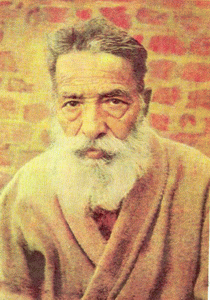
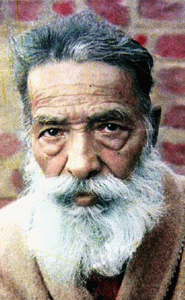
by David Christopher Lane
A lady sent me a letter stating that she was having
her bath in a river in Kashmir, when suddenly a wave of
water came and took her away for ten or fifteen yards. She
writes that when she was drowning “I” appeared there, caught
her hand, and brought her out of the river and said, “You
have yet to do a lot of work.” She has written to me so as
to know what work she is to do. Now neither did I go there
to save her, nor did I tell her that she was yet to do a lot
of work. This is the secret which has been kept so
guarded.
Baba Faqir Chand August, 1978
On Friday night, September
11, 1981 at 10:45 p.m., Baba Faqir Chand, the renowned
master of surat shabd yoga, died. He was ninety-five years
old. Although the public at large remained unaware of this
event, there were a small number of highly advanced sages,
yogis, and mystics in India, Europe, and North America who
realized that humanity had lost one of the great saints to
have appeared in this century. Having known Baba Faqir Chand
person ally and being aware of his failing condition, I
wrote to him in the summer of 1980 at his ashram in
Hoshiarpur (at the Himalayan foothills) asking if he would
write his life story before he left the world. To my great
joy and that of other interested scholars and seekers, Faqir
kindly accepted the request with the following blessing:
You can do this work. I will help you with all the
experiences of my life. I heartily wish you success in your
life in all aspects. My love and respect to you.
He subsequently dictated his autobiography in Urdu and
had it translated for me into English.1 What Baba
Faqir Chand has presented both in his life narrative and
numerous spiritual treatises is without precedent in the
Sant Mat2 tradition. For not only has
Faqir detailed his spiritual quest with disarming frankness,
but he has also in uncompromising terms revealed the true
nature behind religious visions and miracles. His work is,
quite simply, without parallel in the history of Indian
mysticism.
1. This article is based on Professor B. R. Kamal’s
unpublished English rendering of the Urdu dictation by Baba
Faqir Chand, which was edited by David C. Lane with the
assistance of Steve Morrow. All quotes in the body of
this article are from this manuscript.
2. Sant Mat (lit., “the doctrine of the saints”) is a
descriptive phrase for a particular spiritual milieu, a type
of religious attitude amongst a group of bhakti poets first
emerging vocally in Medieval India. What distinguishes these
uirguna bhakti poets, as P. D. Barthwal calls them
(worshippers of the Lord who is non-dual, unnamable and
formless), from Vaishnavites, Tantrics, Goraknathis,
Shaivites, and other followers of Indic piety, is
essentially the importance and emphasis they give to three
cardinal precepts: Sat Guru, both as the Absolute Lord
(uirgaaa) and the living human master (sagerm); Shabd (sound
or melody), which encompasses both nirnalmak (that which is
spoken or written) and Dhwanyatmak (inner or spiritual sound
which is beyond expression), the primal current or
manifestation of the Supreme Lord (Sat Purush); and 3)
Satsang, externally the congregation of earnest devotees of
the truth, and internally the communion of the soul (surat)
with the Sat Guar and Shahd.
THE LIFE OF BABA FAQIR CHAND Early Years
Faqir Chand was born on November 18, 1886 into a Brahmin
family in the Hoshiarpur district of the Punjab. Tormented
by the poverty at home and always fearful of his father’s
strict disposition, Faqir from the age of seven years onward
sought relief in the Name of God. In the course of time he
studied the Ramayana, the Mahabharata, and other scriptures
of the Hindu tradition. From these works Faqir developed a
love for the incarnations of Rama and Krishna and felt drawn
to meditate upon their forms.
At the age of eighteen he was employed as a signaler of
the Indian Railways. At this impressionable age he came-in
contact with the contractors of the department, who were all
meat eaters, and their company also turned Faqir into a
non-vegetarian. Recollects Faqir:
Due to my association with these people . . . I ate
meat for six months; drank rum on three occasions; gambled
once and lost one rupee and a quarter; and also once visited
a prostitute.
To earn pardon for the four sins he had committed, Faqir
prayed to God in the form of Rama and Krishna. Writes
Faqir:
I prayed and wept very hard. I was helpless to do so.
I wanted my mental slate clean, and it was not possible
until my transgressions were eradicated. Perhaps my tears,
shed so profusely, spoke of my conscientious desire to be
purified.
My peace of mind was disturbed. I felt restless most
of the time. It was a moonlit night. I was praying to the
Lord and weeping bitterly. There appeared before me an aged
sadhu (holy mans with a long gray beard and a tanbura
“guitar) in his hand. Most lovingly he asked me, “Dear
child, what makes you weep?” “I have committed four serious
sins. I have known from the Hindu scriptures that God takes
birth in the human form in this world. I want to see Rama
and get myself pardoned for my sins,” I said. The kind, old
sadhu assured me thus, “For you, your God in the human form
is already on this earth. You will come into His contact and
all your sins will be pardoned.” After saying these words
the sadhu disappeared. Following this incident, my
impatience to see God face to face increased.
In the meantime, Faqir got a permanent job with the
Indian Railways as Assistant Station Master and was posted
at Baganwala. But his craving to see the Lord did not
diminish. Rather, during this time it reached its peak. Once
Faqir wept for twenty-four hours continuously for a glimpse
of the Lord. Doctors were called in. They administered
medicine to him. At about five o’clock in the morning Faqir
describes ,seeing; in a vision the form of Maharishi Shiv’,
Brat Lal. the (,Guru drew water from a nearby well and
helped Faqir take a bath and then told him his address in
Lahore. When an employee woke Faqir, the vision carne to an
abrupt end.
This experience convinced Faqir that clod had incarnated
Himself in the form of Maharishi Shiv Brat Lal. So he
started writing one letter every week and sending it to the
address that appeared in his vision. In his letters,
however, Faqir always addressed Maharishi Ji as God. For ten
months Faqir wrote regularly to Shiv Brat Lal. Then he
received a letter from Maharishi in which the Guru wrote,
“Faqir, I have been receiving your letter, regularly, I
value your sentiments and your passion for the Lord. You are
a Moon among the saints, though you do not realize it. I,
myself, have discovered Reality, Truth, and Peace at the
feet of Rai Salig Ram Ji of Radhasoami Mat.3
Provided you feel no reluctance in following this path
come and see me at Lahore.” Elaborates Faqir:
My craving to see Cod in the human form had reached
its fulfillment. I had previously submitted an application
for leave some time back. As per his will, the same day that
I received a letter from Maharishi Shiv Brat Lal, a station
master reached Baganwala and told me that he had come to
relieve me. What a coincidence it was! I handed over the
charge to hire and left for Lahore the same day.
I reached the ashram of Hazur Data Dayal Ji (Shiv Brat
Lai) and prostrated my humble self at f His Holy Feet. He
gave me an exceptionally affectionate welcome and initiated
me into Radhasoami Mat, His Holiness gave me a book and
asked me to go through it. The work was Sar Barliari written
by Shiv Dayal Singh, the founder of Radhasoami. I went
through some pages of the book in the very presence of Hazur
Data Dayal Ji. But I could not pursue it any further,
though, because Shiv Dayal Singh had most vehemently
criticized almost every religion, including Vedanta, Sufism,
Islam, Jainism, and Buddhism. He declared them all to be Kal
[death] and Maya (illusion[. It was too much for
me. I felt hurt and tears rolled down my eyes. His Holiness
noticed my reaction and inquired for the reason. I broke
out, “Hazur, God is One. I have failed to understand the
justification for condemning all other religions as
incomplete. This is a direct attack on the religion of my
ancestors.” Hazur very lovingly advised me, “Keep aside this
book and never read it until I ask you to read it.”
Maharishi instead gave me two other books, one on the life
history of his guru, Rai Salig Ram Ji, and the other by
Kabir Sahib entitled Kabir Sakhi. He advised me to attend
the satsangs (meetings) of Radhasoami Mat wherever
available.
3. Radhasoami (literally “the Lord of
Radha”) is a spiritual sect of shabd yoga begun by Soamiji
Maharaj (1818-1878) in North India. The many subjects of the
Radhasoami Faith place great emphasis on the importance of
the Spiritual Master.
Discipleship
The spiritual practice as
directed by Shiv Brat Lal became part and parcel of Faqir’s
life. As he was not yet adept in the inward practice of
ascending to the higher stages of light and sound, Faqir
remained contented with his concentration on the Holy Form
of His Holiness Data Dayal.
In 1916, during the First World War, Faqir volunteered
himself for war services in the field in order to earn more
money and repel the pressure of poverty from his family.
Before leaving for his post on the war front, he went to his
Guru for his blessing. Hazur gave him the book Sar Bachan
(which he showed his disciple on his first visit) and
advised Faqir, “study this book now and devote more time to
simran (repetition of a Holy Name or Names) and bhajan
(listening to the inner Shabd, the Audible Life Stream).”
Thereafter Faqir left for Baghdad, where he was to be
posted.
During his stay in Baghdad, Faqir devoted himself
wholeheartedly to spiritual practice. He gave as much time
as possible to inward practice (meditation) and led a life
of complete celibacy. These sincere efforts, combined with
his desire to know the Truth, bore fruit; in due course
Faqir ascended to all the inner regions and experienced the
lights and sounds at each stage on the inner path. These
inner fruits of his meditation filled Faqir with joy and
ecstasy, but in spite of this achievement he was not yet
contented because he wanted to realize the Truth which had
prompted Shiv Dayal Singh to condemn all religions.
Towards the end of 1918, Faqir was granted annual leave.
He went straight to his Guru in Lahore to spend as much time
in his company as possible. During his stay with Shiv Brat
Lal, Faqir continuously troubled him with never-ending
questions. One day Faqir placed before Hazur the main agony
of his heart in these words, “My Lord, I have traversed many
inner stages of Sant Mat. I have dwelt in the Light within
and have experienced Shabd (Sound-Current) in indescribable
abundance. No doubt, these experiences have been a great
source of joy for me. But still, I long to see myself and
know the sublime goal of Radhasoami Mat. How and why does
the goal of Radhasoami Mat differ from that of other
religions? I yearn to experience the supremacy of the
Radhasoami faith myself.” His Holiness assured Faqir that he
would answer the question the very next day. Describes
Faqir:
My anxiety increased and I was very eagerly awaiting
the next day. It was December 25, 1918. Hazur Data Dayal Ji
called me in his room. I was already waiting for the moment.
I went inside. Lo! His Holiness with a strange blend of
affection placed in my hands one coconut, five pice, made a
frontal mark on my forehead and bowed himself to my feet
saying, “Faqir, you are yourself the Supreme Master of your
time. Start delivering spiritual discourses to the seekers
and initiate them into the path of Sant Mat. In due course
of time, your own satsang’s will prove to be your ‘True
Guru,’ and it is through your experiences with them that the
desired secret of Sant Mat will be revealed to you.” Touched
by these words, I experienced both joy and sorrow within me.
Hazur noted both these expressions on my face and asked for
clarification. I humbly said, “Your Holiness, I am myself
ignorant of the Truth, how can I lead others on this sublime
path? Hence, a flash of sorrow. And, when the thought that I
have become a degree holder and would deliver discourses and
initiate people arose within my mind, I felt that I had
become something and thus a spark of joy.” Hazur then said,
“Faqir, you may be suffering from ninety-nine shortcomings,
but one sure virtue of Truth which is within you will lead
you to your goal in life. You will not only redeem yourself,
but will help many others to attain release.” I spent my
entire leave at the Holy Feet of Data Dayal Ji and then left
for Baghdad to join my regiment.
Mastership
In Baghdad, Faqir used to
sing devotional songs. Every fiber of his being became
saturated with a passionate longing for the Ultimate Truth.
He always felt overflowing love for his Lord, Shiv Brat Lal,
who was for him the incarnation of Rama. Faqir’s
devotion-transformed personality made him a center of
attraction for other spiritual seekers in Baghdad. He came
to be regarded as a Mahatma, while some chose Faqir to be
their spiritual master.
In 1919 Faqir was posted in Iraq. The aboriginal
inhabitants (known as Baddus) revolted, which led to a
fierce battle. There was heavy loss of life on both sides.
During a lull in the fighting the Major came to Faqir and
asked him to telegraph to the headquarters at Divinia that
they were short of ammunition. And if they had to face
another such attack, the supplies would not last for more
than an hour. If the ammunition supply failed to reach them
before dawn, none of the group would be alive. Faqir wired
the message to the headquarters accordingly. The situation
was tense and everybody felt as if the end had come near.
Faqir too was gripped by the fear of death. Remembers
Faqir:
In this very moment of fear, the Holy Form of Hazur
Data Dayal Ji appeared before me and said, “Faqir, worry
not, the enemy has not come to attack but to take away their
dead. Let them do that. Don’t waste your ammunition.” I sent
for the Subedar Major and told him about the appearance of
my Guru and his directions concerning the enemy. The Subedar
Major followed the directions of my Guru. The rebel Jawans
came and carried away their dead without attacking our
positions. By six o’clock in the morning, our airplanes came
and they dropped the necessary supplies. Our fear vanished.
We gained courage. We were safe.
After about three months, the fighting came to an end and
the Jawans retired to their barracks. Faqir returned to
Baghdad, where there were many satsang’s. When they learned
of his arrival, they all came together to see Faqir. They
made him sit on a raised platform, offered flowers and
worshipped him. It was all very unexpected and a surprising
scene for Faqir. Recalls Faqir:
I asked them, “Our Guru Maharaj is at Lahore. I am not
your Guru. Why do you worship me?” They replied in unison,
“On the battlefield we were in danger. Death lurked over our
heads. You appeared before us in those moments of danger and
gave us directions for our safety. We followed your
instructions and thus were saved.” I was wonder-struck by
this surprising explanation of theirs. I had no knowledge of
their trouble. l, myself, being in danger during those days
of combat, had not even remembered them.
This incident caused me to question within myself,
“Who appeared to them? Was it Faqir Chand?” My faith was
strengthened, and I concluded that “Whosoever remembers God
in whatever form, in that very form He helps His devotee.”
This gave a new turn to my conception of the Spiritual
Master. Henceforth, I came to believe that the Master is not
a separate entity. Rather, He is the disciple’s Real Self
and resides within. Happy with this conclusion I came to
India on annual leave in 1921.
In 1922, Faqir went back to Baghdad. For about seventeen
years (until 1939), he shied away from delivering spiritual
discourses. However, if any deserving individual approached
Faqir for guidance, he would initiate and instruct him to
concentrate on the Holy Form of Hazur Data Dayal. Explains
Faqir:
I stopped giving satsangs. Why? I thought that if I
were to deliver spiritual discourses I must say the Truth,
at least up to the point that I knew it. If I were to remain
true to my conscience and rise up to the expectations of
Shiv Brat Lal Ji, I had to reveal the secret about the
manifestation of the Guru’s form to his devotees in moments
of physical, mental, and spiritual difficulties. And if I
did that, the love, devotion, and faith (blind faith) of
people for His Holiness would be reduced. The offerings in
cash, free and voluntary service, and the like by the
disciples at Radhasoami Dham ashram may also come down to a
painfully low level. Thus I willfully waited for the proper
time to come, so that Maharishi’s ashram may not suffer any
loss due to me. Ever since 1919 1 had a very strong desire
to disclose the secret and let the world know about all
types of manifestations within and without.
In 1938 before His Holiness Shiv Brat Lal shed off his
mortal frame, Faqir sent him a telegram with the following
resolution: “I solemnly promise that I shall spread the
Truth to the world to the best of my ability and
circumstances.” Hazur died in 1939, only after having
declared in his last open satsang that he does not
consciously manifest to anybody in their meditations.
Since the death of his Guru, Faqir devoted all his
possible time to recitation of the Divine Name, listening to
the inner sound, and meditation. But still Faqir remained
undecided about what he should do, because he had a lurking
fear in his mind that if he disclosed the Truth in plain
words, the narrow-minded, orthodox, and illiterate amongst
the satsang’s would turn against him. Thus, in 1942 Faqir
got leave and went straight to Baba Sawan Singh Ji,
the spiritual head of Radhasoami Satsang Beas in the
Punjab and a close friend of Maharishi Shiv Brat Lal, to
explain his fears and difficulties in person. Writes
Faqir:
I had great reverence for Baba Sawan Singh Ji and I
identified him with my Guru Hazur Shiv Brat Lal Ji. With
utmost reverence I submitted to Baba Ji, “Your Holiness,
kindly relieve me from the duty assigned to me by my Guru
Maharaji. Pray, take this burden off my conscience, so that
I may get released from the sin of disobedience to my Guru.”
His Holiness Baba Sawan Singh placed his loving hand on my
back and said, “Faqir, you do your assigned duty fearlessly.
I shall be at your back under all circumstances.” Since then
I have been doing the work of satsang and writing books on
my personal experiences and observations.
By 1942 Faqir initiated about twenty-two disciples into
the path of Sant Mat. Thereafter, he did not initiate anyone
by the traditional method of Nam-Dan, “Giving of the Name.”
Faqir, in his autobiography, explains the reason why:
A lady from Jabbal accompanied by her husband and three
children came to see me at Ferozepur, where I had taken a
service as U.D.C. in defense after my retirement from the
Indian Railways. She was a great devotee and her spiritual
practice was on the second center of meditation (i.e.,
Trikuti, the causal region in the terminology of the Sants),
where she used to visualize my form in red light. As a
result of this, she remained in a state of ecstasy. She said
to me, “I want to devote more and more time to abhyas
[spiritual practice] but my children take up most of
my time and I feel disturbed.” I inquired of her if she had
any helper at home. She replied in the negative. Her husband
was a telegraph inspector. He would leave home at nine
o’clock in the morning and return only at eight o’clock that
night. Thus it was quite impossible for him to share her
domestic responsibilities. The willpower of the woman had
immensely increased due to her regular concentration at
Trikuti. As such, her desire to get more time for her
spiritual practice had to be fulfilled. This is the law of
nature. So, there was no way out except one: that she should
be relieved of her children by nature. Before leaving me she
bowed and I said, “Your wish will be fulfilled.” When she
left with her husband and children, I told my friend Pandit
Wali Ram, who was sitting with me, that all the three
children of this lady would die. My observations came true.
Within a period of nine months all of the children died. I
was shocked and thus stopped initiation, except to those who
had a pure mind and a strong desire for
Self-purification.
Despite Faqir’s radical stance with regard to
spirituality, he attracted a substantial following
throughout India and even gathered disciples from Europe and
North America. Faqir’s following, before his death, was
estimated to he in the tens of thousands. However, Faqir
never saw himself as a guru but rather a seeker after I
Truth. As he himself recorded several months before his,
death, it was in obedience to the command of his Guru Sliv
Brat Lal, which obliged him to speak out about his
experiences and research to the world. (Concerning his
eternal quest, Faqir Chand wrote the following
Words.
Now, at this age of ninety-five Years, I live a life
of peace and happiness. While knowing, I lead my life as if
I know not. The entire creation is a game of one Supreme
Power. Whatever we see, feed, or know is a mere play of that
Supreme Power. Whatever happens, good or bad (or beyond
these both), is within His Order. By His Will man can
achieve the state of Nirvana; and under His Will man must
continue to remain in the cycle of transmigration. To His
Will I bow, to Him alone I surrender. This is the last stage
of my lifelong research. His Will is Supreme.
SUGGESTED READINGS RELATED TO THE FIFTH STAGE OF LIFE
SUGGESTED READINGS RELATED TO THE FIFTH STAGE OF LIFE
Annamatat, Sp. The Life and Teachings of Saint
Ramalingar. Bombay: Bharatiya Vidya Bhavan, 1973
Eliade, Mircea. Shamanism: Archaic Techniques of
Ectasy. Princeton, N.J.: Princeton University Press,
‘1974.
The Hathayogapradipika of Svatmarama with the
Commentary “Jyotsna” of Brahmananda. Madras: The
Theosophical Society, 1972.
Heline, Corinne. Occult Anatomy and the Bible, also
Healing and Disease in the Light of Rebirth and the
Stars. Oceanside, Calif.: The Rosicrucian Fellowship,
n.d.
Mukherjee, Jugal Kishore. The Destiny of the body: The
Vision and the Realisation in Sri Aurobindo’s Yoga.
Pondichery, India: Sri Aurobindo International Center of
Education, 1975.
Puri, Lekh Raj. Radha Swami Teachings (As given in
Swami Ji”s Book “Sar Bachan” Poetry). Delhi: Lekh Raj
Puri, n.d.
Sivananda, Swami. Spiritual Experiences: Amrita
Anubhava. 2d ed. Sivanandanagar, India: The Yoga-Vedanta
Forest Academy, 1960.
Tirtha, Swami Vishnu. Devatma Shakti (Kundalini)
Divine Power. Delhi: Swami Shivom Tirth, 1974.
Vivekananda, Swami. Raja-Yoga: or Conquering the
Internal Nature. Calcutta: Advaita Ashrama, 197b.
Vyas, Swami Dev Ji. Science of Soul. 2d ed.
Rishikesh, India: Yoga Niketan Trust, 1972.
EXCERPTS FROM THE TEACHING OF BABA FAQIR CHAND
When a man realizes that birth, death, happiness, or
grief are all His sport; (lila), he remains undisturbed. He
remains at His Will and enjoys bliss. This is the state of
Jivan Mukti (Liberation While Living). I feel that the
indirect method adopted by our saints is no more required in
this changing world, so I have made use of the rod of Truth.
My mission is not to entrap people with hollow word. This is
a hard fact: the plain truth does not help in establishing
centers; it does not increase the number of followers. But
how is anyone to understand it (Truth)? Only after this
realization: that he is a bubble of consciousness. A bubble
of consciousness would not claim himself to be a yogi,
sadhu, or gyani. Had I not realized this Truth, I might have
made claims of my greatness and got myself worshipped by you
and exploited you….
None on this earth can avoid His Will and neutralize the
reactions of his deeds, You have been befooled and
mercilessly looted by these so-called mahatmas and saints.
You have not been made to realize your “Self.”
The question arises that being the dweller of that
Supreme State, can I bring some miraculous change for the
good of humanity? Nay, everything is pre-planned and
pre-destined; I am no one to interfere or bring any
change.
At least two hundred barren womenmany among them had no
menstruation-begot male children with my parshad (blessed
food). But contrary to it, my own daughter, who has been
married for the last fourteen years, is still issueless,
whom I intentionally have given parshad many a time. What
does this prove? I am none to bless anybody. Had it been so,
my daughter must have been blessed with a child. I can do
nothing more than wishing good for all. My egoism is
vanished.
I am nothing more than a bubble of consciousness. I have
not been able to reach His Abode so far. He is the Supreme
Power and His end is beyond my reach. It is posssible that
Swamiji, Data Dayal Ji, Mohammed, and other saints have
reached His Abode or have known Him, but I have not. The
feelings of the existence of self-power (Hasti) have ended,
and even the thought of liberation and bondage has
disappeared.
Now mine is quite an old age; I am sure to leave this
mortal world sooner or later. But where shall I go? I have
understood that if I could remember Him, the Unnamed, the
Formless and the Profound, I shall merge in Him losing my’t
wn entity. But if I remained attached to the worldly
cravings or this gurudom, then I cannot say what would be my
end.
breaking chains of all, body, mind and
thought
Follow those who desire
our path of hanging on the gallows
To reach that immortal Abode one has to dispel all
worldly longing, thoughts, desires, and attachments. Now
what is meant by hanging on the gallows in Sant Mat? When
someone is punished to death by hanging, a rope is put
around his neck from the gallows. The wooden plank is
removed from beneath his feet, and he is suspended in the
air with only a rope around his neck that throttles him to
death. The accused gets no support whatsoever to his body,
except the rope of the gallows. Likewise, in Sant Mat His
Ahode is the gallows. Surat or Self is to he hanged to it
with simran, dhyan, and bhajan (spiritual sadhana, interior
meditation) and later to be suspended without any support of
desire, longing, or even that of simran, dhyan, and bhajan,
except with the string of Love. This is what I understand
from the word “gallows.”
O Fagir, these satsangis have taught you the method of
hanging at the gallows. Only this experience of the
manifestation of my form at different, places, of which I am
never aware, has changed my life. . My experiences prove
that Yogi, Meditator, Guru, Disciple, and even the aspirant
of salvation are in bondage. Bondage means attachment of our
surat (attention) to some thing, be it gross, subtle, or
causal. Devotees of God are attached to their devotion and
lost in it. They too are in bondage; the only difference is
that some attachments are a source of joy, whereas others
prove to be a source of worry.
Those people who create my form with their mental forces
to fulfill their worldly desires are not interested to know
the Truth. They do not hang themselves on the gallows,
because they depend on the support of my Form. Whereas to
a man oil the gallows there is no support. This is the
highest stage.
Now I understand that all the lower centers (or inner
regions from Sahansdal Kanwal to Bhanwar Gupha) are not the
Reality. It is all phantasmagoria.
How did my delusion perish? Firstly, this realization
that I do not manifest anywhere, removed the darkness of my
mind. Secondly, when I ascend to the state of Light and
Sound, I try to search out the object which sees the Light
and listens to the Sound. But I fail to find its end. It is
Infinite. What did I understand, Have I attained some
extraordinary powers by reaching that state? No. I cannot
treat my own ailments. Neither I nor any other saint could
and can do anything. I reached this conculsion that this, is
all His Will.
more:
Baba Faqir Chand was born in a Brahmin family on18th
November 1886 in the village Panjhal in district Hoshiarpur
of Punjab State. Baba Faqir Chand studied up to middle
standard at Pind Dadan Khan in Distt. Jhelum , (now in
Pakistan ). His father Pandit Mast Ram was a Constable in
the Indian Railway Police and couldn’t give him higher
education. In 1904, at the age of 18 he was employed as a
signaller in construction line of the Indian Railways. One
day whilst going for a walk, Baba Faqir Chand accompanied a
village head man. Before departing the gentle man handed
over a chicken which Baba Faqir Chand handed over to an
employee who beheaded and dressed it for cooking. Once at
home Baba Faqir Chand asked his wife to cook it. When his
mother learnt about this act she went inside the kitchen,
closed the door and bolted it from within, she wouldn’t open
the door and then frightened, (because smoke was coming out
of the kitchen) Baba Faqir Chand forced the door open with
an axe. His mother came out, suffocating the smoke in the
kitchen, angry and disappointed. Overpowered by motherly
affection, Baba Faqir Chand embraced her and implored,
“Mother, why did you not open the door? Had you been
suffocated to death, where could I have found you dear
mother?” Then she spoke thus, “you have killed the baby of a
mother. The mother hen must be wailing over the loss of her
dear child. You have committed a terrible sin.” Baba Faqir
Chand prayed and wept to God in the form of Rama and Krishna
because he wanted his mental slate of the sins of his
undesirable acts cleaned. Once, he wept for 24 hours
continuously for the glimpse of his Lord. Doctors were
called in and they administered medicine to him. At about 5
A.M. Maharishi Shiv Brat Lal Ji Maharaj appeared in his
vision. He drew water from a near well and gave him a bath
and then told him his address of Lahore .
This vision convinced Baba Faqir Chand that God had
incarnated Himself in the form of Maharishi Shiv Brat Lal
Ji. So Baba Faqir Chand wrote every week to the address,
which Data Dayal Ji had told him in the vision. Inside the
letter he always addressed Maharishi Ji as God. After full
ten months, he received a letter from Data Dayal Ji Maharaj,
wherein he wrote, “Faqir, your letters, I have been
receiving regularly. I value your sentiments and your
passions for Lord. I, myself have discovered, Reality, Truth
and peace at the feet of Rai Sahib Salig Ram Ji of
Radhaswami-Matt. Provided you feel no reluctance in
following this path, come and see me at Lahore “.
Baba Faqir Chand reached the ashram of Hazur Data Dayal
Ji and prostrated his humble self at His Holy feet. He
advised Baba Faqir Chand to attend Sat Sangs of Radha Swami
Matt wherever available. In-ward practice as directed by His
Holiness, became part and parcel of his life. And remained
satisfied with his concentration on the Holy Form of His
Holiness Hazur Data Dayal Ji Maharaj.In 1916 (during the 1st
world war) Baba Faqir Chand was posted in Baghdad . Here, he
threw head, heart, and himself in Sadhana. and gave as much
time as possible to inward-practice and shed a life of
complete celibacy. With these sincere efforts and cravings
to know the truth bore fruit and in course of time Baba
Faqir Chand ascended all the inner stages and experienced
the relative lights and sounds at each stage of the inward
path. In 1918 Baba Faqir Chand was granted annual leave from
Iraq and went to His Holiness at Lahore to spend his maximum
time in His Company. During his stay with His Holiness, he
always troubled him with never-ending questions and queries.
One day he placed before His Holiness the main agony of his
heart in these words, “My God, I have traversed many in
Light within and experienced sound in indescribable
abundance. No doubt, these experiences have been a great
source of Joy to me. But still I long to see myself and know
the sublime goal of Radhaswami-matt. How and why the goal of
Radhaswami-matt differs from that of other religions? I
yearn to experience the declared supremacy of Radhaswami
faith-myself.” His Holiness assured him that he would answer
his questions the next day.In December 25, 1918
. Hazur Data Dayal Ji called Baba Faqir Chand to his
room. Hazur Data Dayal Ji placed one coconut and 5 coins on
Baba Faqir Chands’ hands and made a long frontal mark on his
forehead and bowed himself to his feet saying. “Faqir, you
are yourself the Supreme Master of your time. Start
delivering spiritual discourses to the seekers and initiate
them into path of Sant-Matt. In due course, your own Sat
Sangies will prove as your “True-Guru”. And it is through
your experiences with them that the desired secret of
Sant-Matt would stand revealed to you. Faqir, you may be
suffering from 99 shortcomings, but one sure virtue of Truth
in you will surely lead you to your goal of life. You will
not only redeem yourself, but would help many others to
attain release.”
The Seven Stages of Eternal Life – Laughing Man
Magazine
Table of Contents
See full study of The Seven Stages of Life