Volume 3, Number 1
The Mystery of the Spermatic Being
a talk by Master Da Free John
March 1, 1980
Section I
THE PSYCHO-PHYSICAL PROCESS
MASTER DA FREE JOHN: According to some schools of
Hinduism, the being is born, or rather first appears, as a
spermatic individual in the father. Most of you have
probably seen photographs of live sperms. They look like
tadpoles with little heads bright with energy. Anatomy
books, however, always call the sperm the “sperm cell,” as
if it were not a being but only a cell. Yet you would not
call a tadpole a “frog cell.” The sperm is a living being.
Although it may never become anything more than a sperm, it
has an individual existence, and if it develops further, it
must and will be transformed. The man, then, is the
life-bearer. It is in the father that the living being first
appears, that even millions of living beings actually
appear.
The woman does not truly give birth to the living being,
since the living being does not originate in the mother but
enters the mother at the moment of conception and becomes
associated with the egg, which is simply a cellular mass of
genetic material. The egg does not show the signs of moving
and having any kind of individual existence. It is living
material that is, in effect, a transformer. If the spermatic
individual can enter into association with the egg—in
other words, if conception can take place—then what
happens in the womb of the mother is something like what
happens in the cocoon of a caterpillar.
During the nine months of fetal life, the living being is
not active or mobile but is rather in a state of deep rest.
It is passing through a profound transformation whereby it
becomes capable of functional associations that will define
it as something quite different from a sperm. In other
words, the individual that emerges at the point of birth
from a woman does not represent the same kind of functional
consciousness that the sperm did. But although its
functional consciousness is profoundly transformed, the
essential living being is exactly the same one. The newborn
baby is nothing other than the living sperm in a highly
transformed state. Birth, then, begins the next stage of the
individuals existence just as the butterflys emergence from
the cocoon represents the caterpillars next stage of
existence.
What if people concerned about abortion today began to
understand the life process as it truly is? What is our
moral relationship to all these millions of beings so
casually thrown away by people in “fun” sex and
self-manipulation, or just dissolved into the body of the
father without the opportunity for conception? Is an
abortion performed a few weeks after conception more a death
than what occurs when a man ejaculates and loses millions, I
mean multi-millions, of sperms? (Laughter.) Every orgasm is
a holocaust! Millions of living beings—the same kinds
of beings as those that ultimately emerge as human beings
through the wombs of women—are released in the male
orgasm. They are used not for conception but just for fun.
(Speaking to the men) We must become very self-conscious so
as not to release these tadpoles into the environment so
freely!
DEVOTEE: It should be made illegal for a man to have an
orgasm.
MASTER DA FREE JOHN: Exactly. If people really understood
the process of birth, male orgasm would become illegal, just
as now some people propose that abortion be illegal. But
then just to be a man would also seem to be a capital crime
(uproarious laughter) since the man is the life-bearer. As a
man, you are constantly producing these living beings. They
are wide awake and swimming around in the body right now.
Men are constantly giving birth to these living beings.
WOMAN DEVOTEE: But ejaculation is not as difficult as
childbirth!
MASTER DA FREE JOHN: I think you would have to be there
to find out! (Laughter.) (To the men) Little do they know
what we suffer! (More laughter.) Constant birth pains.
The sperm is a kind of fish-like creature, very lively,
with a radiant energy center, basically a life-impulse. But
each sperm has a sexual identity, male or female, and each
has the capacity either to enjoy the destiny of becoming a
human being, or to remain a guppy and become absorbed in the
males body, or to be ejaculated and to perish. Most sperms
do not have the opportunity to enter the cocoon phase and to
emerge as the “butterfly” that is a human being.
Each of us has had just such a fish-like existence. Each
of us actually lived in the watery medium of the bodies of
our fathers. We have each lived in an ocean, or a river, as
a tadpole-like being, and there were millions of others whom
we knew there who ecstatically flowed with us in this fluid
medium, developing from a latent molecular or cellular state
in the body.
The male, insofar as he retains the sperm in his body, is
said to absorb great life into himself. In contrast, the
pleasurable exploitation of sexuality by a male whereby he
throws the semen from his body is a literal loss of life,
even a loss of companions. (Laughter.)
DEVOTEE: Master, does the sperm or the egg incarnate?
MASTER DA FREE JOHN: The sperm that makes it to the egg
incarnates. The other sperms do not incarnate. They
terminate.
DEVOTEE: Do you mean that all the qualities of the being
that incarnates at the moment of conception are already in
the sperm to begin with?
MASTER DA FREE JOHN: Yes. The spermatic being is the one
who is transformed. Think of the sperm as something like a
caterpillar. When it reaches the womb of the woman, it
enters into a cocoon-like state. When the sperm contacts the
egg, it encloses itself just as the caterpillar spins a
cocoon around itself. The caterpillar remains in a latent
state while it passes through a process of cellular
transformation and finally emerges as a butterfly, just as
the human being is transformed in the womb, finally to be
born and to begin its life cycle.
DEVOTEE: Does the state of the two people at the moment
of conception literally determine which sperm wins?
MASTER DA FREE JOHN: Conception is a very mysterious
process that must be examined if we are to see how it works
out altogether. What is the significance of the fact that
generally only one sperm reaches the egg? Are all those
sperms really many? In fact they are all clones of the
father, and each is simply the existing Being, the infinite
Radiance of God. Thus, they are not really many except in
their manifestation, just as we are all many only in our
manifestation.
DEVOTEE: Then why are the born beings different from one
another?
MASTER DA FREE JOHN: The father, who is the life-bearer
of the essential being, also represents a genetic quality of
his own. He clones all of his own children, each of whom has
its particular genetic characteristics. The mother, in whom
the egg mass develops, also represents genetic
characteristics that come through her line of inheritance.
When these two combine—the egg mass and the living
entity in the form of the sperm—the unique individual
is developed.
All the sperms are the same except at the most exterior,
manifest, cellular level. They are the same at the level of
essential existence or the energy of the being, although
each of them has the body of a sperm and is an apparent
individual. Each sperm has a potential to produce a male or
a female in association with the egg, but most sperms will
not produce a human individual. Most will not come in
contact with the egg mass and thus be permitted to enter the
cocoon stage and emerge as a human being.
The spermatic being is minute compared to the egg. To a
sperm the egg is big! As a sperm you are so small that you
do not have any difficulty locating the egg when you start
getting close to it You see it ahead, very obvious, down the
channel, while you are just booming along with all the other
guys. As soon as you see it, you become very active as you
all try to beat one another to it. (Laughter.)
The sperms are a little bit like societies of bees and
other insects that develop one queen and a superfluity of
males (or sperms) to fly after her. Just so, the human male
develops a superfluity of sperms. Eggs, however, generally
develop one at a time. In other words, while living beings
are being sacrificed by the millions, inert eggs are as rare
as pure gold!
As a sperm you and millions of companions made a great
sacrifice on that night your parents embraced, however
gloriously they did so or not. (Laughter.) You and millions
of your companions, all of you brightly shining there in
that river of elixir, were drawn out into the ocean it
seemed, or suddenly scattered like flying ants released from
the mud hive to chase the queen. All fifty million or more
of your companions died that night. And you—how is it
possible?—you out of all those millions were permitted
to be metamorphosed so that you could contemplate the
Mystery as we are presently doing it.
What happened to all those millions of others that night?
How terrible that every last one of them died! How terrible
that there are billions of us here now flying toward who
knows what, and we are all going to die! This existence is a
hopeless flight in the night toward death, the urge of
Nature to repeat the cycle. A death that occurs in the
moment of reproduction has a terrible aspect. It causes us
to consider whether we are born to eat or to be eaten, to
consider whether we are born to be eaten in this cycle of
reproduction or whether we are born to be. To be or to be
eaten—it looks like “to be eaten” is it! Even
reproducing is eating and dying.
On some level, at the level of this consideration, for
example, our perception of the world is dreadful. Likewise,
if we examine our experience in another way, we can see
things about it that are beautiful and very hopeful. There
is far too much that is beautiful, dont you think? Well,
maybe not. There is not enough that is beautiful, nowhere
near enough! (Laughter.) Imagine if we were informed of this
fact of existence when we were young—that every one of
us has the possibility to live forever in more and more
glorified forms, until any one of us can become the very one
God, in person, the only Person. But (chuckling) it is not
known who will be the one who will survive to the very end,
and only one in your generation will survive to the next
stage. What if only one person on Earth, or one person in
each generation, would survive in a glorified condition? All
of us have the possibility to be that one, but only one of
us is going to be it. What if that were actually the case?
What a mad, mad world it would be.
(Speaking to the three pregnant women in the room.) All
of us men here are pregnant right now and just three of you
women are. We men must relax and take care of ourselves!
(Laughter.) Things would change a lot if we could appreciate
these facts of our reproductive functions. The style of our
lives in community could very well change. I have become a
little weary from batting my head against the world out
there. I think the women ought to take over. (Laughter and
cheering from the men.) I would not mind staying home and
cooking and sewing (much laughter) and jawing with the other
guys, and letting these ladies confront that animal out
there. I am ready for it!
MALE DEVOTEE: We should stay home and take care of the
sperm.
MASTER DA FREE JOHN: They are alive in you right now. We
must devise a method whereby we can enable a maximum number
of our spermatic children to survive. In some sense many of
them become part of the father, and perhaps that is a part
of the process we should maintain—it is good to keep
them intimate with you. (Laughter.) But if you are going to
send your spermatic children out—earlier somebody was
talking about a sperm bank. Instead of sending off millions
of sperms, only one of which will have a shot at conception,
perhaps you ought to collect them and keep them alive in a
place they like. Maybe some sort of aquarium, some sort of
fluid environment where they can survive and have some
semblance of a lifetime. (Laughter.)
Then, when it comes time for reproduction, deal with it
much more conservatively. “Artificial insemination” is a
plastic term for the process, but select a certain number of
them sufficient to guarantee conception. Such a greatly
superfluous number need not die, you see. More than one
would be necessary certainly, but select, say, two thousand
at a time. And then before you send them on their mission,
have a party for them. (Laughter.)
You know how the quality of the semen changes from day to
day based on your physical state or your mood. If the sperms
were removed from the male body first and placed in an
optimum environment, they could be conditioned for the
reproductive moment. Train them like an army. Speak to them
as Krishna speaks to his warrior Arjuna in the Bhagavad
Gita: “Remember me and fight!” (Applause.) Then, instead of
sending the entire fifth army out just to get one egg, send
out a platoon.
You know what happens during sex. For a moments
pleasure—zap!—bereft of fifty million living
beings to support you in your old age. A man is an army of
souls, but if he throws them out, ultimately he finds
himself alone. Every coin in his purse spent on women.
Therefore, from this moment I institute a renunciate order
for men. (Cheers.) All married men may feel free to join it.
If they are married and have children, they should arrange
for their dependents support in the community setting, but
they will be otherwise free of all conjugal obligations.
Basically, they should live with other men, maintain strict
celibacy, do body-building exercises, and eat a lot of
meat.1 (Laughter.)
DEVOTEE: We would be in training like commandos.
MASTER DA FREE JOHN: This is exactly the way traditional
yogis think. For them life is a kind of warfare against
everything that woman represents as an attractive force to
relieve them of the army of their native power. However, we
say, “Oh, the yogis are ascetics. We are householders. We
are Westerners. We understand this sexual thing. We are more
sophisticated. We can realize God and simply live a
healthful, relatively conservative sexual life.” And even
zing it every now and then, you know what I mean? Throw it
all away. “What the hell,” right?
But, maybe, just maybe, these yogis are right. Maybe we
should conserve every last drop. (Laughter.) And maybe we
should start conserving it now before we get too old and can
no longer raise an army. Every time you have an orgasm you
are the greatest killer since Attila the Hun! In one night
with your wife you murder fifty million souls! (Laughter.)
Section II
THE TRANSCENDENTAL REALITY
MASTER DA FREE JOHN: The magical significance of women is
that they represent the possibility and the force of
transformation. The mystery of the male is existence itself,
unaccountable existence, spontaneous existence. The woman
does not give existence to beings. She is the machine, as
Nature itself is the machine, of the transformation of
beings.
In some schools of Hindu philosophy, the “jivas” or
individual beings—souls that appear in the realm of the
feminine Principle, “Prakriti,” the realm of Nature—are
regarded to be priorly and independently existing. Jivas do
not have any beginning or end. They are not given birth by
Nature, but they are constantly transformed by association
with the conditions of Nature. To realize its true identity,
prior to transformations, changes, and experiences, to
realize its inherence in the masculine Principle, the
“Purusha,” the Radiant Being, the absolute Radiance prior to
changes, is, for the jiva, liberation. But then the jiva
must realize that the Matrix of changes, the Prakriti, the
Shakti, the transforming Power of Nature, is also nothing
other than that same Radiance, which is mysteriously
transforming itself without ever losing its fundamental
Identity.
This same being, or jiva, that was the sperm and entered
into the cauldron of transformation in the egg of the
mother, emerges and goes through a life-cycle, just as the
sperm emerges and goes through a cycle. The jiva goes
through a cycle of transformation, but it does not go
through a cycle of existing and then not existing. The child
did not exist before conception and birth as a human being.
It previously existed as the spermatic being. And what was
its existence previous to that, before it differentiated
itself as an identifiable and moving cellular mass? It
inhered in the energy that is associated with the head of
the sperm. It inhered in the Domain of Life.
The destiny of this spermatic being, this central being,
can be seen in the biophysics of Nature as the transition
from sperm to embryo to fetus to human baby. Even so, the
central being is not at any point separate from the Living
God. It is not created in the womb. It appears
spontaneously, always inherently identified with the
fundamental Radiance, prior to the transformability
represented by Nature. The particular trend of the
consciousness of the being, or its cause and effect
associations with the realm of manifestation, influences its
destiny after death. But fundamentally the living being is
always already identical to the Divine Condition. Thus, it
is possible that, while alive, and from the point of death,
it transcends the limiting force of the cauldron of Nature,
the realm of mutability or change. It can control the
future, its destiny, and it can utterly transcend the matrix
of transformation—not only the egg and the womb and the
mother, but the world itself.
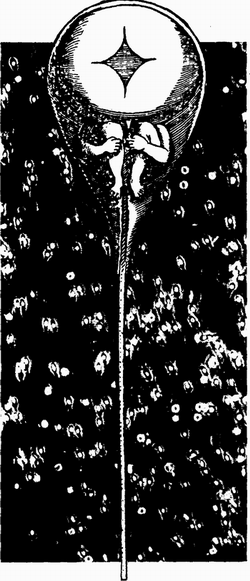
A HOMUNCULUS (“little man”)
When the spermists of the seventeenth and eighteenth
centuries examined sperm cells under their microscopes, they
believed that they saw a future human being in miniature.
Are we not injected into the cosmic scheme like sperms
thrown into the egg? We are mysteriously entered into a
condition of ceaseless transformability, as if to be born
and change and die were the summation of who we are, whereas
actually we fundamentally always already exist in a
Condition of perfect identification with that which is
Eternal, Absolute, Transcendental. This has always been the
essential Spiritual discovery.
If we examine the portion of our history that we can see
in the original appearance of the sperm and its destiny,
then we can see that the physical description of our early
history corresponds with the elaborate, philosophical
estimate of our true Condition that is found in spiritual
philosophy. On the one hand, spiritual philosophy points to
the separability of the essential being from the
transforming Matrix of Nature, the inherence of the being in
the Domain of the Purusha, or the absolute Divine Being. On
the other hand, we are told that the living being can, by
transforming its understanding or its relationship to the
pattern of changes, transform its destiny within the pattern
of changes. Both of these philosophical points of view
describe the same condition that seems to be represented by
the sperm, prior to conception and after conception.
What, then, is the actual identity of the sperm? You know
from your medical textbooks that in the male body a certain
number of cells eventually develop into sperms. But what is
the nature of a sperm, apart from its cellular, material
appearance? Why do photographs of sperm always show light
emanating from their heads? They all appear to have light in
their heads.
The body of the male is like the body of the female, in
that it too is a place where the original living entity is
received and goes through a process of transmutation. In the
fathers body the entity becomes the sperm itself. It already
has associated features. It is already a living creature. It
is born in the fathers body. But what is its identity prior
to the cellular transformation in the male body that makes
it a sperm?
If we look at a photograph of a sperm we intuitively
identify the sperm with an essential livingness,
concentrated most profoundly in the head as light. We intuit
the same livingness in every living being. There is this
fleshy stuff that goes through all its changes, and there is
its associated mind or creature consciousness, but
fundamentally there is simply this living being. The mystery
is not its capacity to be or to experience. Rather, the
mystery of the spermatic being is the fact of its existence
itself. How does that which is immutable, pure light enter
into the realm of mutability or change and take on forms and
experience a destiny? How does a tadpole become a human
being?
Well, it is a mysterious or, rather, a magical process.
But the mystery is the mere existence of the livingness of
the being, because as soon as it dies, all that beautiful
transformed stuff is just a pile of shit. It is all over.
The universe in itself and the changes of existence in
themselves are just a torment, something with which we
struggle constantly, a magical association that binds us to
processes of change. What is mysterious is the
Transcendental nature of existing.
DEVOTEE: Master, to trace the origin of the being, we
must follow it to the original cell that is governed by the
sperm of the father. And then, obviously, that sperm was
governed by the sperm of the fathers father, and so on.
MASTER DA FREE JOHN: Yes. Essentially there is only one
individual. All individuals are the same being except that
they associate apparently with different states of change.
Associated transformation differentiates us, but at the
level of our fundamental existence we inherently feel a
sense of identification with one another, not a sense of
differentiation.
The original entity that passes through the process of
transformation and is born as a human being is still present
as the individual when it is born. It associates with
transformations, a body, circumstances, changes, a
life-cycle, but the original being or entity constantly
exists. It refers to itself as “me” and “I.” It is simply
the conscious being associated with all the phenomenal
conditions of change, experience, and embodiment. The same
one that is the sperm is sitting here right now as each one
of us, aware as the self and conscious. It feels itself
mysteriously and magically associated with changes, it feels
the ability, the necessity, and the obligation to be
associated with change, while at the same time it is
constantly and tacitly aware of simply existing.
The traditions of spirituality are filled with literature
that calls the attention of the being to this immutable
dimension, the merely conscious dimension of itself prior to
all forms of change, and that calls for such a profound
immersion in that original identity that there is literal
transcendence of all of the phenomenal aspects of the being,
all of the associated phenomena of the magic of changes.
Thus, one becomes established simply in that fullness that
is the being. This is called Self-Realization—in my
language, the sixth stage of life. But even Self-Realization
must be transcended in God-Realization, or the seventh stage
of life, whereby the essential being and the realm of change
are both recognized to inhere in, and arise as modifications
of, the Radiant Transcendental Being.
SUGGESTED READINGS RELATED TO THE FIRST STAGE OF LIFE
At the end of each section we offer a list of books that
will give the reader a further understanding of the
characteristic point of view represented by that stage of
life.
These publications are selected from the
4000 titles which comprise The Seven Schools of God-Talk,
a bibliography compiled by Master Da Free John, eventually
to be published by The Dawn Horse Press.
In future issues we will present additional books related
to each stage in general and also to the specific topics
featured in the magazine.
Most of these books can be ordered from The Dawn Horse
Book Depot, P.O. Box 3680, Clearlake, CA 95422.
Gribbin, John, Genesis: The Origins of Man and the
Universe. New York: Delacorte Press, 1981.
Hatterer, Laurence J. The Pleasure Addicts: The Addictive
Process-Food, Sex, Drugs, Alcohol, Work and More. New York:
A. S. Barnes, 1980.
Sabbath, Dan and Hall, Mandel. End Product: The First
Taboo, New York: Urizen Books, 1977.
Shelldrake, Rupert. A New Science of Life. London: Blond
and Briggs, 1981.
Simpson, George Gaylord. The Meaning of Evolution: A
Study of Life and of Its Significance for Man. New Haven:
Yale University Press, 1976.
Ghandi, M. K. The Nature Guide. Bombay: Bharatiya Vidya
Bhavan, 1966.
Smith, David W., ed. The Biologic Ages of Man.
Philadelphia: W. B. Saunders, 1978.
The Seven Stages of Eternal Life – Laughing Man
Magazine
Table of Contents
See full study of The Seven Stages of Life