On The Teaching of J.
Krishnamurti People often equate the
Teaching relative to understanding with the ideas of J.
Krishnamurti but if you examine the work of Krishnamurti you
will see that he is a modern representative of the mind
dharma, the way of dissolving, by-passing, or transcending
thoughts and mental inclinations or impressions in order, as
a result, to enjoy such a state of sensitivity to the rising
world that it may be felt and known directly and even
unqualifiedly. He recommends no method for this attainment
other than attention to the mind itself to the point of
seeing that it is not identical to the realities it seems to
contain (in language, symbols, experiences) but is a process
of obstruction to real awareness of things. This teaching is certainly not identical to the Way of
Understanding, as must be clear to anyone who reads The Knee
of Listening, The Method of the Siddhas, and Garbage and the
Goddess. It’s only basic similarity to the Way of
Understanding is its denial of the value of motivated
techniques for attainment. However, it relies on a form of
attention that is methodical or deliberate and certainly
oriented toward ‘a specific goal’ (“choiceless awareness”).
It does not enforce a technique of attainment that meditates
upon that goal itself in order to acquire it, but pursues a
process of examination and insight, in the perfect event of
which the thinking mind is undone. The final stroke of that
process is the subjective realization that the perceiver
(limited self active as mind) and the perceived (the mind or
stream of perceptions and cognitions) are the same event. In
that realization, the process of mind is halted, at least
temporarily, and a state of openness, quiet, or choiceless
(non-mental, or non-reflexive) awareness appears. But this state of non-reflexive awareness or “meditation”
is not identical to Truth. It is only a functional state,
one of many conventional ways in which we may enjoy
conscious awareness in and of the world. The Way of
Understanding involves spontaneous insight into even this
strategy of self-observation and this meditative state which
we may call the goal of Krishnamurti’s path of conscious
awareness. One who understands does not depend upon any
experiential state, nor can his enjoyment be equated with
any functional condition. He knows that no process, high or
low, in any plane of manifestation, is Truth or leads to
Truth. Therefore, he releases both the quiet mind and the
obstructive mind from the burden of being either a way to
Truth or, in itself, the very antithesis of Truth.
Krishnamurti is speaking from the traditional point of view
of dilemma, search, and goal, even though he pursues his
path with a great deal less baggage than most. But he is
asking his listeners to settle for a meditative state, and
his way pursues a change of state as a specific exercise.
Truth is not a matter of the quiet mind, the empty mind, the
blissful mind, the transcendent mind, or even the Divine
Mind, Truth is of a radical and most prior nature, and our
initial entrance into the domain of Truth involves insight
into the entire process of the world and our own event. In
that case, no experiential state or condition or path or
attainment fascinates any longer. The possibility of release
no longer moves the man of understanding. No meditative
condition attracts him or seems hopeful to him. He has no
functional condition to recommend. He only confounds his
friends with paradoxes, until they no longer seek or depend
upon any experience, even any insight. For him, not only is
the mind not identical to what it denotes (the world in
fact), but nothing that arises is either obstructing Truth
(so that it must be eliminated) or leading to Truth (so that
it must be followed, maintained, meditated upon, or known).
The man of understanding does not recommend a meditative
state, but he abides in the radical Condition that is Truth,
which is prior to all states, and thus not separable from
any state. Sadhana Krishnamurti, however, is an exponent of the path of the
meditative mind. Apart from this we may also ask: What
sadhana does Krishnamurti recommend? What Siddhi does he
represent among friends? What, other than their thinking
minds, is exercised, transformed, or undone the process?
Does not such a communication attract the most mediocre and
sophomoric inclinations in men, who always seek and settle
for a little subjective calm rather than pass through the
fire of utter transformation, perfect sacrifice, absolute
knowledge, and the unspeakable dissolution of every
consolation, state, or attainment? It is all such adolescent
philosophizing? Krishnamurti is himself an essentially honorable and
serious man. He is attractive, even fascinating, by virtue
of a certain intellectual purity and a superiority founded
in a profound sense of separate, subjective, and personal
freedom. But what is he teaching? How does it compare to the
incomparably graceful communication of the Siddhas and even
the greatest of mystics, yogis, saints, and sages? Krishnamurti’s teaching work is related to certain of the
lesser dimensions of Buddhist meditative teaching. And
certain of his attitudes represent a self-purifying
sophistication relative to common cultural, religious, and
spiritual nonsense. As such, he serves a popular social and
philosophic role. But once you have stood up from your
silly, primitive way of thinking and seeking, you still
remain bound to an ignorant, sophisticated way of thinking
and seeking. In either case there is suffering only, and
bondage to what is hidden and actually controlling life and
consciousness. And one who is thus made an advocate of the
quiet mind is typically self-involved, bereft of the juice
of grace, incapable of yielding to God or Guru, insensitive
to the Presence of the Siddhas and essentially disgusted by
his fellow men. It would be better to be cooked alive than
to gain a little peace by method and trickery. And even if
there is a little quiet, real
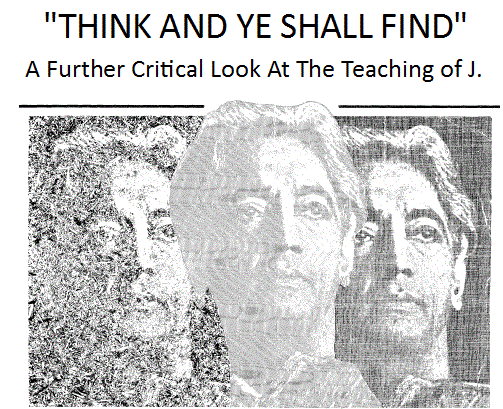
sadhana must begin at last. Bubba Free John, April 5, 1975 By Sandy Bonder and Tony Montano Krishnamurti tells people to think, and they start
believing immediately. – Bubba Free John The last issue of The Dawn Horse (No. 5) included a
short article by Bubba Free John, “On
the Teaching of ]. Krishnamurti.”
Essentially, this was Bubba’s brief and characteristically
exaggerated response to the often repeated suggestion that
what he teaches is the same thing Krishnamurti teaches. His
remarks there were probably not -entirely comprehensible to
someone who is either unfamiliar with Bubba’s own work or
personally attached to Krishnamurti s work. The article was
not fundamentally a criicism of Krishnamurti himself or the
content of some of his best statements, but rather of his
teaching as a whole and as a living event. It was
principally a criticism of how others tend to understand and
use Krishnamurti’s statements and considerations. In any case, the article prompted a flurry of
responses and reactions, some of them quite shrill and
vehement. Of the several letters we have received, we have
printed a single representative below, one which voices the
major arguments that have been brought forward. Following
that is our own response, with lengthy quotes from Bubba’s
recent talks and writings, which we hope will clarify
matters generally as well as address the specific objections
raised in the letter. We hope to show, among other things,
that Bubba’s apparently severe appraisal in the first
article was not an ill-conceived string of epithets, but a
humorous, strongly worded but nonetheless accurate picture
of J. Krishnamurti’s teaching work. Read more >>>
by Bubba Free John
The Dawn Horse Magazine, Nbr 5, 1975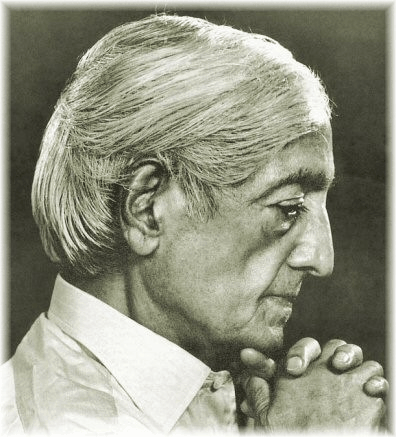
return to Dawn
Horse Magazine