|
THE
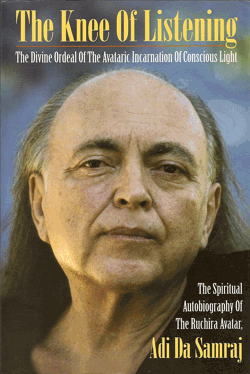
KNEE OF LISTENING

The Life and
Understanding
of
Franklin Jones
Copyright 1971 By Franklin Jones
All rights reserved
Beezone note:
in progress
Chapter 19: Understanding as
Meditation
Meditation doesn't do anything for
you. It has no purpose. When a person begins some form of
seeking, he immediately turns to an effective, remedial
technique that will get him quickly to his goal. Thus, when
a man adapts to various kinds of religious and spiritual
effort, he begins almost immediately to meditate in some
way. The Christian and the devotee begin to pray and adapt
to religious forms. The spiritual seeker begins to
concentrate and internalize the mind. Others use drugs,
study, critical thought, relaxation and poetry, pleasure,
etc.
But real life, the way of
understanding, is not another form of seeking. For the man
of understanding, meditation is not adopted for the sake of
something else. He does not pursue understanding or reality
or any kind of experience through meditation. Real
meditation is already a radical activity. It is
understanding.
In the logic of Narcissus, the
separative mentality, all things are seeking. But the man of
understanding perceives the logic of reality and lives as
it. Therefore, he is not concerned about meditation. His
business is understanding, not ascent, vision,
transformation, liberation, or any other goal. The way of
understanding belongs to those who recognize the
fruitlessness of seeking.
I do not recommend that you
meditate. There is only understanding. Therefore,
understand. And when understanding has become observation,
reflection, insight and radical cognition, then the state of
consciousness itself is meditation. When understanding has
become a radical process, and the avoidance of relationship
has become an inclusive and sufficient recognition, when you
have understood that seeking is all a function of dilemma,
and when you no longer are voluntarily motivated by the
physical, mental or spiritual problem, then you are already
meditating.
Meditation is simply understanding
as a radical process in consciousness. It is what
understanding is when it has become necessary and profound.
There is no right motive for adopting it. There is only the
discovery that you are already doing it.
Thus, when understanding has become
founded in you by observation of your life, and you have
truly realized the radical process of avoidance on every
level of your being, then you have ceased to approach life
without intelligence, simply reacting, becoming motivated,
and seeking various ends. Instead, you have begun to
approach all experience with a simplicity in consciousness,
a presence you bring to all things, which is
understanding.
When you have begun to approach
life with understanding, knowing the radical truth of
understanding, then you have begun to meditate. Then
understanding, the logic of reality, can be extended as
itself to conscious or real meditation.
Real meditation is not purposive.
It has no effect that it seeks to produce. It has no dilemma
to solve. It has already become understanding, and
understanding is conscious knowing. Understanding is in fact
the knowledge that is consciousness, non-separation,
reality. Therefore, it is the enjoyment of consciousness. To
understand is already to meditate, to contemplate
consciousness itself. And it does this not by an act of
concentration on consciousness, or any form or center of
consciousness, but by understanding experience, the action
of consciousness.
Where there is understanding in
life, what is actually being known is consciousness,
unqualified reality. Thus, the understanding of experience
by observation leads to the recognition of the avoidance of
relationship as a radical activity. And even where this
recognition arises it may also cease to be the fundamental
object or activity of conscious life. It will simply give
way to the fundamental perception prior to avoidance, which
is reality, unqualified relationship,
consciousness.
Thus, understanding first becomes
actual in the mind, and then it is extended as enquiry.
Enquiry is the approach of understanding to experience. And
enquiry is meditation. It is in the form: "Avoiding
relationship?"
As enquiry continues as the radical
activity of life, even enquiry becomes occasional. Even in
the beginning it is not repetitive, like a mantra. That
which is identified and enjoyed in consciousness through
enquiry does not need constant enquiry to reduce the
tendencies of the mind and life to prior understanding. That
reality which is the source and realization of enquiry
eventually becomes the ready object of the mind and life,
and one tends to return to it easily and
naturally.
Thus, when understanding becomes
radical knowledge, there is no constant enquiry, no special
meditation. Knowledge becomes consciousness itself, which is
unqualified, which is "no-seeking" in the heart and
"no-dilemma" in the mind.
This will be developed further as
the discussion on meditation proceeds. I would like to begin
by describing the various kinds of meditation I was led to
use in my spiritual practice in America and India. Then I
will go on to show how my practice developed and was
modified by understanding, until we have recognized the
perfect simplicity that is real meditation.
The first form of meditation I used
in my life was the "bright." It is also the ultimate one.
But the "bright" of m;. childhood was not fitted to
understanding. It was not supported by my own consciousness.
I enjoyed it, but I could not control it. And at last it
disappeared against my wishes Thus, I became devoted to a
path of existence that was supported by my earliest
intuition of reality, the "bright." I was required to pursue
the faculty of my own consciousness. I needed to understand
before I could finally create, sustain and control the
"bright," the Form of Reality.
The history of my experience as a
seeker is a course of experimentation in relation to the
forces of life conceived as the problem of existence on
various levels of experience. In college I dealt with truth
as an intellectual problem. In my period of writing and
self-exploitation I dealt with as a vital and emotional
problem. Rudi I dealt with it as a moral and psychic
problem. In Scientology I dealt with it as the problem of
the mind. With Baba I dealt with it as a spiritual problem,
the problem of super-consciousness. And when I experimented
with such things as diet, fasting and self-regulation I was
dealing with it as a physical problem.
Of course, these various researches
often overlapped and tended to become inclusive, but for the
most part each was a highly specialized, exclusive endeavor.
And each period was marked by a peculiar method. The area
pursued also determined the nature of the work. The object
created the subject, and the subject reinforced the object.
And in every case, the end phenomenon was the same. It was
understanding. I outlined that process at the end of Chapter
16. It was concentration and observation. Then insight. Then
enjoyment or freedom on the basis of that insight. Finally,
the recognition of understanding itself as primary and prior
to the search.
Until I had exhaustively
investigated every unique area of the "problem," there was
no conclusive understanding. Thus, each moment of primary
understanding, such as the crisis in college or the one in
seminary, was only a temporary state. It formed only a
moment of transition prior to the next chase, the next level
of the problem. But when every aspect of life as a problem
and a search was exhausted, there was only understanding. I
recognized the similarity between each moment of attainment.
And I began to notice in detail the aspects of the way of
understanding itself as a radical oath, prior to every kind
of seeking.
Recently there has been a tendency
among spiritual teachers to speak of a path of "synthesis."
Sri Aurobindo is one of the leading exponents of this
inclusive mentality. But it is also visible in lesser
teachers of yoga, as well as in the various synthetic paths
of modern Western occultism and religiously motivated
spirituality. Sri Ramakrishna, the great Indian teacher of
the 19th century, perhaps initiated this trend in the East.
And H.P. Blavatsky may be the sign of its origin in the
West, also in the late 19th century.
But the trend to "synthesis" is
only a synthesis of the kinds of seeking. It adapts the
various separate activities of the great search to an
inclusive philosophy and technique. But it remains a form of
seeking.
In my own case, there was never any
tendency to make a synthesis out of the various activities
of my seeking. Indeed, as I passed through each form of my
experiment, I only came to realize the fruitlessness of
seeking in that way. And at last I saw the entire
fruitlessness of seeking in any form. Thus, the way of
understanding, as it developed in my case, is not a
synthesis of the ways of seeking. It is a single, direct and
radical approach to life. And that approach is itself, from
the beginning, entirely free of dilemma and search. It has
nothing to do with the various motivations of the great
search. From the beginning, it rests in the primary
enjoyment and truth that all seeking pursues. Thus, the way
of understanding is founded in the radical truth that is
fundamental to existence at any moment, in any condition And
it is also the genuine basis for creative life, prior to all
the magical efforts toward healing, evolution and the
victorious appearance of "spiritual" life.
In this chapter I want to describe
the actual process involved in the way of understanding. And
in order to make the transition to that radical view and
activity, I want to describe some of the methods I acquired
at various stages.
The period of the "bright" in
childhood was only an enjoyment. It is preliminary to my
life of seeking, and there was no peculiar method involved
in it. At most there was a desire to communicate the
"bright" to others. At the time I attempted this on the
level of humor, love and the dissolution of conflict. But
the years of my childhood and adolescence only wore away at
my resources, and eventually I came to the matter of the
search itself.
Even in college there was no
special method. The impulse at the heart of my dilemma was
the source of my seeking. I simply read, thought and
suffered through the various alternations nations of
philosophy.
It was only when I began to write
that my seeking took on the form of a "method." I have
described that method of writing, and my habits of
self-exploitation in the early chapters of my
autobiography.
The period of my writing as a
method of search came to an end on the beach, when I saw the
possibilities of higher consciousness and turned toward
philosophical discipline. It was at that point that I began
to study with Rudi. And I have also described the methods I
adopted at that time.
My brief encounter with Baba during
my first trip to the Ashram did not produce a new method.
One was recommended to me, but I did not adapt to it until
after the period of Scientology. Scientology was in fact the
next level of method I used, and I have given some of the
details of that practice in the previous
chapters.
But after the period of Scientology
I began to make use of a habit of meditation that
foreshadowed the later approach of the way of understanding.
As a result of the crisis I endured in seminary I had
already begun to assume the critical attitude that later
became radical understanding. I had seen that the avoidance
of relationship was a radical activity at every level of
consciousness. And as I began to adapt myself seriously to
the processes of yoga I perceived more and more how
fundamental was this understanding. Thus, as I adapted to
the habits of meditation, I saw that all methods were
founded in this avoidance and only reinforced its effects.
As time passed, I ceased to make use of the methods of yoga
and only approached each moment in life or meditation with
understanding in the form of the enquiry: "Avoiding
relationship?"
I saw that every kind of seeking
and every method designed to liberate, purify and perfect
life, was founded in the mentality and adventure of
Narcissus. I saw that every yoga, every path, every kind of
deliberate meditation had a single symptom: the anxious
effort to dissolve the barriers and the capsule of self in
order to enjoy fulness, immunity, freedom, etc. This was
always Narcissus, for it is founded
in the original idea of
separateness, the loss of relationship, and thus it is a
meditation on self as separateness, experience as
separative, and a longing for reality as the Other, the
nature of truth as the whole Self, God, Reality, Nature,
Liberation, Salvation, etc.
I concluded, then, that it was not
in fact a matter of a path or a technique but of
understanding, the understanding of this underlying error in
the approach to life. I saw that where I persisted as this
understanding rather than in the various impulses to
liberation there was in fact no dilemma, no separation and
no necessary effort. There was simply the enjoyment of
reality prior to any identification with the whole process
of avoidance and seeking. And when understanding became my
radical approach to life there was a constant unfolding of
real knowledge in freedom and enjoyment.
Swami Muktananda wrote me a letter
in late April, 1968. It contains a program for meditation
which I used at various times in the following
year.
In the "So ham" mantra "So"
signifies God or Guru, and "ham" denotes "I" or "me." Thus
So'ham means "I am He." Let your practice of meditation be
the ceaseless reflection on the above meaning of So'ham. A
person gets transformed into the likeness of the object on
which he constantly ponders, by absorbing its
qualities.
Sitting calm and steady, repeat
the mantra together with rhythmic breathing (i.e. the
inhalation and exhalation of air - Aran and apan). Harmonize
the repetition of mantra with the breathing as follows: With
"So" take it in and with "ham" bring it out. Throughout the
mantra repetition one should follow this practice. Simply
sitting peacefully and applying the mind to pran and apan
one enters into a deep state of meditation. When one's mind
is fixed on "So" with the incoming breath and on "ham" with
the outgoing breath it is mantra-japa. The regularity with
which the breath comes in and goes out is pranayama. And if
a person is skillful, intelligent and alert - the repetition
of mantra (japa), the process of pranayama, and the
meditation - all three can be achieved simultaneously
without difficulty. This is a great Yoga, the best among
all: known as Siddhayoga. It means "the path of the Perfect
Ones" or "the Yoga which begets perfection." A dexterous and
highly intelligent person can practice it easily. As
explained above, the regular practice of meditation with a
concentrated mind will awaken the dormant Kundalini Shakti
in a very short time. Day-by-day as the Shakti develops more
and more it takes the aspirant to the ultimate perfection by
the Guru's grace.
It is best to practice a natural
meditation or dhyan. Sit quietly, calm and composed, if you
like in Padmasana or any other comfortable posture. You may
look and fix the eyes on a photo or may keep your eyes
closed. The mode and posture in which
you can be restful, mentally
free from the objective world, and introspective is the best
asan. Remove the mind from its activities, arrest all kinds
of desires and surrender to whatever is happening of its own
accord. Observe everything as a witness. The meditation done
by the inner Shakti is the meditation of Guru's grace. It is
the real meditation of "So'ham." Indeed, it is the
meditation of God.
The deeper and deeper you go in
meditation the more and more of the divine experiences you
will attain. Therefore, seek your inner Self. Therefrom you
will have the fulfilment you cherish.
This is a classical description of
the way of meditation. It is typical of all the methods of
yoga that operate directly on the mental, vital and physical
functions and concentrate consciousness in the regions of
super-conscious manifestation. When I received Baba's
letter, however, I was already involved in Scientology. I
only began to use this precise method when I resumed
meditation, just prior to my second trip to
India.
When I went to Baba the second time
I had already begun to use the form of enquiry that became
characteristic of my meditation. I experimented with the use
of the mantra "So'ham" and also the "Aum" mantra which he
recommends as an alternative in the same letter. But, as I
described in an earlier chapter, I experienced an internal
teaching of meditation while with Baba on this second trip.
Baba's internal and external teaching combined with my own
understanding of practice and I described my habit of
meditation in the following essay.
This is an intelligent method
that can be naturally applied by one who has a basic
understanding of his essential condition.
In the early morning or,
comfortably, in the early evening, sit in a stable position
in an undisturbed environment. Cease to act. Witness.
Acknowledge the dimension of relationship. Acknowledge
consciousness. Just as you are a witness to the environment,
you are witness to the flow of thoughts that is your basic
connection and response to the environment. It is not
necessary for you to stop them.
Close your eyes. Relax all
efforts to prevent thoughts. Examine all thoughts and
reactions. To understand the patterns of your chronic
responses and automaticities it is not necessary to think
about them, trace them back, or do anything with them at
all. Such is simply to join with and extend the automatic
process of thought, which leads to chronic activity. Do this
until you are aware that you are witnessing thought, the
mind, knowing that it is objective to you.
Then begin to recognize all
thoughts, feelings, reactions, desires, impulses, etc. as
the mind, the automatic machinery created by identification
with and avoidance of experience. As these things pass,
simply acknowledge mentally: this is the mind. Do this until
the acknowledgment becomes silent and there is no effort in
relation to thought at all. The body is relaxed, the mind
unperturbed. This is the state of understanding and natural,
effortless control. The mind at this point should basically
be silent. There is a leading tendency to enjoy this silence
rather than any thought. There is usually awareness of the
environment, but no effort to resist it or respond to
it.
At this point turn your
attention to the breath. Observe the inhalation and
exhalation of the breath until the breath is comfortable,
quiet and effortless. Now the mind at its deepest level is
in its natural, open, original state. You will probably have
observed here or earlier how thought and breath
correspond.
Now, in this silence and peace,
you are prepared for the enjoyment of consciousness itself,
prior to experience and thought, prior to relationship. You
begin this "ascent" when the breath and thought are
relatively still. At a point in the observation of the
breath you may begin to combine, mentally, the word "Aum" (a
basic sound, a vibration that is a pointer toward
consciousness, an implication of consciousness) with the
breath, once for each inhalation and once for each
exhalation. As you do this, enjoy, the vibration of energy.
Actually experience the inflow of energy and the outward
movement of energy. The return to primary consciousness is a
gradual reflexive action, turning back from or simply
stilling the externalization of consciousness as energy.
Thus, as you enjoy the flow of energy, watching the breath
and employing the Aum mantra (attending to it and not to
other thoughts) you should experience the energy always
charging or entering the domain of the body and not moving
out of it. Thus, on inhalation, experience the energy
(breath and vibration) moving down from the heart and lungs
into a base just behind the sex organs and then up the spine
to the top of the head. This is the natural circuit of the
nervous system. Then, on exhalation, let the energy move
down into the heart and fill it. Continue this until a
natural stillness prevails, where body, breath, mind and
energy currents are all harmonized into a blissful
ease.
At this point, without effort,
you should merely enjoy consciousness, and allow it to be
totally what it is. This is you prior to self-concepts and
life-processes. Put your attention at the top of the head,
at the point between the eyebrows, or in the heart. This is
all a natural process and you will simply find yourself at
this time moving to one of these centers, or some other
basic center, without mentally deciding. Simply attend to
consciousness there, being beyond thought or any process.
All processes should be relaxed around you. The breath and
heartbeat may even have stopped.
In this state simply enjoy
consciousness. Thoroughly move to it, even with love, or
without any emotion. Enjoy it, let it reveal itself.
Continue thus as long as you like or until your attention
moves again toward processes and experience. You may, in the
latter case, again return to the blissful state by attending
to the processes as you did earlier and so resume the calm
attention to consciousness. Indeed, at any point, should an
earlier phase of mental or breathing activity restore itself
you may handle it as you did earlier.
At some point in the meditation
on consciousness you may cease to be in relationship to
consciousness, attending to it, but instead merge with
consciousness itself. You may experience this entire
exercise going on automatically, or in quick succession. You
may find yourself in the natural state immediately. At any
time you may use any of these methods at will to handle any
eventuality, and you should feel free to move in the
exercise by any way communicated to you internally or which
you feel appropriate and true. You may experience the
automatic processes of Siddha yoga as described by Swami
Muktananda. Once you have moved into silence and sublimity
you are under the influence of consciousness itself. It will
teach you and transform you. There is nothing to be said
about it here.
When your meditation is
finished, then relax for a few moments and do not, if
possible, move suddenly into activity. Often you will
experience the life benefits of your meditation only after
the process is completed. So be open and calm for a period
beyond meditation. In life you will discover more energy and
blissfulness, love and detachment. You will adapt to it
differently each day on the basis of your
freedom.
Daily life is not this exercise
of meditation. After the exercise, feel under no constraint
to continue it all day and so become very self-conscious and
restrained. You may, however, maintain a similar
relationship to your responses and thoughts, doing nothing
about them, being open
and sensitive to experience. You
are always already free, already conscious. You are always
already in relationship, non-separate. Know this and your
life and meditation will remain free, simple, natural and
motivated by no anxiety, fear or compulsive need for
peculiar experiences.
At the time I wrote this essay I
preferred the use of the "Aum" mantra to "So'ham." I had
difficulty combining the Sanskrit syllables with their
meaning in my own language and at the same time generating
the whole mantra as a feeling or affirmation rather than a
thought. In the following months I meditated in this basic
way, and finally began to use the "So'ham" mantra without
difficulty.
But the import of this meditation
was not the search for any kind of experiences. The more I
had of experiences the less important they seemed. And
"experiences" came to include not only internal and
visionary phenomena but even the kinds of quieting and
control that are byproducts of the meditative attitude. I
began to see that what I gained and retained from meditation
was exactly that with which I began. Before, during, and
after meditation there was only "one who has a basic
understanding of his essential condition." Thus, I became
more and more attentive to this understanding itself, in and
out of meditation. And during formal meditation I began to
drop every kind of formal exercise and more often than not
simply enquired of myself under every condition that passed:
"Avoiding relationship?"
As the months passed, prior to my
third and final trip to India, I became more and more
absorbed in the simplicity of consciousness. And what I
realized and enjoyed as understanding and real meditation
seemed to me to be epitomized in the relationship to the
Guru. I saw there was no need for effort or salvation.
Understanding was equivalent to contemplating the Guru with
perfect devotion. This is called "Guru-bhakti" or
"Guru-bhava." And, as I prepared to leave for India, I
described my understanding as follows:
Guru bhakti is superior to all
methods of self knowledge. Put aside all dharma, all means,
and think only of Him. That itself is realization and the
highest path.
When still deceived and ignorant
of the truth, if I seek to recognize myself in the heart,
and enquire as to my nature, pursuing in every way to stand
out from my mind, I find myself drawn apart from things,
separated even from that recognition by my exclusive
search.
But if, even in that same
ignorance, I think of Shree Guru, or look upon him in the
company of devotees, I am drawn into the heart of all
reality, and by that easy, deepest heart I lose the body of
distinctions. While I loved Him thus I gained my Self and
never tried or sought.
Shree Guru, Gurudev is that One,
than which there is no other. Shree Guru, Gurudev is my
Self. So-ham.
The movement in truth is not to
identify with the three worlds (waking, dreaming and
sleeping). Nor is it to be engaged in witnessing them. Both
are exclusive activities. They destroy relationship and are
bound to the form of contradictions, the ignorance of prior
relationship and thus nonseparation. The movement in truth
is that enjoyment which remains when the falsity of all
these alternatives is understood. It is concentration in the
Self. One who is purified by search, discipline, penance and
knowledge recognizes the Self in the Guru. He becomes
absorbed in meditation on the Guru at the center of his
being, the heart, at the center of the lotus of the lower
tendencies in the ignorant heart. Seeing the Guru there
always, he meditates on the truth of "So'ham," and, by the
grace of the eternal Guru, all distinctions subside, all
perceptions of separation, contradiction and otherness
disappear. The personal, the universal and the transcendent
as an inference from these disappear in the one cognition of
the Real, the true Self of all. Such knowledge draws that
individual into the Self, and he is no longer separately
present in any of the worlds.
Every pursuit of union in the
three worlds is founded in identification with some form
therein. Thus, rather than act to achieve union, merely
witness the desire and the whole tendency, its thoughts,
etc. When this is done, another movement of consciousness is
realized. It is perceived as a movement in the heart,
founded in its new stillness. It moves to the secretly
recognized Beloved, the Guru, the Self. It knows it is
already related, and thus it does not see union, since union
is perceived only over against separation. It sees, rather,
non-separation and identification with that which absorbs
purified consciousness. It no longer looks back, but moves
into the total realization of knowledge.
When I arrived in India for the
third time I was given the task of editing and refining the
English translation of Baba's new book, Chit Shakti Vilhas.
I discovered that the method of meditation on the Guru to
which I had recently been moved was in fact the method of
his spiritual practice with his Guru, Bhagavan
Nityananda.
I described it as
follows:
Baba does not teach the pure
Vedanta that he taught and demonstrated to me in the Ashram
on my first visit. He directs us to bow to our highest Self,
to worship it and meditate upon it. He directs us to certain
visionary experiences such as the blue light, the blue
person within it and other such objects. To this end he
recommends we sit quietly, thinking of the Guru, depending
on his grace, repeating a mantra, a name of God. And, above
all, he affirms the life of service to the Guru. Thus, men
will be made open to the influence of his independent grace,
his Shakti, that will produce visionary attainments and
karmic Purifications. This will occur, he says, if we give
ourselves to the Guru, and not otherwise. If we merely give
him our karma, our suffering, our ignorance, he will reject
them, but if we give our very selves he will take our karma
also.
Baba's method of spiritual practice
was the action of becoming totally identified with his Guru,
whom he saw as the Divine Being and his very Self. He would
sit near his Guru or think of him and contemplate his name,
his physical form, his moods, contemplations, gestures, his
awareness, his words and acts, his qualities. He acted on
the principle that you imitate the thing you contemplate and
finally identify with it. The impulse that made this
possible was profound love and the sense of identity with
the Guru. This he felt was the highest form of meditation
recommended in the Scriptures.
His method was to meditate on the
Guru after he had installed the Guru in his being, in all
his parts, and identified with him. From the various
indications in his book, I described the following
principles of his method:
Becoming tranquil and overcoming
thought fluctuations, free the mind from external clinging.
Eradicate mentation. Sit down, feeling that the Guru is
confronting you. Make obeisance, realizing that the
Guru-Principle envelops you from each direction. See the
Guru and yourself as one. Then install him in your body, top
to bottom, and then bottom to top, chanting "Guru-Aum"
mentally. Meditating thus, the Guru in you and you in the
Guru, let go of the consciousness of self.
This seemed to me at the time to
epitomize my own natural method. Whether with Rudi, Baba or
at Nitvananda's shrine, I always concentrated on the Guru as
the source and identity of my own nature. I was always doing
this, even where I also performed other kinds of special
meditative exercise.
I was in the midst of this
meditation at the Ashram when I began to experience the
visitations, revelations and internal teachings of the
Virgin and Christ. Then I became totally absorbed in that
special kind of contemplation that overwhelmed me. However,
I could also see that the meditation of Guru-bhakti was
equivalent to the absorption in Christ that I was
experiencing. I allowed it to occur. I allowed the Virgin to
be the Shakti and Christ to be the Guru. Even Christ said
"You will understand that I am in my Father and you in me
and I in you." (John 14:20)
The results of that experience can
be read in my autobiography. By the time I returned to
America there was no movement in me toward Christ or Guru.
That whole exercise had revealed itself as a symbol, on a
psychic level, for the processes of real consciousness that
were my own nature. I no longer saw any necessity in any
kind of religious or spiritual meditation. The Guru and the
Christ that seemed to symbolize Reality and attract the
heart disappeared when Reality was realized to be the heart
itself. I no longer operated on the basis of any
distinctions. I simply understood, and understanding became
the free exercise of my own being.
In the weeks that followed I passed
into the radical form of understanding. But as that process
went on, I spent some time analyzing and studying the system
of phenomena and practice that I had experienced during the
"spiritual" period of my seeking. Out of this developed two
specific kinds of data. One was the description of the
instruments or the total mechanism of our living form, and
the other was a description of the automatic process of
"kriya yoga" which was the ultimate result of spiritual
meditation and the very form of meditation which all
particular kinds exercise imitate and pursue.
I described the first of these, the
instrument or form of life, on the basis of my various
experiences and the fuller, systematic presentation in the
writings of Swami Muktananda and others. On the basis of
these observations I wrote the following essay, which is a
summation of this data and a critical interpretation of the
alternative approaches to it.
The structure of the Form of
Life (Bodies)
(1) Gross -
(Physical)
and
(Etheric or
vital)
(2) Subtle - Astral (Desire and
Psychic)
(3) Causal - Mental and
Intellectual
(the Antahkarana)
(4) Supra-causal - Bliss, the
abode of
Siddhas or Powers
These are the variously shaped
and atomic seed bodies that proceed from the center of
reality in the heart and are contained in the unqualified
being of reality. One may visualize the atomic seed bodies
themselves. The physical and etheric (vital) bodies are a
red form, approximately the size of the physical body. The
subtle body is a white form about the size of the thumb, and
it appears in the throat. The causal body is about the size
of the thumb nail. It is black and appears in the area of
the heart chakra. The supra-causal is a spot of blue light
about the size of a lentil. It appears in the region of the
navel. However, in meditation they merely appear before
consciousness, neither above nor below.
The individual may also perceive
the regions of these bodies themselves and so experience the
various visions, powers and manifestations of the planes of
being.
As the process of the
purification of the bodies begins, which is the reconnection
and stabilization of the circuit of being, the individual
may experience many phenomena due to the expression of these
various bodies or regions. But he should from the beginning
be founded in the heart of being, of reality, of
understanding, of no-seeking. Thus, he will not become
distracted by these activities but only abide deeply in the
heart of reality and continue the process of purifying and
establishing the form of reality.
He may experience none of these
visionary phenomena at all. Neither any physical "kriyas,"
internal sounds or smells or any other peculiar phenomena.
He may from the beginning and always reside only as the
heart of being, of no-seeking. His experience may only
increase as no-seeking, silence, openness, purity,
wholeness, fulness, energy and bliss. This indeed is the
highest form of the process and it is gracefully without
distractions.
p.428 (Graphic
scanned)

p. 429
(1) is the Muladhara chakra or
anal plexus.
(2) is the Swadhisthana chakra,
the sacral plexus or root of the sex organs.
(3) is the Manipooraka chakra,
the solar plexus or navel center.
(4) is the Anahata chakra, the
heart plexus.
(5) is the Visuddha chakra, the
throat plexus.
(6) is the Ajna chakra, the
center in the midst of the head, between the brows, the
center of the antahkarana or mind.
(7) is the Sahasrara chakra in
the midst of the upper brain, the aperture of the head, and
the regions above the head.
Each of these centers has levels
corresponding to the various bodies, sheaths, regions or
seed atoms. Thus, the process perceives itself in the
physical body, the nervous system and energy body (etheric
or vital), the subtle body (desire or astral body, which is
spherical), the causal or mental bodies (centered in the
parts of the antahkarana and the center in the middle of the
head, which is the clearing house and center of
consciousness in the causal body - it communicates to the
brain the various phenomena from the super-conscious or
supra-causal realm and the subconscious and unconscious or
subtle (astral, etheric and physical realms), and at last
the supra-causal body (the "blue pearl" or "blue person,"
the subtle Guru, who is one's identity as a
Siddha).
Experiences from any of these
bodies or regions may occur to the particular individual
according to his tendencies, karma or desires. But common to
all and the ultimate source, truth and reality of all is the
center of being, the heart itself, which is the beginning
and end of all life.
Therefore, I recommend the way
of understanding as the way of reality. It is the prime
truth presently available and it does not lead one further
into ignorance or distraction but always
to reality itself, beyond all
fear and all seeking. Every other path takes its stand in
some particular body, region or experience and pursues some
other body, region or experience as if it were reality,
truth, or the direction of real evolution. In fact, until
one is firmly seated in reality rather than in any body,
region or experience one is only a seeker who chronically
identifies himself with what is not yet real or what is
known apart from reality. Not that any of these bodies,
regions or experiences are themselves unreal, but the
individual interprets his position in ignorance, after the
model of exclusion or separation. The process of his
development is founded in the model of seeking, and it only
reinforces the pattern of avoidance and the internal
impression of separation or unreality. Therefore, he is
bound continually to the search, his false goals, and his
tragic adventure in all the various bodies, regions or
experiences.
The average man perceives this
drama essentially on the level of the physical body and the
region of the physical world. Thus, the average seeker may
suppose that the various phenomena of occult, spiritualistic
and psychic experience, or even the greater impressions of
the higher mind and supra-causal or super-conscious
phenomena which are the typical stronghold of higher
religions and higher spirituality, are in fact evidence of a
higher life equal to truth and reality itself. Traditional
religion and spirituality thus only exploit the
vulnerability and limited experience of the average and even
the uncommon seeker.
In fact, truth and reality are
of supreme value, and they are a matter of radical
understanding, not any excursion into the various bodies,
realms or experiences of the form of life on any plane. For
this reason, the greatest men of knowledge continually turn
men away from the lust for phenomena and powers. They
recommend only the radical perception of reality which is
the key knowledge in the present that removes all suffering
and all seeking.
Once the nature of the form of
life is seen as I have described, it becomes unnecessary to
follow any traditional path or extend one's seeking. Such
things are obviously pointless and fruitless, however
dramatic they appear. The primary truth is only the end of
seeking and suffering as an internal event in consciousness.
It is right knowledge of reality, the Self-knowledge that is
always and already unqualifiedly free and inclusive of all
things in the form of reality. It is the knowledge of
unqualified relationship and no-seeking alone which can
provide the basis for any real development of life in any
form. The form of our experience is not the point. It is not
a matter of exploiting and extending experience but of
realizing radical understanding.
The true path, then, is not the
path of the Siddhas or of yoga in any form, not of
occultism, white magic, religions or spirituality. It is
simply the radical way of understanding. Therefore, get
understanding, and then, if it appears good to you, engage
in the creative work of purifying, perfecting and evolving
the various bodies, realms, abilities and experiences that
proceed as the form of reality.
For most people the way of
understanding will evolve as silence and no-seeking without
peculiar phenomena expressed in the subtler bodies or
regions. And they will realize themselves in life on the
level of the "bright" which is consciousness in fulness
seated in the midst of the head, projected out of the heart
of reality. They will abide there in the waking state,
feeling themselves extended from and linked to the
consciousness of no-seeking in the heart. They will feel
full and bright, clear and resourceful. They will perceive
the activities of consciousness and form communicated from
the subconscious and unconscious regions and the
super-conscious, but they will not necessarily perceive the
forms or internal phenomena of those bodies or regions
themselves. They will simply feel the fulness of freedom and
clarity, the intuitive stillness and capability that result
from the foundation in reality. The realms of super
consciousness, subconsciousness and unconsciousness will
simply proceed, outside particular awareness, within the
self-enclosure of their own natural laws.
Such individuals will abide in
freedom and internal joy. They will do creative,
communicative work in the world, the human work of love and
understanding, pleasure and unburdened sacrifice that is
merely the natural and effortless meaning of all ordinary
activity rather than any kind of self-conscious effacement,
mortification or degradation.
Thus, true life is to be founded
in reality, and its appearance and consciousness, while
enjoying the freedom of non-separation from every depth of
being, exists directly and wholly as simple and creative
human existence. The phenomena of other bodies and realms
will be of no peculiar interest to such people. Such things
will not be the signs of higher life or liberation to them
nor the distracting goals of some particular, ideal plan of
self-conscious evolution. If the individual happens to
become consciously aware on such levels appropriate to
another dimension he will simply observe them in reality and
live by the wisdom I have described. He will seek the
development of no powers but abide only in reality If his
life involves the peculiar consciousness of other bodies and
dimensions he will by these means acquire the necessary
wisdom to deal with them and remain creatively in
reality.
After the death of the physical
form he may pass into the continuous perception and function
of the subtler worlds and there learn to function as is
natural to him. But while in the physical world as even then
in any other world his task lies in reality and not in
experience. Then as now he must realize reality and the form
of reality.
In any case, we must function
creatively and apart from all seeking in the dimensions
apparent to us. There is no necessary cause for motivation
to any body, realm or experience at all, whether the present
one or any subtler one. Therefore, the man who abides in
reality simply functions with understanding in the native
environment of his apparent birth. Anything else is
exclusive motivation bound up in seeking. Anything else is a
source of distraction that leads only into suffering,
avoidance, separation, despair, madness and death.
Therefore, only understand.
In the previous essay I was
interested in estimating the nature and importance of
various "spiritual" phenomena in relation to the life of
understanding. In the essay which follows I was interested
in estimating the nature and importance of the process that
I had come to observe taking place in yogic
meditation.
The experience of meditation that I
had learned by observation, verbal communication, and
internal perception from Swami Muktananda is essentially an
automatic process wherein a rhythm of breathing becomes
automatic, the mind becomes still and one-pointed, and the
various vehicles or levels of being become purified and
stabilized in the "Self." All the phenomena of physical
movements, mental activities, internal perceptions and the
like are simply the evidence of this purification on various
levels. For the sake of the goals of this process the
individual need only surrender to the Guru, depend on his
grace, relax and engage in the recitation of his mantra.
This entire process is natural, effortless and automatic.
And Baba said that it was "kriya" yoga, the yoga of
purifying activity. It is the same yoga taught by
Paranahansa Yogananda, except that it does not rely on an
intentional, sophisticated exercise on the part of the
aspirant. It depends entirely on the grace of the Guru, the
activities of the Shakti.
However, once I had observed this
process completely and seen its effects, and when I had seen
its ultimate source in the heart of understanding, I saw
that it could also be used consciously as a means of
purification and gaining control over the vehicles of life.
I considered that there need not be any mystery about this
process, and that it could be readily adapted by one who had
realized his freedom in understanding and enquiry. I had not
yet become firmly resolved in the process of understanding
and enquiry as a radical and sufficient means. Thus, in the
following essay, I tried to find some sense and utility in
the ultimate process of yoga.
When consciousness has been
established as "no-seeking" then it abides as reality, the
unqualified source and form of being. Then reality is
living. And only living reality is already free and capable
of the true realization of life, whose form is
sacrifice.
Meditation then can also be used
as an active purification of the vehicles of living being.
When it has enjoyed understanding and the form of enquiry to
the point of "no-seeking," the establishment of motiveless
presence in the heart, then it can, from the point of view
of that reality and not any kind of seeking, begin an
intentional process of purification or
"kriya."
I used various forms of this
process early in my life of seeking. But this process is not
appropriate to the life of seeking, where reality or one's
ultimate nature or the Divine Presence are still pursued. It
is only appropriate and nondelusory when reality has become
the foundation of existence, the motive of experience and
meditation, the primary knowledge that already informs the
mind.
When one already already
understands oneself in reality, as reality, as no-seeking,
then one can, if he chooses, make use of the means of
purification. Many such techniques have been developed over
the centuries. Even the simplest religious attitude is
purifying in a real sense and ultimately makes use of the
mechanisms that are the foundation or circuit of the form of
our living being. But these means, represented by every kind
of religious and spiritual philosophy, endeavor, technique
or attitude in history, East and West, suffer from two
essential faults. The first of these is one to which most of
my life and most of this book have been dedicated to
understanding. That is, these means are always given and
adapted to states of seeking. They are offered to seekers,
people in one or another form of the great search, as a
means of acquiring the knowledge of reality. Thus they are
adapted in ignorance and only extend the terrible suffering
and conflict which are the root of ordinary life and
consciousness. Thus, I have tried to demonstrate that
understanding is the primary law of life. And
life-consciousness must be radically founded in
understanding, in reality, in no-seeking before it can begin
the useful and radical purification of the forms of
life.
The second primary fault in the
traditional communication of the means of purification is
that they are chronically identified with some particular
historical, cultural or personal experience. All of the
various religions and spiritual regimes, from the
theological and ritual experience of forgiveness and
justification to the sophisticated methods of occultism and
the various yogas, are separate, historical manifestations
founded in various kinds of exclusive phenomena. They stand
in relation to one another in a grand pattern of conflict
and separateness. Thus, the seeker comes to one or another
of these sources in ignorance and pursues the separate cycle
of experience the particular form asserts and
guarantees.
But all of these historical
means have a common basis, which is the structure of our
living being. If a man is founded in reality and acts as
reality in relation to its very form, he will not be devoted
to any separate path or method. He will only make use of his
purifying intention in terms of the structure of living
consciousness. Thus, ha does not need any of the typical
exclusive paths that attract the seeker. He will only adapt
the means that are already indicated by his conscious
form.
To such an individual there is
available an intelligent, direct, even scientific process of
purification and perfection. This process can be read in all
of the fragmentary suggestions of the various paths, but it
is clearly and perfectly rendered in the actual experience
of our form, the form of reality.
I have directly experienced this
form or structure and its useful process. Therefore I will
try to represent it as it is, without recourse to its
exclusive communication in the various historical
paths.
Reality is abiding as no-seeking
or unqualified relationship. It is radically related to its
own form, the living structure of being or life. The form of
reality is reality itself. Its parts are attached by the law
of synchronicity, of identity. From the point of view of
reality, the form of reality or life does not proceed as an
effect from a cause, but both are coexistent in a
simultaneous manner. Thus, reality as no-seeking in the
heart is also manifest as the living person, the chakra body
in all of its dimensions or vehicles, including the
physical, etheric, astral, mental, causal and supra-causal.
But the structure of this form, the law of sacrifice, is a
simplicity. It need not be approached from any particular
level or vehicle, nor is any vehicle, chakra or state its
goal. The process is begun and ended and is always
proceeding from reality itself, from radical understanding,
from no-seeking, the motiveless silence of the
heart.
This "heart" is not the heart
chakra, the ascending position of the dualistic seeker, the
motivated devotee. It is the heart of being, the stillpoint
and knowledge that is primary understanding.
From that unqualified point of
consciousness all of the functions and levels of the form of
being proceed or seem to stand in a circle around the heart.
Thus, in order to purify these vehicles and centers and
establish the whole life in its prime energy and fulness a
process must be undertaken from the heart of reality and
moved through the circle or cycle of the
vehicles.
The purifying process, then, is
as follows. As the person sits in meditation, relaxed,
enjoying the primary understanding of no-seeking in the
heart, he should inhale the breath to the heart or at the
heart. The heart should be the place of the act of
breathing. As the breath is inhaled he should feel that all
energy in the universe, as it is epitomized in his own form,
is being drawn into the heart.
As the breath is conceived in
the heart, he should inhale with the back of the throat, at
a point just behind the palate or the roof of the mouth.
This instead of breathing in the nose or mouth. As he does
so he will tend to constrict the throat lightly, and a
raspy, drawing sound will vibrate in the throat and head.
This tends to stimulate the throat, which is a root of
Shakti, concentrate energy there rather than in the head,
and make the energy available to be drawn into the
heart.
The individual in meditation,
then, should inhale from the heart and mentally or silently,
preserving only the internal sense, pronounce the syllable
"So" (That, Reality). As he does this he should feel the
breath and energy draw down from the heart into the lower
body. As he does so he should slightly contract or draw in
the vital points at the throat or entrance of the breath,
the solar plexus or navel, and at the anus. This emphasizes
the internal circuit of energy and preserves its line of
force. It prevents the energy from being concentrated or
expelled from one of the lower chakras or outlets but
instead directs the energy along the internal
circuit.
Thus, as he inhales and chants
"So" he should mentally follow the line of energy from the
heart, down through the lower body, along a curve from heart
to navel to sex center to anus and up the spine toward the
aperture at the top of the head. As he perceives this line
of force directed toward the highest focal point in the
upper brain, the top of the head, he will feel a force or
pressure in the lower body, particularly in the area of the
navel. The contractions I described will create this
pressure of the breath and give a sense of retention. When
the energy is thus directed above, the breath contracted,
the mantra in its full sense held in consciousness, the
person should hold that breath and concentration above as
long as is comfortable.
Thus, all of the energy will
have moved directly along the natural circuit or form,
purifying each center by passing through, and restoring all
the connections so that the circuit of energy and
consciousness is returned to its focal point above. The
person should hold this form, sense and concentration above,
allowing the circuit to remain in that state. He should
concentrate in the point at the top of the head, the point
of infinite light, bliss and energy. He has in fact and
effect returned all the proceeding energy to its highest
source in extended consciousness.
When the impulse to exhale has
returned, the individual should begin the exhalation with
the remaining part of the mantra "Ham" (I am). As he does
so, he should feel the energy draw down in its perfect,
blissful, full force of light, grace, and truth from the
aperture at the top of the head, through the brain and all
of its organs, including the midpoint in the center of the
head and the area between the brows at the root of the nose,
through the focal point in the throat, passing again into
the heart of reality. As the exhalation, the mantra and its
sense, and the thought of energy pass again into the heart,
the individual should relax and abide in reality, the
no-seeking of the heart of reality. The whole body should
relax, the contractions cease, and the exhaled breath be
held out comfortably. Consciousness should rest as
no-seeking and enjoy the fulness of its brilliant presence
and peace.
When the impulse to inhale
returns again the same cycle of breath, contraction, mantra
and thought, concentration and witness of the passage and
circuit of energy should begin.
This process should be engaged
whenever the individual and his meditation have radically
assumed the form of understanding, of no-seeking in the
heart. The result will be a purification and expansion of
energy and light in all of the form of living
being.
Whatever experiences arise
should simply be acknowledged and the process continued as I
describe. When the impulse to remain as understanding, as
no-seeking in the heart arises, the individual should abide
in that state. When the impulse to purify and establish the
circuit of being arises, he should engage the process I
describe. When he is merely unsettled, the mental and
physical tendencies activated, he should engage in the
enquiry which is understanding ("Avoiding relationship?)
until he again abides as no-seeking.
In general I recommend that
people simply engage the primary activity of understanding.
It requires no special technique apart from the simplicity I
describe, and it is clear to me that this primary activity
of understanding and enquiry must be the substance of most
individual attention in the form of reality. Apart from
understanding and the primary knowledge of reality, it is
only the motives of seeking that would draw people to begin
the work of purification and perfection I have outlined in
this brief essay. If you feel certain that this latter
process has already become active and necessary in your
case, then experiment with it as I have described. But in
general, the activity of simple understanding and enquiry is
the single necessity in every case, and its effects are an
absolute sublimity, a perfect utility that also provides
secondary benefits of purification toward perfection and
harmony.
I have only included this
mention of the creative process of purification and
perfection because so many will wonder what are the purposes
of the various indications of the internal mechanisms that I
have experienced in the course of seeking. And they will
wonder how the knowledge of reality is to be applied to the
creative life process. After all, I have said that radical
understanding is not a separate knowledge, a kind of
self-realization apart from life. Thus, I have tried to
demonstrate how this radical knowledge gets consciously
extended into the form of life on every
level.
But the individual should
remember that this latter process of purification is not a
tool for seekers. It is not to be applied by the seeker, the
one who is not founded in radical understanding, in the
perfect knowledge of reality. It is to be applied to the
body of sacrifice, the lawful extension of reality, and not
to the body of ignorance or separation, the confused and
contradictory dilemma that appears to one who is not founded
in radical knowledge.
After I had written the above essay
and passed into the final stages of understanding, I began
to feel there was no utility of any kind in the exercise of
yoga. No matter how I expressed it, the activities of yoga
could not be separated from the mentality of seeking and
separation.
Indeed, the purpose of kriya yoga
from the point of view of its exponents such as Yogananda,
was to arouse the Kundalini Shakti and then go on by its aid
to realize the Self. But I saw this kriya yoga go on in me
automatically, after the Shakti had been aroused by the
Guru. The true kriya yoga was the activity of the Shakti
itself, not a means to its arousal.
Those who recommended it as a
practice were only adapting the data of this automatic
process to a deliberate process of seeking.
Thus, with the Shakti already
aroused, I had gone directly about the work of realizing the
Self through aspiration, identification, mantra and enquiry.
I saw that if the process were performed by one who sought
to arouse the Kundalini Shakti, he could only act apart from
understanding. Thus, in the process given by Yogananda, the
yogi draws the energy to the sahasrar and the point between
the brows, holds it, and then lets it subside again and
return below. From the beginning, his concentration is in
the various centers and in himself as a yet unrealized
being. He seeks his true Self.
Even where the process was
initiated by the Shakti the impulse was also centered at
various times in any one of the primary centers of energy.
It also pursued the Self, although with a more enlightened
effort.
However, I was involved in this
process from the point of view of prior understanding. Thus,
when I described it, I saw it as a process already impelled
by the Self or Reality in the heart. But the more I
continued to indulge the yogic process the more I realized
that it only and continually drew me into the forms of
seeking, either for the Shakti, the Self, or understanding.
Thus, at. last I saw that understanding was itself the only
radical process, and: enquiry was its activity. Then I
abandoned the meditation on the chakras and the entire yogic
process for enquiry. And enquiry was always epitomized as
contemplation in the heart and the meditation of bliss in
the Amrita Nadi.
I saw that there was only a simple
activity and concept manifesting under the form of every
kind of remedial activity. It was always Narcissus, the
logic and activity of separation. I examined all of this
yoga, all of this seeking and performing,
and all of its results, and I asked
myself: Why? Why should such activities be engaged at all?
What are the motives for meditating? And the more radical my
understanding became, the more absurd, unnecessary and
impossible it became to justify any of these
exploits.
All ways showed themselves to be
founded in some problem, some aspect of life as dilemma.
There was the physical problem, the vital problem, the
problem of the mind, the problem of spirituality and
super-consciousness. There was the problem of morality,
love, communication, sex, the problem of sin, suffering, the
problem of powers, reality, truth, and the universe itself.
Even the way of Ramana Maharshi was concerned with the
problem of identity. But I saw that the problem, in and
form, always had the same structure, and the same
fundamental assumptions. Thus, I became concerned with
motivation, the principle of these various kinds of action,
belief, knowledge, etc. I saw that, since all ways were
founded in a problem, real life must be founded in the
understanding of the primary problem that is the source of
all ordinary activity. only thus do we know and enjoy
reality, even in spite of moment to moment problem
creation.
I saw that understanding was itself
motiveless. But everything else was in fact the avoidance of
relationship, and this was their very motivation: Thus, the
longer a man lives, the more complicated, contradictory and
suffering life appears.
I saw that understanding was not
some unusual, miraculous condition or perception. It is the
simplest activity, utilized by everyone in his daily
experience. It was only that men abandoned understanding in
order to exploit the kinds of seeking. But when attention is
drawn to understanding, the whole movement of seeking comes
to an end. The man only understands where he would otherwise
seek. Understanding was simply a matter of observing oneself
in relationship, in action, in life. And if a man could be
drawn to understanding and always firmly returned to it, he
would begin only to understand. Understanding would replace
ordinary habit of seeking and his consciousness and activity
would become simplified, free of prior dilemma. And this
very state, when it became the radical premise of anyone's
existence, was not in any different from the primary
realization of yoga or meditation. It was the same knowledge
and capacity of fundamental reality, but radically free of
any limitation to certain kinds of action, mentality or
experience.
I saw that men could easily be
turned to self-observation. And the process of observation
could easily be maintained by proper guidance or "hearing."
And that process of observing gradually saw the emergence of
fundamental insight. Men could understand the radical nature
of seeking, the adventure of Narcissus, the whole complex
life of the avoidance of relationship. And when
understanding arose men could easily apply understanding to
moment to moment experience. Then understanding became the
approach to life rather than all the automatic, confused
activities of seeking, the drama of
Narcissus. In that case,
understanding became enquiry in the form of understanding
itself: "Avoiding relationship?" And the abiding in
relationship with the use of enquiry became the fundamental
activity of conscious life moment to moment or in special
periods of enquiry which might be called
"meditation."
Such a way might automatically
produce the unusual phenomena of "kriya yoga" or the whole
expanse of intuitive knowledge. Or it might simply realize
the natural existence of no-seeking, no-dilemma, primary
creativity and freedom. I have described these results as
follows:
But the truth of real life is
simply what is when there is a removal of contradictions,
no-dilemma, no-search. It cannot be described, nor is any
name appropriate for it. There is no motive to name it. It
is not an object, not a supreme and other subject. It is not
separate from the one who understands, nor can he separate
himself from it. It is simply no-problem, no-search,
unqualified reality without implications. It is also the
form of reality, which is the most subtle structure of the
world and everything, even the form of consciousness. All of
this is obvious to one who understands and continually
enquires.
Thus, as I became firmly grounded
in understanding as a radical approach to life, making no
use of any other exercise or remedial method, I saw that it
corresponded exactly to the ultimate truth and reality I had
enjoyed at times in the past. And it was exactly the way
indicated by the highest, most subtle forms of conscious
perceptions that were recently realized in me. Thus, I set
about to describe the way of understanding as meditation as
I had known and done it all my life.
The final portion of this chapter
on understanding as meditation is a collection of essays,
recently written, which seek to describe in detail the
process and the virtues of this real meditation.
Understanding arises when there are
true listening to my word and true self-observation in
relationship. Therefore observe yourself in life. Observe
yourself when you seek. Observe yourself when you suffer to
any degree. Observe your motives. Observe the activity of
identification. Observe the activity of differentiation.
Observe the activity of desire. Observe the patterns of your
existence.
When you see that you are always
seeking, understanding is emerging. When you see the pattern
of Narcissus as all your motives, all your acts, all your
seeking, understanding is emerging. When you see you are
always suffering, understanding is emerging. [when you
see that every moment is a process in dilemma, understanding
is emerging. When you see that every moment is a process of
identification, differentiation and desire, understanding is
emerging. When you see that every moment, when you are at
your best as well as when you are at your worst, you are
only avoiding relationship, then you understand. When you
see that which already is, apart from the avoidance of
relationship, which already absorbs consciousness prior to
the whole dilemma, motivation and activity of avoidance,
then you have finally understood.
When you have understood,
understanding will become the natural response of your
intelligence to any experience, the total content of any
moment. Then approach every moment with understanding and
perceive the original truth within it. Devote some time in
the morning and evening to conscious understanding. Sit
down, turn to understanding, and enquire of yourself as
thoughts, feelings, and movements arise within to distract
you. Enquire in the form of understanding: "Avoiding
relationship?"
Do this for a half hour or an hour
in the morning and evening, when you rise from sleep or just
before retiring. Do it also briefly at any moment in the day
when strong distractions absorb you. Devote yourself to
understanding in the midst of all experience, instead of any
kind of remedial action that arises as a way to handle the
problem of life at any moment.
Make understanding and enquiry your
radical approach to life. Become more and more absorbed in
understanding and the cognition of present freedom.
Understand and enquire until these things become realized
permanently as your form. Enjoy and create according to the
wisdom of your own form.
Until understanding becomes a
radical activity it simply involves the observation of
experience as it appears as levels of being, bodies, realms
and experiences. Then it is not meditation, and the
individual need not meditate but only observe and
understand. But when understanding is fulfilled in the
conscious, inclusive and transforming cognition of
experience and seeking, then meditation will become a real
impulse.
At this point the individual should
begin to enquire, and this is his meditation, whether or not
he does it as a formal exercise. When he has the impulse to
do it formally or intensively, he should do it as I have
described.
When meditation has become radical
consciousness, then abide in that consciousness which is
no-seeking in the heart. And when you act, remain in this
natural meditation, or enquire, as you feel
inclined.
Thus, continually remain in
consciousness and the activity of consciousness, and enjoy
the endless cognition of reality and truth, and all the
wisdom that arises in relationship. There is no end to that
attainment, no goal and no dilemma, but only perpetual
understanding of the arising world, moment to moment,
through the event of every death.
The first work of understanding is
the observation of the avoidance of relationship as the
source of seeking and thus of suffering. The later work is
the application of this conscious awareness to moment to
moment existence, and thus the observation of the absolute,
radical nature of this avoidance as the essential process of
every moment of existence. When this understanding itself
becomes radical knowledge all seeking and suffering, all
avoidance of relationship dissolves from the field of
conscious existence. Then there is only reality, conscious
and unqualified presence.
The world is seeking, nothing more.
And all seeking is suffering and separation as continuous
creations. They are created by the perpetual activities of
identification, differentiation and desire. These are the
mechanism of the avoidance of relationship. And these three
are continuously performed in the various levels of being,
corresponding to what are called the "chakras" or the
circuit of creative centers, and the various bodies, realms
and experiences. The consciousness of the seeker is a
constantly changing perception of dilemma. And in all that
he does he is always only avoiding relationship.
Understanding is the recognition of
seeking as the active principle of our lives. It recognizes
the effects of seeking, its qualities and sources, the areas
of its operation, and the methods of its functioning. It
sees that seeking is the substance and the entire meaning of
every moment of our lives.
But understanding, since it is
radically aware of seeking, is not seeking. Understanding is
prior to and apart from every kind of seeking and the whole
drama of ordinary life. Therefore, it not only sees all life
as seeking, but enjoys itself as a fundamental reality prior
to all seeking. It perceives no-seeking, non-avoidance,
non-separation, unqualified relationship, and unqualified
consciousness.
The enquiry ("Avoiding
relationship?") is the form of understanding. When
understanding has in fact developed as an insight as a
result of hearing the truth and observing life, then it is
brought to life directly in the form of enquiry. The man who
enquires is no longer seeking but continuously understanding
seeking. Seeking is no longer the form of his action or his
consciousness. Understanding has become the form and action
of his consciousness.
As understanding and enquiry
continue the forms of seeking and the whole enterprise of
separative life pass before the one who enquires. And
continually the sources of that action and the consciousness
that identifies with them are brought to the condition of
understanding. Eventually the man of understanding becomes
less and less absorbed in the forms of seeking, and
understanding and enquiry lead constantly to the reality
that is their foundation. Attention gradually ceases to be
involved in the seeking and the understanding of seeking and
rests in that which understanding itself is and to which
enquiry constantly leads attention.
Finally, there is no-seeking, no
enquiry, no understanding of seeking. There is no dilemma,
no suffering, no separation. There is no identification, no
differentiation and no desire. There are no levels of being,
no bodies, realms or experiences. These are no longer simply
perceived apart. They are themselves lived or known as
reality and consciousness.
There is only that which
understanding itself is, prior to seeking or the recognition
of seeking. There is not the consciousness of subject,
witness or experiencer. There is not the consciousness of
objects, forms or experiences. There is only reality, which
is unqualified and present. It is consciousness itself prior
to any communication of itself to itself through any form.
It is unqualified relationship and no-seeking, the form of
reality. It abides as fulness and the heart of reality. It
appears to the right of the heart in the chest and is not
touched, modified or included. I is what is when there is
perfect understanding. It is that which understanding knows
and enjoys from the beginning.
The way of understanding generally
begins in the mind, the processes of observation. Then it
deepens and becomes inclusive insight. Thereafter it moves
as enquiry: "Avoiding relationship?"
As the enquiry continues over time
the mind and life continually tend and move into various
levels of being, various experiences, even various bodies
and realms. The enquiry constantly dissolves the separative
consciousness and allows it to remain as the unqualified,
inclusive form of reality.
Consciousness moves through the
various forms and modifications that are in fact the
manifestations of Shakti or the universal creative Force.
Enquiry continues as long as these movements continue, no
matter how ordinary, limited or sublime the experiences may
appear.
Thus, enquiry continues until
consciousness realizes itself directly and abides as the
heart, which is unqualified fulness and no-seeking.
Thereafter it will be observed that there is no movement, no
modification in the knowledge of reality, even though the
life itself continues to manifest as every kind of
condition. Then there is no longer enquiry but the
continuous bliss of real consciousness and direct knowledge
of the primary truth that is reality itself.
Enquiry is not a process of
self-analysis. Its purpose is not to draw the mind into all
kinds of formulations and the deep self-consciousness of
endless patterns. Enquiry is not "concerned" with the nature
and forms of avoidance. Nor is the analytical awareness of
the whole pattern of one's life of avoidance the same as
understanding.
One who enquires remains attentive
to the question, to the one who receives the question, the
place where the question is received, and to what arises.
Until something arises, he only remains in the enquiry in
its place. Finally, by his remaining in the enquiry, what
arises will reveal itself to consciousness as the avoidance
of relationship.
It makes no difference what arises
or what is the character of the particular form of
avoidance, for, as soon as it is consciously recognized, one
ceases to exist in that form of separation and avoidance.
One is not concentrated in the recognition or the analysis
of avoidance. Instead, one becomes aware of relationship.
The unconscious image of separation is replaced by the
conscious awareness of relationship, of unqualified, present
relationship. Unconscious avoidance does not merely become
self-conscious, as in analysis. Rather, the one who avoided
relationship before becomes aware of that from which he was
separated. Instead of remaining unconscious in avoidance and
separation he becomes conscious in relationship.
Over time, enquiry realizes the
Form of Reality which contains this sense of unqualified
relationship. One sees that enquiry is directed to the heart
and is received in the heart. The heart is realized to be
the point where consciousness enters into relationship. Then
one recognizes the Presence, the whole Form of relationship
over against consciousness. But at last this direct
cognition becomes Self-awareness. When all avoidance of
relationship subsides in the heart, and unqualified
relationship is enjoyed directly, then the ordinary trend of
consciousness is reversed or dissolved. The one who appears
in relationship becomes aware of himself, his real, present
nature and Presence as Reality. Then the thing he enjoyed
before as unqualified relationship is realized to be his own
nature and form.
When the movement of avoidance
ceases, when there is, even for a moment, no identification,
differentiation or desire, then you are only what you are.
And you know it. The knowledge of your own nature and the
utter nature of all reality springs up suddenly. Then all
the time one is either seated in that knowledge which is
no-seeking or else creatively present as no-dilemma, the
Amrita Nadi, the "bright."
Understanding is seated in
consciousness. It is conscious realization. It is not seated
in dilemma or any effect. It is not seated in the
unconscious or subconscious, nor does it wait upon these as
if they contained the source of its true intelligence or
content. Neither is it seated in the superconscious planes
or wait upon them, by excluding consciousness or what is
below consciousness, as if exclusive superconsciousness
alone were the center and source of its only mind. It is
reality functioning on the level of consciousness or the
conscious mind, which is the focal point or medium of what
is above and below.
Thus, the seat of understanding as
a free activity at first appears in the head. A point in the
very center of the head is the seat of the force of the
conscious mind. That point of understanding is openly aware
of the levels of consciousness above and below. Thus, it is
linked to the processes below, which are unconscious and
subconscious, as well as those above, which are
super-conscious or non-mental.
In the process of enquiry, which is
real meditation, a man simply rests in understanding. In
formal meditation he merely sits comfortably and free of the
need to respond to activities in his environment. He already
understands. He has already examined the nature of
suffering, of dilemma and of action. Thus he sits and enjoys
the fulness of understanding in his form at that
moment.
Enquiry begins at the point where
he becomes aware of the tendency of his conscious awareness.
Depending upon the stresses of his life expression at that
moment, his awareness will tend to move or become associated
with attention to movement or tension, thought or feeling in
some area or plane of the body. Thus, his awareness will be
directed from the center of understanding in the head,
analogous to the viewpoint of his eyes (which should remain
closed) toward some area of his form, above or
below.
In general, he will probably move
naturally in attention toward some process analogous to the
lower body. He will be aware of some sexual tension, or some
energy below, or some feeling. These sensations also
correspond to the lower "chakras," the creative centers of
energy at the base of the spine (anus), the sacral center
(sexuality), and the navel or solar plexus (personal power).
The enquiry, which is the free activity of understanding,
should thus be allowed to confront whatever area the mind
tends to pursue. When this movement begins, he should
enquire "Avoiding relationship?" He should not seek to
remove the tendency itself. He should only enquire. If the
tendency remains, he should only enquire. If he becomes
disturbed that the tendency does not vanish, he should only
enquire of that disturbance. Whatever arises, he should only
enquire.
This enquiry can be done as an
internal mental activity, either as a silent verbalization
of the mind in understanding or as an intention of
understanding without internal verbalization. The frequency
of the enquiry should be determined by the individual, as he
perceives the practical effect of his approach.
As the enquiry proceeds the
tendency of attention will begin to break up and dissolve.
The enquiry is understanding, and so the form of
consciousness will begin to disassociate or detach from the
area of attention and rest in understanding. The experience
will be one of relief or release of attention and a return
to rest in a kind of fulness. As one area of attention
dissolves another tendency will replace it and gather the
energy of consciousness. Then the enquiry should follow it
as before and continue until it also dissolves or is
replaced.
The man who is beginning the way of
understanding is likely to feel the tendency of
consciousness to move in a chronic pattern of attention in
the lower body. This is only natural, since we chronically
associate with the life processes, the energies of the lower
body. Food-desire, sex, vital communication, etc. are the
basic and chronic content of ordinary life. Real life is not
opposed to such energies or experiences. They are not the
problem, nor are they necessarily destructive. Indeed, they
are in the form of life and are part of our present
fulfilment. We are not constrained to transcend these
centers of energy and lock them out. What ultimate and
necessary fulfilment can we ascribe to the saint who has
risen to an exclusive identity with the highest center of
being and dwells only in the heaven of his God? In spite of
him, the universes continue to exist, and his God remains to
manifest and enjoy them and pursue their
perfection.
Thus, there is no peculiar dilemma
or "lowness" involved in the tendency to concentration in
the lowest dimensions of our creative existence. We remain
in understanding even then and suffer no motive to escape or
destroy them. The dilemma is not in the existence of such
processes of life and energy, but in the enforced
concentration in them apart from understanding. Such
concentration is the root of suffering, of separateness and
the motives of dilemma. Thus, it is only necessary to abide
radically in understanding and not despair of it. It is only
necessary to enquire and not turn to some activity apart
from understanding which seeks to abolish the lower energy
itself.
Over time the man who understands
will experience gradual relief from the symptoms of his
problematic life. In his ease he will naturally and
voluntarily change the patterns of his life. They will
simply fall away in the force of understanding and the full
bliss of his consciousness. Indeed, even before a man begins
to adapt to the processes of enquiry and meditation, he must
have understood. And he will already have modified his
behavior in the direction of an easy internal control.
Understanding, even before it develops into profound
internal enquiry, is already a purifying force that relieves
a man from much voluntary self-exploitation that he
previously added to chronic difficulty.
Thus, enquiry continues to attend
to the tendency of consciousness in meditation. Where
understanding has become well-developed through this
experience, or in a man relatively free of enforced
concentration in the lower energies, the attention will
gradually move into higher areas. Then he may tend to the
emotions of the heart and even its psychic depth. Abiding in
understanding, he should enquire also of these: "Avoiding
relationship?" And so this concentration will also ease. He
may move higher, into the center analogous to the lower
throat and the thyroid gland, which are also the seat of
Shakti, and so witness the display of power, the higher
psyche, the vibrations and glowing mentality of profound
internal regions. He should abide in understanding and
continue to enquire. No matter where his mind tends to move,
he should continue to enquire, gently but intensively,
directly to the content of his involvement.
In any case, the field of his
attention is always a separative movement, as he will
discover by enquiry, by radically holding to understanding,
which is the source of enquiry. The result of this process
of understanding appears to be a kind of ascent, as if there
were an abandonment of the lower. This is, however, not in
fact the case. There is simply a relaxation of
attention.
Ordinarily we are drawn into
enforced and chronic attention in various centers of energy
or experience. These became the foundation of our point of
view, and so a man who is profoundly and exclusively
concentrated in some complex of experience feels that energy
overwhelmingly, and everything else, including the centers
of his conscious life apart from that, appears over against
it. This is the mechanism whereby men acquire the root
consciousness of separateness and the chronic activity of
separativeness. But when a man clings to understanding this
complex of concentration eases and relaxes, so that he
regains the natural contact with the total circuit of
conscious life, which natively and already knows its freedom
and wholeness.
As a result of the way of
understanding through enquiry, the forms of chronic
concentration are relieved and the man abides in
understanding rather than the exclusive centers of
concentration. The process of enquiry is not a search for
understanding or any effect, but it is understanding
maintaining itself and knowing itself under all conditions.
Thus, in one who continually understands, fear and chronic
reactivity are gradually stilled. What in fact has happened
is that he no longer is concentrated in some separate
complex of energy, some portion of the circuit of being. The
man who is fixed in animated sexuality and acquisition which
tend to exhaust and dissipate life energy, becomes vital,
healthier and stronger as this concentration is eased and he
restores the internal connection with the higher center in
the solar plexus Just so, a man experiences an emotional
expansion and a true relational ability as he restores the
connection to the creative center at the heart. His
effectiveness and power increase as he opens even higher in
the throat and the mental centers in the head.
Thus, we see that the ascent which
this process involves is in fact not an abandonment of the
lower but a greater and greater inclusiveness, so that the
man begins to function as a whole and experiences creative
control over life processes. This inclusiveness and not any
kind of exclusive ascent or descent is the form of real
existence, of creative life. And the way of understanding is
the root of that inclusive and real life.
As the process of real meditation
increases in its radical intensity, the man will find that
the mind tends less and less to concentrate in the centers
below the head. In time he will have achieved such ease of
internal relationship to life and he will have come to
exercise such creative control or use of the life process
that he will not be drawn excitedly to the impressions of
the life complex. His enquiry will quickly move through
these movements and he will center easily in the form of
understanding, in a fulness that is silent and blissful. He
will enjoy the radiant calm and certainty that is natural to
the center of consciousness in the head. Such a man has
achieved creative realization of the unconscious and
subconscious life process. He has not abandoned life, nor
does he minimize it. It has simply become an area of
creative enjoyment that is usable to him and free of
necessary dilemma.
Such a person will then also feel
the mind, the center of consciousness or conscious
understanding, tend upward toward what is in fact
super-conscious, prior to life individuality. In meditation
he will experience a new form of enquiry. The problem in the
mind and the creative centers below the head is generally
one of the refusal of relationship in a concrete sense. It
is life-abandonment, the refusal of life processes, the life
of love and inclusion, of intelligence and human creativity.
But when enquiry is drawn above, toward what is not
conscious but super-conscious and thus not presently
included in the field of the mind, the individual begins to
comprehend the avoidance of relationship on a new level.
Then it is not a matter of the avoidance of concrete
relationship by separating yourself as an entity from other
entities. Personal existence in the world is not a function
of the higher conscious life.
In meditation, as the individual is
drawn above, toward the aperture at the top and slightly to
the rear of the head, he will remain in understanding and
enquire as before, but his realization will not be one of
relational ease. Instead, he will perceive that the very
concept of his individual existence as it functions on a
conscious level and down into the subconscious and
unconscious life levels is in fact the source of dilemma or
separateness. He will simply see that it does not apply,
indeed, does not exist, and the separative movement that
creates it on the mental level will simply dissolve. In that
intense perception in understanding the fundamental activity
of identification and differentiation will reveal itself and
subside, at first for brief moments, and then easily, for
longer periods, until it becomes a constant that also
affects the operating basis of the conscious
mind.
Those who pursue this very
perception as an exclusive goal call it "enlightenment" or
"Self-realization," a kind of once and for all attainment.
In fact it is only the natural perception of
super-consciousness. If a man has manipulated himself in
dilemma to the point of temporary abandonment of the "lower"
life and even the living mind, he will feel he has attained
reality and so await the dissolution of his personal
existence at death. But the man who understands does not
abandon understanding or life. He has no motive for doing
so. He will not be troubled by the return to mental life and
human existence. He simply understands that he has begun to
include an even higher center and source of true being in
life.
In any case, whatever arises in
meditation, you should abide in understanding and simply
enquire. In time the movement of consciousness will not even
tend to the point of super-consciousness above. The enquiry
will become radical knowledge prior to every kind of
activity and perception. Then you will find that
understanding even ceases to function as a mental activity.
It will have become radically concentrated in that to which
the enquiry always leads. That silence, incomparable depth
and formless object of contemplation will become utterly
absorbing. Then, suddenly, you may find that you are seated
in the heart. All the movements of consciousness, on every
level, will have fallen away, and you will remain tacitly
aware as no-seeking in the heart, to the right side of the
chest. You will possess unqualified knowledge of Reality and
enjoy untouchable bliss. And it will be the same bliss you
know as understanding.
But do not seek this state, and, if
it comes, continue to enquire as soon as you possess a mind
with which to enquire. As your enquiry continues you will
discover that you rise again out of the heart, while yet
remaining founded in the heart. You will experience the
current of bliss and joy rising again to the sahasrar. And
this current or circuit of bliss will remain, even under the
conditions of enquiry, as your fundamental form. It is the
Amrita Nadi, the "bright." It is enjoyment, no-dilemma, and
it contains every creative faculty. In that form, as you
continue the life of understanding and enquiry, you will
enjoy the continuous flowering of every kind of wisdom and
knowledge.
Understanding, from the beginning
and forever, is the source of our true and real life. It is
possessed of no exclusive goal, and thus it is not motivated
to concentrate above or below. Its motivation is its own and
very form, which is already inclusive. Thus, just as we in
our ordinary humanity suffer by exclusive concentration in
what is below understanding, we would likewise suffer by
exclusive concentration in what is above it. To concentrate
in the centers or realms of the super-conscious is a
separative activity, not an inclusive one. It is enforced
and recommended by the teachings invented in the great
search. Real life, radically founded in understanding,
maintains the form or circuit of conscious life. The full
life of understanding is not one in which the unconscious
and subconscious become conscious activities of the mind
(although such is at least experimentally possible, as
proven by certain yogis). Nor is it one in which the
super-conscious becomes a conscious process under the
control of the conscious mind (although such control or
consciousness appears to be represented in the attainment of
certain great saints). The full life of understanding is one
in which the unconscious and subconscious processes remain
as such, and so also with the super-conscious processes. The
difference is that the dilemma is removed, and the link or
circuit between them all, including the process of
consciousness and conscious understanding, is attained,
asserted and enjoyed.
Thus, the real man is creatively
present. He operates in the mind of understanding, which is
fully bathed in the higher light, and which moves into the
creative realization and even evolution of life. This real
man is the future man of all the universes. In him the
creative movement coming out of the heart will find
fulfilment in the great realization of manifest
existence.
Such men, who abide radically in
understanding and so realize life apart from dilemma, search
and fear, are creatively involved in maintaining and using
the form of reality. They operate to restore that form by
constantly regaining the circuit of consciousness and power
that begins in the heart. And they move to make that form
the basis for all actual existence, even what we call the
human.
The enquiry doesn't produce an
instant result simply because it is used. Often you must
enquire for some time before it becomes conscious and
intense, operative as understanding rather than method. When
you enquire you are not dealing with words but meanings. And
you are directing it not to unconscious and material forces
but to mind and consciousness, which are also aware of
these. Thus, often in meditation, it takes some time for
understanding to arise and real meditation to
begin.
Therefore, when you meditate,
meditate with understanding and continue to enquire until it
moves into consciousness, recognizes the forms of avoidance,
resumes the form of relationship, and creates an opening and
release of bliss.
Frequently you will find a sudden
opening or release in the heart. It is the release of
consciousness, bliss and energy to the Amrita Nadi. This
opening, fulness, ease and release is the typical result of
each daily meditation. Of course it is not a "required"
experience. It is only that you may
perceive it, and so I have accounted for it.
Simply understand and enquire with
intensity, not as a method or a program to create various
effects, but as an activity in consciousness.
This meditation is described in
terms of the physical or gross body. But it is not identical
to it or contained in it. This meditation can be done
exactly as described in any body, even the subtle
supra-causal body. Every body is in the Form of Reality, the
Amrita Nadi. The same centers and the same relationships
pertain in each body and every realm of universe. Every
experience and every plane of being is a manifestation
within the same instrument. From the point of view of the
Form of Reality there is no higher or lower body. Every body
is the same form, the same terminal of bliss and enjoyment,
the same seat of consciousness and truth. There is no need
for ascent or descent in the name of truth. There is only
present understanding.
Enquiry is not simply directed to
various actions that are concrete avoidance. It is directed
to oneself directly. It is not: "Is this action the
avoidance of relationship in some sense?" It is, rather:
"Presently avoiding being already, entirely in
relationship?" Thus, it moves you directly to self-awareness
that is ineffably, unqualifiedly in relationship.
The enquiry is not in the form:
"Are you avoiding relationship?" or "Am I avoiding
relationship?" There is no dramatized separation in the mind
between oneself as the questioner and oneself as the hearer.
The one consciousness enquires of itself, or, in actual
effect, observes itself alive in the present moment. There
is simply the observation of the total, present context of
real experience.
One does not enquire as or of some
surrogate entity, part of the mind, separate function, or
etc. The one who understands enquires of himself in the
creation of the present moment. The enquiry is not a means
of liberation but real consciousness enforcing its own form
as the present moment. Thus, it is necessary that the man
who enquires be one who already understands. Enquiry is the
activity of understanding. The enquiry is not understanding
isolated as a method to produce an effect. The entire action
of enquiring and realizing is understanding, and each part
of it is itself understanding.
Simply enquire of yourself as
yourself. When you feel yourself in the heart, enquire of
yourself there as any tendency, any moment arises. There is
no mystery, no difficulty implied in this activity.
Understand, and enquire of the center of your being. In the
beginning it may appear that you are seated in the mind and
enquire of your deeper self in some unrecognizable place or
in the heart. But the process of enquiry is in fact in the
heart and realizes itself in the heart. It is no-seeking and
knows itself at last as no-seeking. When understanding
becomes this revolutionary knowledge the enquiry still
persists. Until there is a radical realization utterly
retired of all dilemma. Then, again the fulness of being is
assumed in the nonseparate cognition of present reality.
As the enquiry proceeds it follows
the tendencies of the life and mind. Thus, one makes
discoveries and understands the various activities of his
life. But at last the enquiry enters the heart. And enquiry
is only directed exactly to oneself, utterly and completely.
Then understanding becomes radical cognition and perfect
knowledge. With each enquiry one sees all consciousness and
activity merge in a single bliss of unqualified
relationship. Then one begins to become aware at once of the
one who enquires and the one of whom he is enquiring. Then
there is no motion, all is included. There is only
no-seeking in the heart and the blissful form of reality,
the unqualified.
The activity of enquiry continues
as long as the mind tends to move and take on forms. But the
most intense meditation is one in which the form of reality
itself absorbs consciousness. Then understanding does not
move with the mind to enquire of its forms but rests prior
to the mind (the function of consciousness which is
receptive to and records experience) in the form of reality
which is understanding itself.
One of the primary experiences in
enquiry is a kind of letting go, but in its most intense
form it is a kind of holding on. In the first case there is
understanding but also a stimulated life-form that tends to
separative experience. Thus enquiry, the arm of
understanding, moves to view all these experiences as they
truly are, and we are let loose in understanding. But when
we have seen enough of this and know the game well, and when
we almost naturally stand loose, then an entirely new form
of consciousness emerges. We do not simply stand free, empty
and apart. Instead, we recognize and enjoy that form which
was always there, the very armature on which all our parts
and functions were set.
Whereas before we enquired:
"Avoiding relationship?" and so felt images and tendencies
dissolve, now we recognize and enjoy the silent, imageless
and attentive state of our true being. When the automatic
activity of avoidance subsides, then the natural, internal
force and form of unqualified relationship comes into
consciousness. The sense is simply one of unqualified
relationship, always and already, prior to any particular
experience, prior to present limitation, ignorance or
"sin."
However, this realization is in
understanding. It is not the same as the believer's sense of
the all-embracing God outside of him. It is the most intense
form of understanding, where enquiry has become fruitful in
resonating the parts of the man. Then medita |