|
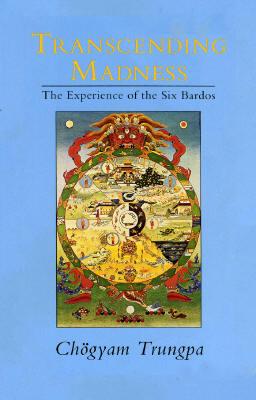
by Chogyam Trungpa The Bardo of Illusory Body The Bardo of Dreams The Bardo of Existence The Bardo of Death The Lonely Journey From seminar’s in 1971 |
 |

Chapter 3
The Bardo of Meditation
In order to understand bardo experiences, you also have to understand basic psychology. Yesterday we discussed the six realms of the world — the world of hatred, the world of possessiveness, the world of ignorance, the world of passion, the world of speed or jealousy, and the world of pride. These different patterns or worlds are the sources of particular emotional experiences — hatred, meanness, passion, or whatever. They are the basic background; they are the space. And within that, there will be the different experiences of bardo, which work with the thought process and with different types of emotions than the emotions that you were born with, so to speak, that you are made out of. The experience of the six realms is like having a body: you have involved yourself in the world of hell or the world of the hungry ghosts. But if you have a wound on your body, that is the experience of the different types of bardo, a flash of bardo experience.
To understand bardo, we have to understand the pattern of ego as well. Our basic involvement with situations, or the six realms, and the specific situation that we are facing, or bardo, have to have some relationship. The specific development of bardo experience—in the form of a dream, in the form of birth or death, whatever it may be—also has to come from the pattern of ego. I have discussed ego previously, but perhaps it is worth going over again, in order to bring out the bardo concept properly.
The Development of Ego
When we talk of ego, it is as if we are talking about a man with a body and limbs. It has a basic makeup and it has its tentacles, so to speak, as well. Its basic makeup consists of paranoia and confusion. But at the same time, its basic makeup started from some kind of wisdom as well, because there is the possibility that we don’t exist as individual entities or as solid persons who can continue all the time. There is the possibility that as individuals we consist of particles or of lots of things — but those particles don’t exist as individuals either.
When that possibility first flashes onto itself, there’s sudden panic. If this is the case, we’ll have to put up some kind of defense mechanism to shield out any possible discovery of the nonexistence of ourselves. We begin to play the game of deaf and dumb. We would like to be individuals who are continuously existing, continuously surviving, continuously being one person, not even making the journey through time and space. Time and space may be extra attributes, but the actual basic phenomenon of our consciousness of being has to be a solid thing — that’s how ego tends to see it. So the whole thing is based on a kind of dream, wishful thinking. It is based on what we would like to be rather than what we are.
That leads to paranoia as to the possible discovery of wisdom. And that paranoia begins to develop: from that paranoia you begin to experiment with extending yourself. You can’t just remain constantly deaf and dumb, you also have to learn to establish your ground as deaf and dumb. That is, you extend yourself into different areas, different realms, trying to feel the situation around you—trying to project yourself and then trying to experience that. It’s kind of an experimental level of feeling. So first you have the basic ignorance of refusing to see what you are, and then you have the possibility of relating yourself through feeling.
The next stage is impulse: feeling begins to develop beyond simply trying to feel good or bad or neutral; feeling has to become more sophisticated and efficient. Therefore, impulse begins to develop along with feeling, as that efficiency, or automatic mechanism.
Next, impulse also begins to develop—into perception. You try to perceive the result of your impulsive actions. A kind of self-conscious watcher develops, as the overseer of the whole game of ego.
The last development of ego is consciousness, which is the intellectual aspect of the ego: trying to put things into categories and make intellectual sense of them. We try to interpret things and their basic meanings, and we begin to see in terms of consciousness, in the sense of being conscious in relating with situations. That is the last stage of the development of ego.
From that point of view of consciousness, the idea of bardo comes through. Bardo experience presents a case of surviving, occupation—in terms of subconscious thought patterns, conscious thought patterns, dreams, birth, death, being with oneself, or the meditative state. These are the types of thought that we begin to put out.
The next situation in the development of ego is that as we develop our personal state of being, up to the point of consciousness, that consciousness not only acts in terms of our own subconscious thoughts, dreams, and such things, but also puts out particular shapes or patterns or creeds, so to speak. It puts out a sense of belonging to a particular race or a particular family. Consciousness would like to associate itself with particular types of world. That is where the six realms we discussed yesterday begin to develop. Consciousness could either begin the six types of world from the world of hell, or it could start from the world of heavenly beings. It could begin either way. That process is like buying land; we associate ourselves with a particular land, with one of the six lokas, six worlds.
Having bought that land—it doesn’t matter whether the land is a hot land, the burning hotness of hell; the tropical land of human passion; the heavenly land with the clear and crystal air of pleasurable meditative states; or whatever land we associate ourselves with as natives—we still have to survive. You see, the point is, how are we going to survive? How are we going to survive as hell beings? How are we going to survive as heavenly beings? We need some mechanism of survival, some method. And that survival mechanism, or survival policy, so to speak, is that of the six types of bardo.
The Bardo of Clear Light
We could begin with the world of heaven, for instance, the realm of the gods. The world of the gods is a state of complete bliss, a spiritual state of complete balance from a temporary point of view, a meditative state. In order to survive in that meditative state of the world of heaven, there is the experience of the clear light. In Tibetan it is called samten bardo. Samten means meditative state, in other words, complete absorption in the clear light, or the perception of luminosity. So in the world of the gods, in order to survive as they are, they have to have the highlight of meditation, like the island which remains in the middle of the river. You need this particular type of highlight of what you are, which is the clear light experience.
In terms of the ordinary experience of bardo, it has been said that the clear light experience can only happen in the moment of death, when you begin to separate from physical being. At the moment of separation between consciousness and the physical body, you begin to develop the idea of clear light as spontaneous experience. In that perception of clear light, if you are a meditator who meditated before, you begin to see the clear light and you begin to recognize it, as in the analogy of son meeting mother. But in the case of the world of heavenly beings, the clear light is a constant process.
This also brings another kind of bardo: the bardo of birth and death. When we begin to leave one kind of experience, whatever it may be, we look for the next experience to get into. And between birth and death, there is a sudden recognition that birth and death never need to happen at all; they are unnecessary. We begin to realize that the experience of birth and the experience of death are unnecessary concepts. They just happen; they are purely perceptions, purely the result of clinging to something. We experience birth in terms of creative things and death in terms of destructive things, but those two things never need to have happened.
A sudden experience of eternity develops, which is the bardo of clear light. And this experience of eternity, beyond birth and beyond death, is the source of survival of heavenly beings in the meditative state. That’s why they attain a pleasurable state in meditation, because each time their meditation experience begins to wane, the only possible kick they could get, the only possible way they have of latching onto their previous meditation experience, is to reflect back on that eternity. And that eternity brings a sudden glimpse of joy, the pleasurable state of jhana experience.
That’s the bardo of clear light. In other words, the experience of the eternity of clear light is the ultimate meditative state of ego — and the ultimate state of nothingness. You see, the point is that when we see eternity from the point of view of the world of the gods, it is an exciting thing to discover. There is tremendous hope that it is going to be the promised state of being, that you’re going to be like that all the time — there is tremendous hope. On the other hand, from the awakened point of view you see that eternity means constant nothingness as well, constant space. Eternity needn’t really have existed, nor do birth and death need to exist. In the absolute clear light, in the case of the awake state, when you begin to feel solidness, you automatically begin to feel the loose quality of the space as well.
The experience of clear light is extremely subtle. It is like experiencing hot and cold at the same time, extreme hot temperature and extreme cold temperature simultaneously. You could appreciate either side. If you’d like, you could believe in hot, although you experience both hot and cold simultaneously; or if you want to believe in the cold, you could believe in that as well, because it is also intense. The whole thing is based on this: believing is, in fact, solidifying the experience of the bardo of clear light. So clear light could present itself as egohood, or clear light could present itself as the awakened state of mind.
This is described in The Tibetan Book of the Dead as the afterdeath experience of seeing peaceful and wrathful divinities. The pattern is as follows: you always get peaceful divinities as your first experience, and then wrathful divinities as the next experience. This, again, is the same analogy as the idea of experiencing hot and cold simultaneously. If you have experienced the more pleasant aspect, the pleasurable aspect of the eternity of clear light as peaceful divinities, then automatically, if you are too relaxed in that pleasurable situation, the next situation brings dissatisfaction and wakes you up. Eternity begins to develop an impermanent quality, or the voidness quality of open space. That is the first experience of bardo, which is connected with the world of heavenly beings.
The clear light bardo could also relate with our own experience of meditation as well. The perception of meditation becomes promising: that promise could become the equivalent of eternity as experienced in the world of the gods, or else that promise could mean that there’s no goal anymore, that you are experiencing that the promise is already the goal as well as the path. That is a kind of shunyata experience of the nonexistence of the journey—but at the same time you are still treading on the path. It is an experience of freedom.
Student: Does one have any choice at all? If you have some kind of eternity experience and then you feel satisfaction, is there anything you can do about that except recognize that you felt that satisfaction?
Trungpa Rinpoche: Well, you see, the funny thing is that once you begin to recognize it, once you begin to be satisfied with it, that automatically invites dissatisfaction. Because you are trying to solidify it, that means that you feel some kind of threat, automatically. So you can’t really secure that experience, but you can just experience it and let things develop in a natural process. As soon as you experience eternity as safe and solid, you are going to experience the other aspect as well.
Student: That’s when ego is involved?
TR: When ego is involved, yes. Ego’s ultimate dream is eternity, particularly when eternity presents itself as meditation experience.
Student: So where there’s hope, there’s fear?
TR: That, I would say, is the heart of the heavenly world, the world of the gods.
Student: You said when you experience eternity it seems to remain a subjective experience. How are you sure that this is eternity, not some game you are playing with yourself? Is there a verification, perhaps by you?
Trungpa Rinpoche: There doesn’t seem to be any way at all to prove it and to definitely make sure. The mirage is more vivid than the desert.
Student: There seems to be no feedback – in the Tibetan Book of the Dead or in the way you explain it – that you really have anything other than what you imagine you have.
TR: In every situation of life, particularly the world of the mind, hallucinations and colors and temperatures are the world – that’s all. If you’re trying to look back and find real eternity, you find just mind, that’s all. Just pure mind, that’s all. That is why bardo is referred to as an in-between period. It’s something you go through between two intervals rather than a permanent thing. That is why the whole idea of what I’m trying to say is no-man’s land rather than somebody’s land, because you can’t build a permanent residence on no-man’s-land.
Student: Rinpoche, what is a hallucination?
Trungpa Rinpoche: Well, we could almost ask, what isn’t a hallucination? I mean, the things we see and perceive are there because we see and perceive. So the real reassurance of absolute proof is because we saw it.
Student: If one is completely absorbed in the eternity, then how could one remember that it’s a passing experience?
Trungpa Rinpoche: Eternity experience in this case is not eternal. It’s a glimpse of eternity-then there will be a moment to appreciate the eternity, then there will be the eternity experience, and then there will be a gap to appreciate the eternity. It is like an artist painting, and then stepping back and appreciating it or criticizing it.
Student: If everything is in the mind, yet we can have experiences of the truth occasionally of which we are absolutely convinced. That truth is an expression of one’s own being.
Trungpa Rinpoche: There is something to that. And that something has to do with the distance of the projections. You judge whether you’re experiencing something or not by the distance of the projections. From this point of view, there’s no such thing as absolute truth; on the other hand, everything is true.
Student: Bardo seems to be the,ultimate extension of ego – what’s the relation of that to the awakened state? In your analogy of the water and the islands, what is the bridge to the awakened state – the mountain?
Trungpa Rinpoche: That’s a very important point, seeing bardo as the path to the enlightened state. On each particular island, bardo is the highest point. In other words, it is the embodiment of the whole experience of each different realm. For instance, in terms of the world of the gods, eternity is the highest point of ego’s achievement. And because it is the highest point of ego’s achievement, therefore it is close to the other side as well, to the awakened state.
Student: When we’re talking about the path to the awakened state, it is almost as if it is all something that has to occur within us, as if what is happening with other people is somehow less relevant and not really worth paying attention to. But you yourself seem to maintain yourself on the path by perpetual response to other people, almost as if you’re forgetting about yourself. Can you describe the path in terms of your own experience, which is more like constantly responding to other people? It seems as if you don’t pay much attention to developing yourself as you suggest that we do.
Trungpa Rinpoche: That’s a good one. I think it’s happening in exactly the same way in the case of others as well, because it is necessary for you to relate with others or to relate with me. I mean, you can’t develop through the path without relationships – that’s the fundamental point. But meditation becomes the starting point of relating; you learn how to create the right environment in order to relate to yourself. In terms of my own experience, that learning process takes place constantly, all the time, in terms of working with other people. You see, that’s the point when you regard yourself as officially teaching other people. When you regard yourself as a student on the path, that student would gain certain experiences and ideas by himself, through practicing meditation, going on retreat, being with himself, as well as by being with his version of the world. But he wouldn’t share his experience with others as much as a teacher would. That’s a very dangerous point, when you begin to work with other people as a teacher. Unless you are willing to learn from students – unless you regard yourself as a student and the students as your teacher – you cease to become a true teacher. You only impart your experience of what you’ve been taught, a package deal. And having done that, there’s no more to say – unless you just repeat yourself again and again.
Student: Your life seems to be so concentrated, in terms of practicing in regard to other people’s needs. But we seem to bypass that worldly side – we forget about practicing the perfections (paramitas) and just get into the meditation; whereas in your life you are always practicing the perfections.
TR: The whole point is that it would be dangerous purely to try to imitate me, and it would be dangerous for me to try to make other people into replicas of me. That would be a very unhealthy thing.
Student: But aren’t there fundamental teachings in Buddhism about how people can best relate to each other on a daily basis? Those teachings seem to be forgotten on account of the fact that they are so rule oriented.
TR: You see, what we are trying to do here is to start purely with the practice of meditation. From that base, you begin to feel the need or the relevance of the other aspect, as you encounter all sorts of temptations.
And then discipline based on individual conviction comes through.
Student: I’m reading Gampopa’s Jewel Ornament of Liberation, which you spoke of so highly in your foreword, and repeatedly he quotes the sutras as being step-by-step: You can’t practice the perfections until you’ve found a teacher; you can’t practice the second perfection until you’ve mastered the first, and at the end of those perfections he gets into meditation. But you don’t tell us much about the practice of patience in everyday life, or charity, or strenuousness.
TR: In actual fact, in following the path you have to have a commitment at the beginning, like taking refuge and surrendering yourself, and the basic practice of meditation always happens right at the beginning. The kind of meditation that Gampopa talks about is the fifth paramita, dhyana, or meditation. Dhyana is the highest meditative state the bodhisattvas achieve-which is different from the basic meditation of beginning practitioners. You see, in terms of patience and generosity and the other paramitas, the conflicts of life bring them out in any case. One doesn’t have to make big speeches about them. People find that meditation is all the time painful or difficult, and–then they look for something. They begin to realize that something is wrong with them or they begin to find that something is developing in them. And these kinds of meditation in action we’ve been talking about, the six paramitas or disciplines, happen as a natural process. The pain of meditation takes on the pattern of discipline – you find that you are running too fast and you need patience to slow down, and if you don’t do that, automatically you are pushed back, something happens. A lot of people begin to find that they are facing a lot of problems if they’ve done something not in accordance with the pattern. And if you were a scholar, for instance, or a sociologist of Buddhism, you could try to match their experiences with the technical aspects of the teaching. But there’s no point trying to prove such an interpretation, anyway.
Student: Gampopa’s Jewel Ornament of Liberation provides an outline of the bodhisattva’s career. Is it helpful to us to study that, or is it a hindrance?
TR: What do you mean by study? Practicing?
Student: Reading the book.
TR: It is definitely an inspiration. I have recommended that most people read Gampopa, and we have also discussed bodhisattva actions. And each time I have interviews with people, almost without fail some aspect of aggression which they find a conflict with always comes up. And the bodhisattva activity of generosity and compassion comes up automatically, as a natural process.
Student: Is sex the human equivalent of eternity?
Trungpa Rinpoche: Sex? I don’t think so. Sex is somehow too practical. It is governed purely by physical experience, whereas eternity is connected with imagination. Eternity has a very dreamlike quality; it has no reality, no physical action, and no involvement with earth. It’s purely living on imagination and dream world. I would say it is more like wish or hope.
Student: How about when you’re creating something, making a form or something? Is eternity something like that kind of creative ecstasy?
TR: I think so, yes. The pleasure of producing something. Meditation is something like that.
Student: In the clear light experience, how does one recognize whether it is egohood or the awakened state?
Trungpa Rinpoche: There’s a very faint, very subtle distinction between the two. When you begin to see the sudden glimpse but it’s not eternity – it’s all-encompassing rather than eternity – then that’s the awakened state of clear light. Whereas if you begin to see all this not as all-pervading but as something definite, solid, and eternal, then that’s the ego inclination.
Student: In the Tibetan Book of the Dead, it seems that they talk about the clear light as reality, but you talk of it as the ultimate ego experience. Is seeing it as eternity like seeing something which is more familiar? That seemed to be in there too, in the description of clear light experience as being like a son recognizing his mother.
Trungpa Rinpoche: That’s beyond ego’s range, the notion of son meeting mother.
Student: Does the complete human ego continue after the experience of death and then go through the bardo states in the process of its disintegration?
TR: I don’t think so. Somehow it continues through all those experiences. I mean, you might have an experience of egolessness, but at the same time, beyond that experience, ego continues.
Student: Even past the bardo state?
TR: Past the bardo state.
Student: And it’s the same ego as right now?
TR: Well, that’s difficult to say. It wouldn’t be the same anyway, would it?
Student: The distinction you made between the egotistical experience of the clear light and the awakened experience seems to me to be partially a difference in emphasis between time and space. The experience of ego involves the notion of endless time, and the awakened experience seems to involve all the spacious aspects.
Trungpa Rinpoche: In terms of ego, it seems that space and time are very solid. In terms of awake experience, the time concept is very loose. In other words, in terms of ego there’s only one center and the radiation from it; in terms of beyond ego, center is everywhere and radiation is everywhere. It’s not one center, but it is all-pervading.
Student: Is it a particular trick of ego to see things in terms of time?
TR: In the ordinary sense of ego, there’s very little understanding of time. Ego’s understanding of time is purely based on desire, what you would like to see, what you would like to develop. It’s sort of wishful.
Student: Is the clear light something you see? The way I see you now? Is it something you see with your, eye, or is that a metaphor?
Trungpa Rinpoche: It should be quite obvious that when we talk of clear light as all-pervading, you can’t see all-pervading. I know that there is a book on psychedelic experience and the Tibetan Book of the Dead, which talks about some kind of glimpse of light that you experience.
But in actual fact, when we talk in terms of the awakened state of mind, that doesn’t mean that Buddha never sleeps. That he is awake doesn’t mean he’s devoid of sleepiness – he sleeps and he eats and he behaves like any other person.
Student: It’s easy to correlate the awakened state and clear light as verbal approaches to something that can’t be discussed, but the subsequent lights which are described in terms of blues and reds and such sound so visual. I never had that kind of visual experience.
TR: They are metaphors. For instance, we talk in terms of a person’s face turning red when he’s angry, that doesn’t just mean the color of his complexion turns crimson; it’s a metaphor. It’s the same thing in the text, which speaks in terms of colors: the color of emotions, the clear light, and many other experiences. It is very complicated. Particularly when you get further into the Tibetan Book of the Dead, it begins to describe all sorts of different divinities and iconographical details-and all these colors and shapes and symbolism are connected purely with one’s state of mind. If a person is open enough to his own state of being, completely absorbed in it, you could almost say the experience becomes tangible or visual it’s so real, in that sense. It’s that point of view.
Student: For example, to experience these colors and forms, is it relevant whether or not your eyes are open?
TR: I don’t think so. I don’t think so at all. In any case, if you experience them in the bardo after” death, you leave your body behind.
Student: When you were talking about ego as having the experience of eternity as something solid and then nothingness afterward, you used the analogy of hot and cold. I started to think about the Chinese yinyang symbol and the knot of eternity; trying to flash back and forth between the space, the light, and the so-called form.
Trungpa Rinpoche: Well, I tried to explain the aspect of experiencing hot and cold simultaneously, the possibility of two experiences coming at the same time, both confused and awake. In fact, that seems to be the whole idea of bardo altogether, being in–:no-man’s-land, experiencing both at the same time. It’s the vividness of both aspects at the same time. When you are in such a peak of experience, there is the possibility of absolute sanity and there is also the possibility of complete madness. That is being experienced simultaneously-in one situation, one second, one moment. That seems to be the highlight of bardo experience, because bardo is in between the two experiences.
Student: Does it have something to do with letting go in that instant when you decide which one you’ll plop back into? In other words, when the thing is over, you either end up awakened or back in samsara.
TR: Yes.
Student: So it seems like you’re given a chance, and if you miss, somehow you’re back in samsara.
TR: Your actual practice in everyday situations, when those peak experiences are not present, brings them into a balanced state. If your general pattern of life has developed into a balanced state of being, then that acts as a kind of chain reaction enforcing the bardo experience. In other words, you have more balanced possibilities of sanity because of your previous chain reactions.
Student: It’s like the base of a mountain-the broader and more solid your base, the stronger and taller you stand.
TR: Quite. Yes.
Student: So that’s what sitting meditation is all about.
TR: Yes. I mean, that’s the whole idea of bardo being an important moment. I think that working on basic sanity provides tremendous possibilities. It is basic-there will be tremendous influence and power, needless to say.
Student: Do you have to go through the bardo to get to the. awakened state?
Trungpa Rinpoche: There will be some moment of experience, peak of experience, before the awakened state of mind. That is called bardo. It is not particularly that bardo is special, but it’s just that the gap is called bardo.
Student: It may not be anything special, but when we see it coming, we say, “Wow, that’s it.”
TR: Well, I wouldn’t make a particularly big deal of it although we are holding a seminar on it.
Student: There is something that continues after death, and I guess that something is the you that reincarnates.
Trungpa Rinpoche: Nobody knows. But if you see it in terms of the present situation, experiences happen; they pass through continuously. Our physical situation can’t prevent the psychological experience of pain or pleasure-it’s beyond control. So if we work back from that level, there seems to be the possibility that even beyond physical death there will be continuity of consciousness throughout but that’s an assumption. are holding a seminar on it. “
Student: If you finally reach the awakened state, you’re released from having to come back-I’ve heard this in Hindu thought.
Trungpa Rinpoche: There is the same idea in Buddhism as well-if you use up your karmic chain reactions and if you use up your karmic seeds, then you are no longer subject to the power of karma, returning to the world. But then, of course, if you are that advanced a person, naturally the force of compassion forces you out, to come back and help other people. So in any case you come back, it seems.
Student: In talking about time, you said that time was an invention, a wishful thought, that it was related to hope. But time is also related to fear, because time moves us up to death. Is it true, then, that if one manages to give up both fear and hope, one is also released from time?
Trungpa Rinpoche: Well, time is a concept, obviously, and you transcend concepts. I would say so, definitely.
Student: But one doesn’t have to be awake to understand the concept of time, because in ordinary everyday life one sees that time is very unreal. Sometimes there are five days that seem like five years; other times there are five years that seem like five days.
TR: If you look at it from a rational point of view, it is determined by your preoccupation. They determine the length of time. But that isn’t exactly transcending time in terms of freedom; that is simply the degree of your determination, your preoccupation. If something is pleasurable, it passes very quickly; if soiriething is painful, it lasts an extremely, long period. And certain people have a kind of noncaring quality, feeling that time doesn’t matter; they are completely easy about it. But that again is purely habitual rather than a fundamental idea of time. You see, time means struggle, or wish. It’s a demand for something you have a particular concept or desire to achieve,: something within a certain limit of time. When you don’t have this desire to achieve something or desire not to do something, then somehow the limitation of time doesn’t become important. But you can’t say that you completely transcend time, in terms of transcending karmic seeds or karmic patterns. Even the awakened state of mind of compassion and wisdom, in communicating and dealing with other people, still has to use the concept of time. But at the same time, your version of time doesn’t last any longer; that fundamental, centralized notion of time doesn’t exist anymore.
Student: You spoke of compassion as being a force that brings us back, insists that we reincarnate again. Is that the same as when we are feeling bliss in meditation and we do not want to stop and go back to everyday activities, but out of our sense of duty to our friends, we do?
Trungpa Rinpoche Any kind of awake experience you have should have sharpness or intelligence as well. I don’t think there will be possibilities of being completely dazed in the experience at all-if that’s so, then something must be wrong. You see, when you are completely involved in the awake state of mind, you develop discriminating wisdom as well as the wisdom of equanimity.
Student: You are here out of compassion. Are we here out of that same compassion?
TR: I hope so.
Student: I never experienced any sharp, clear choice to stay in the world for the sake of others.
TR: Perhaps you feel that you are not ready to help others yet.
Student: I feel I have no choice but to be in the world.
TR: That’s generally how things operate: you have no choice. You are bound by karma; you have no choice.
Student: Is there an alternative state where the awakened person constantly has the option of being in the world or out of it?
TR: Well, if an awakened person is not bound by karmic duties, so to speak, then of course there is that option, definitely. Even the arhats, who have achieved the equivalent of the sixth stage of the bodhisattva path, supposedly have the option of not stepping back into the world, because they have transcended certain, karmic seeds. They remain for kalpas and kalpas (eons) in the meditative state until a certain Buddha comes to the world. He has to send his vibrations to wake them up and bring them back to the world and encourage them to commit themselves to the bodhisattva path of compassion, not to stay out.
Student: You mean you can leave if you don’t feel a strong enough duty to others?
TR: That would mean that it was a partial kind of enlightened state. A fully enlightened state automatically would have compassion, whereas a partially enlightened state would have wisdom without compassion; and in this case, you quite likely would stay away.
Student: Is remaining in nirvana for kalpas something worth shooting for?
TR: That’s purely up to you.
Student: I have a question about the difference between buddhahood and egohood in the six bardos. At certain times I’ve experienced leaving this situation, a kind of transcending, but there’s still a center, a source of radiation. But at a certain point, if I’m willing to let go further, it seems to break loose into a more spacious quality without this center.
Trungpa Rinpoche: Well, you get a potential glimpse of that constantly. All aspects are in individuals all the time, and you do experience that, yes. But that doesn’t necessarily mean that one has reached higher degrees; more likely, a person is able to see the potential in himself.
Student: How would you relate the deja-vu experience to the six bardos, the feeling that you have been someplace before?
Trungpa Rinpoche: Before?
Student: [Repeats]
TR: I suppose that experience is within the six realms of the world.
Student: Would you translate bardo again?
Trungpa Rinpoche: Bar means “in-between” or “gap” or “the middle,” and do means “island,” so altogether bardo means “that which exists between two situations.” It is like the experience of living, which is between birth and death.
Student: What is not bardo?
TR: The beginning and the end. [Laughter]
Student: Can there be wisdom without compassion or compassion without wisdom? Can either exist independently?
Trungpa Rinpoche: According to the teachings as well as one’s own personal experience, it is quite possible ;you could have wisdom without compassion, but you couldn’t have compassion without wisdom.
Student: I know somebody who almost doesn t sleep at all, he sleeps sometimes one hour a day, and he leads a frightfully energetic life. He’s not. ‘a Buddhist, but he’s a rather enlightened person is that at all relevant?
Trungpa Rinpoche: Well, I don’t know about that. You see, ultimately there are certain requirements for the physical being, as long as you have a physical body-like sleeping and food. It’s a natural process. And of course there’s the balance of whether you need a great deal of sleep or a great deal of food, which depends on whether a person is using sleep or food as an escape, or, in some other way. I mean, from a rational point of view, one would presume that enlightened beings would eat balancedly, sleep normally. They wouldn’t have to fight with the pattern of their life anymore, whether it was sleep or food. It just happens, I suppose. But that’s pure guesswork on my part.
Student: I think I’ve read somewhere that if one is really relaxed one sleeps more efficiently, so one doesn’t need much sleep.
TR: Generally you need very little sleep. It depends on your state of mind. But you need some sleep anyway, and you need some food. On the other hand, there’s the story of the great yogi Lavapa in India: he slept for twenty years, and when he woke up he attained enlightenment.
Student: What do you mean when you say that no one knows about the after-death period? I thought all bodhisattvas would know, all those who have returned.
Trungpa Rinpoche: I think they would have confidence, definitely, and they would have some definite intuitions about it, or quite possibly memories of their previous lives. But in the ordinary case, nobody knows; nobody has actually gone through it, like a journey.
Student: In other words, for a bodhisattva, all his lives aren’t just like one life, just one change after another?
TR: It wouldn’t be as clear as that for a bodhisattva. A bodhisattva still works with situations; therefore he works with his own life and death, and his physical being as well.
Back to Transcending Madness Table of Contents
TRANSCENDING MADNESS – by Chogyam Trungpa
Bardo | The Six Realms of Being | The Bardo of Meditation | The Bardo of Birth
The Bardo of Illusory Body | The Bardo of Dreams | The Bardo of Existence
The Bardo of Death | The Lonely Journey