Science of Soul
A practical exposition of ancient method of
visualisation of Soul (Atma Vijnana)
Swami Vyas Dev Ji
Swami
Yogeshwarananda
Saraswati
Published
by Yoga Niketan Trust, Bharat,
India
The Constituent of Bliss Sheath.
We have already described the physical form and size of the heart in an earlier chapter. Here we have to show how the lord of the five sheaths, Jivatman, the individual soul, abides in the Bliss Sheath situated in the space of the heart, the reservoir of blood. This is shown in Illustration No. I in the chapter of Food Sheath.. It can be seen by divine vision that this human body, which is like a castle of the divine city Ayodhya, contains the heart, of the size of a pear, or like the lotus bud drooping downwards. Inside this heart is a hollow of the size of a small seedless grape. Inside this hollow is the Bliss Sheath, luminous’ like a golden egg. This Bliss Sheath is an aggregate of six luminous orbs. It is very pleasant to see and appears like an oval mass of light.
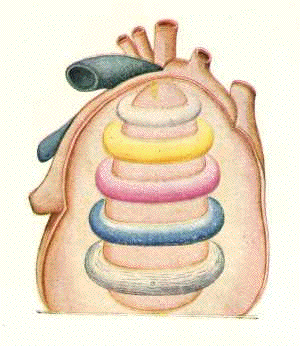
The First Orb. Brahman The outermost circle or orb is called the orb of Brahman. Brahman, the Absolute, is all pervading and interpenetrating, thus it may seem absurd to locate Brahman in a circle, yet it is not so ridiculous. Just as the all-pervasive ether is spoken of as the ether of a jar, the ether of a house, due to the limiting adjuncts of the jar and the house, so the all-pervasive Brahman is said to be in the ether of the heart in the form of the orb of Brahman, just for the sake of easy understanding. We do not wish to show any division in Brahman. In order to enable aspirants to realise the Absolute to be all, full, indivisible; all.pervasive, omniscient, without parts, Brahman is first described in the form of an orb. When a person realises Brahman, this realisation appears initially in the form of this orb for two reasons. First, the region of perception is circular in form; secondly, Prakriti (nature) has endowed the faculty of realism Brahman in the heart,
Purnam Pravartinim Sriyam Labhate Ya Evam Veda.
(chandogya Prapa 3, Kh. 12, c-6)
In other words, the ether that lies in the region of the heart of man is the same ether that is outside, just as the external ether, although void of objects, is filled with Brahman. Even so the ether of the heart, though apparently void, is filled with Brahman. The Gayatri Mantra sings the glory of this very Brahman. This ether is not vacuous. It is full of Brahman and is harmonious. The aspirant who realises this attains the wealth of bliss which is all full and immutable. Brahman, as sung by the Gayatri hymn, abides in this ether of the heart even in the same way that it abides outside man.
Twam Yastwam Vashatkar Apo Jyoti Rasomritam.
(Katyayana Parishishta)
These utterances clearly show that the relation between the internal organ and Brahman is of the pervaded and the pervader. The ether of the heart is the mirror for the vision of Brahman. The reflection of the sun falls on a stony rock and on a reservoir of water, but it is the latter that reflects the sun and not the former. Even so, the vision of individual soul and the Supreme Soul is possible in the lake or ether of the heart in the form of an orb But even as by seeing the reflection of the sun one does not have the knowledge of its being in the east or the west, in the same way by realising Brabman in the heart one does not realise the all pervasiveness of Brahman.
This orb of Brahman thus encompasses all other orbs in its womb, as it were. This orb is, so to speak, non manifest. Its colour is indescribable. But in so far as one can speak, it is extremely white, glowing, transparent and clear. An aspirant realises this last of all. In the immature state of Sddhand, until mastery of Sainyama has been attained, a Sadhak does not get the vision of the orb of Brahman, even by entering into the heart through meditation.
The
Second Orb. Prakriti (Subtle Nature)
Inside the orb of Brahinan there is an orb of subtle Prakrti which is a sort of miniatute non manifest, supreme Prakriti (nature). It is light yellow in colour. This is the real causal body of the individual soul. The individual soul is related to it from eternity.
(Patanjal IV-9)
In other words, the subtle desires or Vasana s are not obstructed by the veils of class, place and time, and Samskara s are in accordance with the memory. Thus, having found the awakener, the Vasana s existing in the form of subtle impressions are awakened.
In other words, these Vasana s of subtle desire are external because the desire of an everlasting life is at the bottom of the heart of every living being and exists from beginningless time. The reason for corelationship is ignorance: Tasya heturavidyda (Patanjal 1I-24). This orb of subtle Prakriti maintains the aggregate of all other orbs in its womb. The practiser may not get the vision of this orb easily because of its subtlety. Even after entering into the heart through meditation, it is by mastery over meditation that he attains the vision of this orb in the course of time.
(Samkhya 1-109)
It being the minutest, it cannot be realised.
The
Third Orb…Subtle Vital Energy:
In the orb of subtle Prakriti there is another orb of subtle Prana. When a practiser enters into the heart through meditation, he first of all gets the vision of the orb of subtle Prana; the colour of this orb is like very luminous vapour, or like dew-drops dazzling in the rays of the sun, or like shining rain.drops. This is affected by the three Gunan s. When Sattwa predominates, it is extremely luminous, like rediant rain-drops. When Rajas predominates, the luminous drops are tainted with a rose colour and are seen to be active or fickle. When Tamas predominates it is of vaporous appearance and opaque and the movement of subtle Prana becomes dull. This orb of subtle Prana is the gross aspect of the contact of Atman with the Chitta in its process of infusing consciousness. It reveals itself in the form of luminous vapour. It is visualised outside the orb of Ahamkara (ego-principle). Further than this you find activity pervading the entire body. Often we see five holes in the heart through which different types of rays emanate. These holes are in the causal sheath. It has been declared in Chhandogya Upanishad:
(Chhandogya Pra. P. 3, Kh. 13, Chhanda 1)
The subtle Prana spreads out its activity and life force through these holes. The flow of light mingles with the shower of rays from the astral body (intellect plus mind), abiding in Brahmarandhra which is ever related to the hcart, and then the mingled flow pervades the whole body. The rays of the astral body mingle with the glow of life in the same way as colours, sugar, or salt mingle in water, just as warmth spreads in liquids, or just as rays of the rising sun pervade homogeneously in the sphere of ether.
The
Fourth Orb ….Ahamkar (Ego):
If you see by the meditative vision inside the orb of subtle PreI~za, you will find an orb resembling the gorgeous colour of a peacock’s neck, extremely luminous, crystal-clear. It is, as it were, a bluish green glass shade placed on a white luminous light. This is the orb of the ego-principle which is the gross form of Asmita (the principle of ‘I’-ness). When Sattwa predominates, this orb assumes a luminous white colour against a luminous green background as if a white cloth has been given a blue colour. In the predominance of Rajas it appears like the blue circle in a feather of a peacock’s tail and is fickle like mercury. In the predominance of Tamas, it becomes slow in motion and has the colour of deep green mixed with blue.
The
Fifth Orb…….Chitta (Mind-Stuff) :
Inside the orb of ego is the orb of Chitta. It is the palace of the individual soul. It is extremely lumiuous white, transparent, pleasant to behold, but by the influences of it, it is ever-changing. Through its modifications Chitta is especially a sensitive part of the internal organ. Vritti s in the form of ripples constantly arise in the lake of the Chitta. It is even as waves arising and subsiding in an ocean of water through contact with the wind. Because of the constant modifications of Vritti-v, Chitta appears to be in the form of Vrilti-s alone. These parts, like waves, awaken Samskdra-s or impressions which abide in the Chit to. Being influenced by the three Guna s, the Vritti-s change their colours. When Sattwa predominates, Chitta is like snowy butter, like white snow, or like the white feathers of a crane. It is glowing white, luminous, transparent, clear and pleasant. When Raja~ predomi-nates, it shines like mercury light, and is fickle in motion. When Tamas predominates, it appears as if light clouds have veiled the Chitta. This Chitta is the revealer of the consciousness of the soul and is a special organ of Antaiikara~ia, which is knowledge-predominating. It is in this cave of the heart that the Atman abides.
The
Sixth Orb …..Atman (Soul):
From the point of view of size in this creation, the orb of Atman, the soul, is smaller than an atom, and from the point of view of subtlety it is similar to Brahman. It is incomparable in its colour and form, and it is thus symbolic of its ownself. Through its association with Chitta, it assumes the same colour and form that Chitta assumes. This Jivatman or individual soul exists in the form of an extremely subtle point or jot.
These six orbs exist in an aggregate form in the region of the heart, and they appear to be constituting a Jyotir Linga, a mass of light. Just as the sheaths of the five Tanmatra s go to organise mind, intellect, the senses and Vijnanamaya Kosha, so does the orb of subtle Prana organise the aggregate consisting of subtle Prana, ego-principle, Chitta and the soul, all of which belong to the Bliss Sheath. This orb of subtle Prakriti is a part of the univeral non.manifest Prakriti through the limiting adjunct of the heart. That is why this aggregate of orbs is described by the Sruti:
Again:
(Mass of gold, covered by dazzling light)
Hiranyamaye Pare Kose Virajam Brahna Nishkalam, Tat Shubhram Jyotisham Jyotih Tad Atam Vido Viduh.
(Munkak 2-2-9)
This Sruti endorses our view that a knower of self realises Brahinan, who is spotless, in the sheath of Hiranyamaya (mass of golden light) which is the light of all lights. Further, another Sruti says:
Haritasya, Lohitasya Purnah
Bri. 4-3-20, 2-1-19. 4-2-3, Chhand. 8-6 and Katha 6-16)
In other words: They are the nerves known as Hita which are filled with white, blue, yellow, green and red colours. These colours have emanated from the sun.
In the third quotation a simile has been given which appears to be the description of Brahman, subtle Prakriti and subtle Prana, Ahamkara (ego-principle) and Chitta abiding in the heart. Some consider this description to cover the meditation on Chakra. They consider this to be the description of self as it abides in the solar orb, but this does not appear proper to me. Illustration No. 22 explains this point clearly
Brahmarandhra and the Heart: Similar to the luminous orb of mind, intellect and senses, circled by the orb of the five Tanmatri s, the contents of the cave of the heart, and the ether of the heart, are luminous and are in the form of orbs. The difference between them is that the luminous orbs abiding in Brahmarandhra appear to be brighter and more radiant than the luminosity of Chitta and Ahamkara. The lights of the heart are gentle, tranquil, milky white, transparent, soft and pleasant. The luminous orb abiding in the hollow of the cardiac membrane is much smaller than the luminous orb that abides in Brahmarandhra in the crown of the head. As we have said, in the heart is a hollow similar in size to a small seedless grape, constituted of skin or fleshy membrane. In the subtle area of this hollow exist the orbs of Chitta (the mind-stuff). Ahamkara (the ego-principle), Sukshma Prana (subtle vital breath), Prakriti (nature) and Brahman (the Absolute). These are luminous orbs pervaded by each other as if bangles have been set on the Sivalinga. These orbs arise from inside and spread outwards. Please see Illustration No. 23. This is, in brief, the description of Jnandcmaya Kosha, the Bliss Sheath. But the knowledge arising out of direct perception will be described later. We have yet to describe in detail the vision of the self and the discriminative understanding between Prakriti and Purusha, nature and spirit, in Anandamaya Kosho.
Illustration No. 22
In the region of the heart, six luminous orbs are visualised:
1. The orb of white colour that has
pervaded the other five orbs is Brahman qualified by the
Heart.
2. The yellow coloured orb is of Prakriti.
3. The rosy coloured orb is of Sukshma or subtle Prana.
4. This is the orb of Ahamara or ego, blue-green colour.
5. The orb of Chitta, from which rays aree emanating, in
white color.
6. In the white coloured orb of the Chitta there is the very
luminous orb of the individual soul.
Illustration No. 23
1. In the hollow of the membrane of
the heart is a space of the size of a small seedless grape,
in which Jivatman, Chitta, Ahamkara, Sukshma Prana, Prakriti
and Brahman are located in the form of girdles, as it were,
as if bangles have been put on a Siva Linga from inside
out.
2. The veiling of Chitta and Sukshma Prana by the Rajas
predominating Ahamkara.
3. The vision of the Sattwik states of Chitta, Ahamkara and
Sakshma Prana.
Go to:
The chapter on the description of
the Heart
as the Center of Consciousness
The description of the elements of the Heart
Center
The description of the meeting of “The
Preceptor”..the source of
Science of the Soul.
Introduction Chapter of Science
of Soul