“You agree at an early (age) to lie, to be this convention of self-reference and to play your part by means of the activity of self-contraction. You never told anybody. You got the idea. You got the message. And you became a some kind of assent to that agreement to be that. Those who don’t quite agree are regarded to be whacko. They can’t fit, you see. They don’t quite get it. You’re supposed to be this – got it? …..I, I, I, I, I – got it? Who’s that? SHUT UP! Do this. [clenching fist quickly and repeatedly] Don’t ask! This, this is it. This is what’s happening here, and that’s that.
Adi Da Samraj – 2004

The Book
The Taboo Against Knowing Who You Are
by
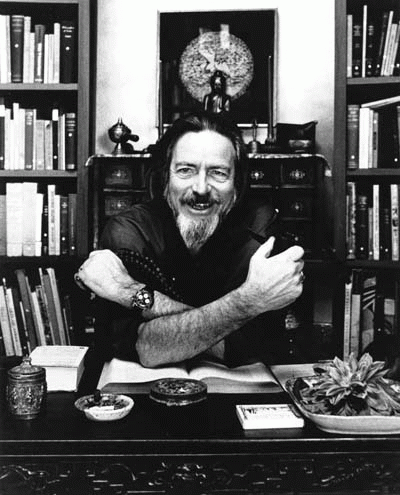
Alan Watts
First published in Great Britain by Jonathan Cape Ltd 1969
Chapter One
THE GAME OF BLACK-AND-WHITE
When we were taught 1, 2, 3 and A, B, C, few of us were ever told about the Game of Black-and-White. It is quite as simple, but belongs to the hushed-up side of things. Consider, first, that all your five senses are differing forms of one basic sense-something like touch. Seeing is highly sensitive touching. The eyes touch, or feel, light waves and so enable us to touch things out of reach of our hands. Similarly, the ears touch sound waves in the air, and the nose tiny particles of dust and gas. But the complex patterns and chains of neurons which constitute these senses are composed of neuron units which are capable of changing between just two states: on or off. To the central brain the individual neuron signals either yes or no-that’s all. But, as we know from computers which employ binary arithmetic in which the only figures are 0 and 1, these simple elements can be formed into the most complex and marvelous patterns.
In this respect our nervous system and 0/1 computers are much like everything else, for the physical world is basically vibration. Whether we think of this vibration in terms of waves or of particles, or perhaps wavicles, we never find the crest of a wave without a trough or a particle without an interval, or space, between itself and others. In other words, there is no such thing as a half wave, or a particle all by itself without any space around it. There is no on without off, no up without down.
Although sounds of high vibration seem to be continuous, to be pure sound, they are not. Every sound is actually sound/silence, only the ear does not register this consciously when the alternation is too rapid. It appears only in, say, the lowest audible notes of an organ. Light, too, is not pure light, but light/darkness. Light pulsates in waves, with their essential up/down motion, and in some conditions the speed of light vibrations can be synchronized with other moving objects so that the latter appear to be still. This is why arc lights are not used in sawmills, for they emit light at a pulse which easily synchronizes with the speed of a buzz saw in such a way that its teeth seem to be still.
While eyes and ears actually register and respond to both the up-beat and the down-beat of these vibrations, the mind, that is to say our conscious attention, notices only the up-beat. The dark, silent, or “off” interval is ignored. It is almost a general principle that consciousness ignores intervals, and yet cannot notice any pulse of energy without them. If you put your hand on an attractive girl’s knee and just leave it there, she may cease to notice it. But if you keep patting her knee, she will know you are very much there and interested. But she notices and, you hope, values the on more than the off. Nevertheless, the very things that we believe to exist are always on/offs. Ons alone and offs alone do not exist.
Many people imagine that in listening to music they hear simply a succession of tones, singly, or in clusters called chords. If that were true, as it is in the exceptional cases of tone-deaf people, they would hear no music, no melody whatsoever-only a succession of noises. Hearing melody is hearing the intervals between the tones, even though you may not realize it, and even though these particular intervals are not periods of silence but “steps” of varying length between points on the musical scale. These steps or intervals are auditory spaces, as distinct from distance-spaces between bodies or time-spaces between events.
Yet the general habit of conscious attention is, in various ways, to ignore intervals. Most people think, for example, that space is “just nothing” unless it happens to be filled with air. They are therefore puzzled when artists or architects speak of types and properties of space, and more so when astronomers and physicists speak of curved space, expanding space, finite space, or of the influence of space on light or on stars. Because of this habit of ignoring space-intervals, we do not realize that just a sound is a vibration of sound/silence, the whole universe (that is, existence) is a vibration- of solid/space. For solids and spaces go together as inseparably as insides and outsides. Space is the relationship between bodies, and without it there can be neither energy nor motion.
If there were a body, just one single ball, with no surrounding space, there would be no way of conceiving or feeling it as a ball or any other shape. If there were nothing outside it, it would have no outside. It might be God, but certainly not a body! So too, if there were just space alone with nothing in it, it wouldn’t be space at all. For there is no space except space between things, inside things, or outside things. This is why space is the relationship between bodies.
Can we imagine one lonely body, the only ball in the universe, in the midst of empty space? Perhaps. But this ball would have no energy, no motion. In relation to what could it be said to be moving? Things are said to move only when compared with others that are relatively still, for motion is motion/stillness. So let’s have two balls, and notice that they come closer to each other, or get further apart. Sure, there is motion now, but which one is moving? Ball one, ball two, or both? There is no way of deciding. All answers are equally right and wrong. Now bring in a third ball. Balls one and two stay the same distance apart, but ball three approaches or retreats from them. Or does it? Balls one and two may be moving together, towards or away from three, or balls one and two may be approaching three as three approaches them, so that all are in motion. How are we to decide? One answer is that because balls one and two stay together, they are a group and also constitute a majority. Their vote will therefore decide who is moving and who is not. But if three joins them it can lick ’em, for if all three stay the same distance apart, the group as a whole cannot move. It will even be impossible for any one to say to the other two, or any two to the other one, “Why do you keep following me (us) around?” For the group as a whole will have no point of reference to know whether it is moving or not.
Note that whereas two balls alone can move only in a straight line, three balls can move within a surface, but not in three dimensions. The moment we add a fourth ball we get the third dimension of depth, and now it would seem that our fourth ball can stand apart from the other three, take an objective view of their behavior, and act as the referee. Yet, when we have added the fourth, which one is it? Any one of them can be in the third dimension with respect to the other three. This might be called a “first lesson in relativity,” for the principle remains the same no matter how many balls are added and therefore applies to all celestial bodies in this universe and to all observers of their motion, wheresoever located. Any galaxy, any star, any planet, or any observer can be taken as the central point of reference, so that everything is central in relation to everything else!
Now in all this discussion, one possibility has been overlooked. Suppose that the balls don’t move at all, but that the space between them moves. After all, we speak of a distance (i.e., space) increasing or decreasing as if it were a thing that could do something. This is the problem of the expanding universe. Are the other galaxies moving away from ours, or ours from them, or all from each other? Astronomers are trying to settle the problem by saying that space itself is expanding. But, again, who is to decide? What moves, the galaxies or the space? The fact that no decision can be reached is itself the clue to the answer: not just that both the galaxies and space are expanding (as if they were two different agents), but that something which we must clumsily call galaxies/space, or. solid/space, is expanding.
The problem comes up because we ask the question in the wrong way. We supposed that solids were one thing and space quite another, or just nothing whatever. Then it appeared that space was no mere nothing, because solids couldn’t do without it. But the mistake in the beginning was to think of solids and space as two different things, instead of as two aspects of the same thing. The point is that they are different but inseparable, like the front end and the rear end of a cat. Cut them apart, and the cat dies. Take away the crest of the wave, and there is no trough.
A similar solution applies to the ancient problem of cause and effect. We believe that every thing and every event must have a cause, that is, some other thing(s) or event(s), and that it will in its turn be the cause of other effects. So how does a cause lead to an effect? To make it much worse, if all that I think or do is a set of effects, there must be causes for all of them going back into an indefinite past. If so, I can’t help what I do. I am simply a puppet pulled by strings that go back into times far beyond my vision.
Again, this is a problem which comes from asking the wrong question. Here is someone who has never seen a cat. He is looking through a narrow slit in a fence, and, on the other side, a cat walks by. He sees first the head, then the less distinctly shaped furry trunk, and then the tail. Extraordinary! The cat turns round and walks back, and again he sees the head, and a little later the tail. This sequence begins to look like something regular and reliable. Yet again, the cat turns round, and he witnesses the same regular sequence: first the head, and later the tail. Thereupon he reasons that the event head is the invariable and necessary cause of the event tail, which is the head’s effect. This absurd and confusing gobbledygook comes from his failure to see that head and tail go together; they are all one cat.
The cat wasn’t born as a head which, sometime later, caused a tail; it was born all of a piece, a head-tailed cat. Our observer’s trouble was that he was watching it through a narrow slit, and couldn’t see the whole cat at once.
The narrow slit in the fence is much like the way in which we look at life by conscious attention, for when we attend to something we ignore everything else. Attention is narrowed perception. It is a way of looking at life bit by bit, using memory to string the bits together-as when examining a dark room with a flashlight having a very narrow beam. Perception thus narrowed has the advantage of being sharp and bright, but it has to focus on one area of the world after another, and one feature after another. And where there are no features, only space or uniform surfaces, it somehow gets bored and searches about for more features. Attention is therefore something like a scanning mechanism in radar or television, and Norbert Wiener and his colleagues found some evidence that there is a similar process in the brain.
But a scanning process that observes the world bit by bit soon persuades its user that the world is a great collection of bits, and these he calls separate things or events. We often say that you can only think of one thing at a time. The truth is that in looking at the world bit by bit we convince ourselves that it consists of separate things, and so give ourselves the problem of how these things are connected and how they cause and effect each other. The problem would never have arisen if we had been aware that it was just our way of looking at the world which had chopped it up into separate bits, things, events, causes, and effects. We do not see that the world is all of a piece like the head-tailed cat.
We also speak of attention as noticing. To notice is to select, to regard some bits of perception, or some features of the world, as more noteworthy, more significant, than others. To these we attend, and the rest we ignore-for which reason conscious attention is at the same time ignore-ance (i.e., ignorance) despite the fact that it gives us a vividly clear picture of whatever we choose to notice. Physically, we see, hear, smell, taste, and touch innumerable features that we never notice. You can drive thirty miles, talking all the time to a friend. What you noticed, and remembered, was the conversation, but somehow you responded to the road, the other cars, the traffic lights, and heaven knows what else, without really noticing, or focussing your mental spotlight upon them. So too, you can talk to someone at a party without remembering, for immediate recall, what clothes he or she was wearing, because they were not noteworthy or significant to you. Yet certainly your eyes and nerves responded to those clothes. You saw, but did not really look.
It seems that we notice through a double process in which the first factor is a choice of what is interesting or important. The second factor, working simultaneously with the first, is that we need a notation for almost anything that can be noticed. Notation is a system of symbols-words, numbers, signs, simple images (like squares and triangles), musical notes, letters, ideographs (as in Chinese), and scales for dividing and distinguishing variations of color or of tones. Such symbols enable us to classify our bits of perception. They are the labels on the pigeonholes into which memory sorts them, but it is most difficult to notice any bit for which there is no label. Eskimos have five words for different kinds of snow, because they live with it and it is important to them. But the Aztec language has but one word for snow, rain, and hail.
What governs what we choose to notice? The first (which we shall have to qualify later) is whatever seems advantageous or disadvantageous for our survival, our social status, and the security of our egos. The second, again working simultaneously with the first, is the pattern and the logic of all the notation symbols which we have learned from others, from our society and our culture. It is hard indeed to notice anything for which the languages available to us (whether verbal, mathematical, or musical) have no description. This is why we borrow words from foreign languages. There is no English word for a type of feeling which the Japanese call yugen, and we can only understand by opening our minds to situations in which Japanese people use the word.’
There must then be numberless features and dimensions of the world to which our senses respond without our conscious attention, let alone vibrations (such as cosmic rays) having wave-lengths to which our senses are not tuned at all. To perceive all vibrations at once would be pandemonium, as when someone slams down all the keys of the piano at the same time. But there are two ignored factors which can very well come into our awareness, and our ignorance of them is the mainstay of the ego-illusion and of the failure to know that we are each the one Self in disguise.
The first is not realizing that so-called opposites, such as light and darkness, sound and silence, solid and space, on and off, inside and outside, appearing and disappearing, cause and effect, are poles or aspects of the same thing. But we have no word for that thing, save such vague concepts as Existence, Being, God, or the Ultimate Ground of Being. For the most part these remain nebulous ideas without becoming vivid feelings or experiences.
The second, closely related, is that we are so absorbed in conscious attention, so convinced that this narrowed kind of perception is not only the real way of seeing the world, but also the very basic sensation of oneself
“‘To watch the sun sink behind a flower-clad hill, to wander on and on in a huge forest without thought of return, to stand upon the shore and gaze after a boat that disappears behind distant islands, to contemplate the flight of wild geese seen and lost among the clouds.” (Seami) All these are yugen, but what have they in common? as a conscious being, that we are fully hypnotized by its disjointed vision of the universe. We really feel that this world is indeed an assemblage of separate things that have somehow come together or, perhaps, fallen apart, and that we are each only one of them. We see them all alone-born alone, dying alone-maybe as bits and fragments of a universal whole, or expendable parts of a big machine. Rarely do we see all so-called things and events “going together,” like the head and tail of the cat, or as the tones and inflections-rising and falling, coming and going-of a single singing voice.
In other words, we do not play the Game of Blackand-White-the universal game of up/down, on/off, solid/space, and each/all. Instead, we play the game of Black-versus-White or, more usually, White-versusBlack. For, especially when rates of vibration are slow as with day and night or life and death, we are forced to be aware of the black or negative aspect of the world. Then, not realizing the inseparability of the positive and negative poles of the rhythm, we are afraid that Black may win the game. But the game, “White must win” is no longer a game. It is a fight-a fight haunted by a sense of chronic frustration, because we are doing something as crazy as trying to keep the mountains and get rid of the valleys.
The principal form of this fight is Life-versus-Death, the so-called battle for survival, which is supposed to be the real, serious task of all living creatures. This illusion is maintained (a) because the fight is temporarily successful (we go on living until we don’t), and (b) because living requires effort and ingenuity, though this is also true of games as distinct from fights. So far as we know, animals do not live in constant anxiety about sickness and death, as we do, because they live in the present. Nevertheless, they will fight when in hunger or when attacked. We must, however, be careful of taking animals as models of “perfectly natural” behavior. If “natural” means “good” or “wise,” human beings can improve on animals, though they do not always do so.
But human beings, especially in Western civilization, make death the great bogey. This has something to do with the popular Christian belief that death will be followed by the dread Last judgment, when sinners will be consigned to the temporary horrors of Purgatory or the everlasting agony of Hell. More usual, today, is the fear that death will take us into everlasting nothingness-as if that could be some sort of experience, like being buried alive forever. No more friends, no more sunlight and birdsong, no more love or laughter, no more ocean and stars-only darkness without end.
Do not go gentle into that good night … Rage, rage against the dying of the light.
Imagination cannot grasp simple nothingness and must therefore fill the void with fantasies, as in experiments with sensory deprivation where subjects are suspended weightlessly in sound- and light-proof rooms. When death is considered the final victory of Black over White in the deadly serious battle of “White must win,” the fantasies which fill the void are largely ghoulish. Even our popular fantasies of Heaven are on the grim side, because the usual image of God is of a very serious and awesome Grandfather, enthroned in a colossal church-and, of course, in church one may decorously “rejoice” but not have real, rip-roaring fun.
O what their joy and their glory must be, Those endless Sabbaths the blessed ones see.
Who wants to be stuck in church, wearing a surplice, and singing “Alleluia!” forever? Of course, the images are strictly symbolic, but we all know how children feel about the old-time Protestant Sabbath, and God’s Good Book bound in black with its terrible typography. Intelligent Christians outgrow this bad imagery, but in childhood it has seeped into the unconscious and it continues to contaminate our feelings about death.
Individual feelings about death are conditioned by social attitudes, and it is doubtful that there is any one natural and inborn emotion connected with dying. For example, it used to be thought that childbirth should be painful, as a punishment for Original Sin or for having had so much fun conceiving the baby. For God had said to Eve and all her daughters, “In sorrow thou shalt bring forth children.” Thus when everyone believed that in having a baby it was a woman’s duty to suffer, women did their duty, and many still do. We were much surprised, therefore, to find women in “primitive” societies who could just squat down and give birth while working in the fields, bite the umbilical cord, wrap up the baby, and go their way. It wasn’t that their women were tougher than ours, but just that they had a different attitude. For our own gynecologists have recently discovered that many women can be conditioned psychologically for natural and painless childbirth. The pains of labor are renamed “tensions,” and the mother-to-be is given preparatory exercises in relaxing to tension and cooperating with it. Birth, they are told, is not a sickness. One goes to a hospital just in case anything should go wrong, though many avant-garde gynecologists will let their patients give birth at home.
Premature death may come as a result of sickness, but-like birth-death as such is not a sickness at all. It is the natural and necessary end of human life-as natural as leaves falling in the autumn. (Perpetual leaves are, as we know, made of plastic, and there may come a time when surgeons will be able to replace all our organs with plastic substitutes, so that you will achieve immortality by becoming a plastic model of yourself.) Physicians should therefore explore the possibility of treating death and its pangs as they have treated labor and its “pains.”
Death is, after all, a great event. So long as it is not imminent, we cling to ourselves and our lives in chronic anxiety, however pushed into the back of the mind. But when the time comes where clinging is no longer of the least avail, the circumstances are ideal for letting go of oneself completely. When this happens, the individual is released from his ego-prison. In the normal course of events this is the golden opportunity for awakening into the knowledge that one’s actual self is the Self which plays the universe-an occasion for great rejoicing. But as customs now prevail, doctors, nurses, and relatives come around with smiling masks, assuring the patient that he will soon get over it, and that next week or next month he will be back home or taking a vacation by the sea. Worse still, physicians have neither the role nor the training for handling death. The Catholic priest is in a much better position: he usually knows just how to go about it, with no fumbling or humming and hawing. But the physician is supposed to put off death at all costs-including the life savings of the patient and his family.
Ananda Coomaraswamy once said that he would rather die ten years too early than ten minutes too late too late, and too decrepit or drugged, to seize the opportunity to let oneself go, to “lay me down with a will. “I pray,” he used to say, “that death will not come and catch me unannihilate”-that is, before I have let go of myself. This is why G. I. Gurdjieff, that marvelous rascal-sage, wrote in his All and Everything:
The sole means now for the saving of the beings of the planet Earth would be to implant again into their presences a new organ … of such properties that every one of these unfortunates during the process of existence should constantly sense and be cognizant of the inevitability of his own death as well as the death of everyone upon whom his eyes or attention rests.
Only such a sensation and such a cognizance can now destroy the egoism completely crystallized in them.
As we now regard death this reads like a prescription for a nightmare. But the constant awareness of death shows the world to be as flowing and diaphanous as the filmy patterns of blue smoke in the air-that there really is nothing to clutch and no one to clutch it. This is depressing only so long as there remains a notion that there might be some way of fixing it, of putting it off just once more, or hoping that one has, or is, some kind of ego-soul that will survive bodily dissolution. (I am not saying that there is no personal continuity beyond death-only that believing in it keeps us in bondage.)
This is no more saying that we ought not to fear death than I was saying that we ought to be unselfish. Suppressing the fear of death makes it all the stronger. The point is only to know, beyond any shadow of doubt, that “I” and all other “things” now present will vanish, until this knowledge compels you to release them-to know it now as surely as if you had just fallen off the rim of the Grand Canyon. Indeed, you were kicked off the edge of a precipice when you were born, and it’s no help to cling to the rocks falling with you. If you are afraid of death, be afraid. The point is to get with it, to let it take over-fear, ghosts, pains, transience, dissolution, and all. And then comes the hitherto unbelievable surprise; you don’t die because you were never born. You had just forgotten who you are.
All this comes much more easily with the collaboration of friends. When we are children, our other selves, our families, friends, and teachers, do everything possible to confirm us in the illusion of separateness-to help us to be genuine fakes, which is precisely what is meant by “being a real person.” For the person, from the Latin persona, was originally the megaphone mouthed mask used by actors in the open-air theaters of ancient Greece and Rome, the mask through (per) which the sound (sonus) came. In death we doff the persona, as actors take off their masks and costumes in the green room behind the scenes. And just as their friends come behind the stage to congratulate them on the performance, so one’s own friends should gather at the death-bed to help one out of one’s mortal role, to applaud the show, and, even more, to celebrate with champagne or sacraments (according to taste) the great awakening of death.
There are many other ways in which the game of Black-and-White is switched into the game of “White must win,” and, like the battle for survival, they depend upon ignoring, or screening out of consciousness, the interdependence of the two sides. In a curious way this is, of course, part of the Game of Black-and-White itself, because forgetting or ignoring their interdependence is “hide” in the game of hide-and-seek. Hide-and-seek is, in turn, the Game of Black-and-White!
By way of illustration, we can take an excursion into an aspect of science-fiction which is very rapidly becoming science-fact. Applied science may be considered as the game of order-versus-chance (or, order-versus randomness), especially in the domain of cybernetics the science of automatic control. By means of scientific prediction and its technical applications, we are trying to gain maximum control over our surroundings and ourselves. In medicine, communications, industrial production, transportation, finance, commerce, housing, education, psychiatry, criminology, and law we are trying to make foolproof systems, to get rid of the possibility of mistakes. The more powerful technology becomes, the more urgent the need for such controls, as in the safety precautions taken for jet aircraft, and, most interesting of all, the consultations between technicians of the Atomic Powers to be sure that no one can press the Button by mistake. The use of powerful instruments, with their vast potentialities for changing man and his environment, requires more and more legislation, licensing, and policing, and thus more and more complex procedures for inspection and keeping records. Great universities, for example, have vice-presidents in charge of relations with the government and large staffs of secretaries to keep up with the mountains of paperwork involved. At times, the paper-work, recording what has been done, seems to become more important than what it records. Students’ records in the registrar’s office are often kept in safes and vaults, but not so the books in the library-unless extremely rare or dangerous. So, too, the administration building becomes the largest and most impressive structure on the campus, and faculty members find that more and more of their time for teaching and research must be devoted to committee meetings and form-filling to take care of the mere mechanics of running the institution.
For the same reasons, it is ever more difficult to operate a small business which cannot afford to take care of the financial and legal red-tape which the simplest enterprises must now respect. The ease of communication through such mass media as television, radio, books, and periodicals enables a single, articulate individual to reach millions. Yet the telephone and the post office enable a formidable fraction of those millions to talk back, which can be flattering and pleasing, except that there is no way of giving individual repliesespecially when correspondents seek advice for personal or specialized problems. Only the President or the Prime Minister or the heads of huge corporations can afford the staff and machinery to cope with so much feedback.
The speed andefficiency of transportation by superhighway and air in many ways restricts freedom of travel. It is increasingly difficult to take a walk, except in such “reservations for wanderers” as state parks. But the nearest state park to my home has, at its entrance, a fence plastered with a long line of placards saying: NO
FIRES. NO DOGS. NO HUNTING. NO CAMPING. SMOKING PROHIBITED. NO HORSE-RIDING. NO SWIMMING. NO WASH
ING. (I never did get that one.) PICNICS RESTRICTED TO DESIGNATED AREAS. Miles of what used to be free-and
easy beaches are now state parks which close at 6 P.M., so that one can no longer camp there for a moonlight feast. Nor can one swim outside a hundred-yard span watched by a guard, nor venture more than a few hundred feet into the water. All in the cause of “safety first” and foolproof living.
Just try taking a stroll after dark in a nice American residential area. If you can penetrate the wire fences along the highways, and then wander along a pleasant lane, you may well be challenged from a police car: “Where are you going?” Aimless strolling is suspicious and irrational. You are probably a vagrant or burglar. You are not even walking the dog! “How much money are you carrying?” Surely, you could have afforded to take the bus and if you have little or no cash, you are clearly a bum and a nuisance. Any competent housebreaker would approach his quarry in a Cadillac.
Orderly travel now means going at the maximum speed for safety from point to point, but most reachable points are increasingly cluttered with people and parked cars, and so less worth going to see, and for similar reasons it is ever more inconvenient to do business in the centers of our great cities. Real travel requires a maximum of unscheduled wandering, for there is no other way of discovering surprises and marvels, which, as I see it, is the only good reason for not staying at home. As already suggested, fast intercommunication between points is making all points the same point. Waikiki Beach is just a mongrelized version of Atlantic City, Brighton, and Miami.
Despite the fact that more accidents happen in the home than elsewhere, increasing efficiency of communication and of controlling human behavior can, instead of liberating us into the air like birds, fix us to the ground like toadstools. All information will come in by super-realistic television and other electronic devices as yet in the planning stage or barely imagined. In one way this will enable the individual to extend himself anywhere without moving his body-even to distant regions of space. But this will be a new kind of individual-an individual with a colossal external nervous system reaching out and out into infinity. And this electronic nervous system will be so interconnected that all individuals plugged in will tend to share the same thoughts, the same feelings, and the same experiences. There may be specialized types, just as there are specialized cells and organs in our bodies. For the tendency will be for all individuals to coalesce into a single bioelectronic body.
Consider the astonishing means now being made for snooping, the devices already used in offices, factories, stores, and on various lines of communication such as the mail and the telephone. Through the transistor and miniaturization techniques, these devices become ever more invisible and ever more sensitive to faint electrical impulses. The trend of all this is towards the end of individual privacy, to an extent where it may even be impossible to conceal one’s thoughts. At the end of the line, no one is left with a mind of his own: there is just a vast and complex community-mind, endowed, perhaps, with such fantastic powers of control and prediction that it will already know its own future for years and years to come.
Yet the more surely and vividly you know the future, the more it makes sense to say that you’ve already had it. When the outcome of a game is certain, we call it quits and begin another. This is why many people object to having their fortunes told: not that fortunetelling is mere superstition or that the predictions would be horrible, but simply that the more surely the future is known, the less surprise and the less fun in living it.
Let us indulge in one more fantasy along the same lines. Technology must attempt to keep a balance between human population and consumable resources. This will require, on the one hand, judicious birthcontrol, and on the other, the development of many new types of food from earth, ocean, and air, doubtless including the reconversion of excrement into nutritious substances. Yet in any system of this kind there is a gradual loss of energy. As resources dwindle, population must dwindle in proportion. If, by this time, the race feels itself to be a single mind-body, this superindividual will see itself getting smaller and smaller until the last mouth eats the last morsel. Yet it may also be that, long before that, people will be highly durable plastic replicas of people with no further need to eat. But won’t this be the same thing as the death of the race, with nothing but empty plastic echoes of ourselves reverberating on through time?
To most of us living today, all these fantasies of the future seem most objectionable: the loss of privacy and freedom, the restriction of travel, and the progressive conversion of flesh and blood, wood and stone, fruit and fish, sight and sound, into plastic, synthetic, and electronic reproductions. Increasingly, the artist and musician puts himself out of business through making ever more faithful and inexpensive reproductions of his original works. Is reproduction in this sense to replace biological reproduction, through cellular fission or sexual union? In short, is the next step in evolution to be the transformation of man into nothing more than electronic patterns?
All these eventualities may seem so remote as to be unworthy of concern. Yet in so many ways they are already with us, and, as we have seen, the speed of technical and social change accelerates more than we like to admit. The popularity of science-fiction attests to a very widespread fascination with such questions, and so much science-fiction is in fact a commentary on the present, since one of the best ways of understanding what goes on today is to extend it into tomorrow. What is the difference between what is happening, on the one hand, and the direction of its motion, on the other? If I am flying from London to New York, I am moving westwards even before leaving the British coast.
The science-fiction in which we have just been indulging has, then, two important morals. The first is that if the game of order-versus-chance is to continue as a game, order must not win. As prediction and control increase, so, in proportion, the game ceases to be worth the candle. We look for a new game with an uncertain result. In other words, we have to hide again, perhaps in a new way, and then seek in new ways, since the two together make up the dance and the wonder of existence. Contrariwise, chance must not win, and probably cannot, because the order/chance polarity appears to be of the same kind as the on/off and up/down. Some astronomers believe that our universe began with an explosion that hurled all the galaxies into space, where, through negative entropy, it will dissolve forever into featureless radiation. I cannot think this way. It is, I suppose, my basic metaphysical axiom, my “leap of faith,” that what happened once can always happen again. Not so much that there must be time before the first explosion and time after the final dissolution, but that time (like space) curves back on itself.
This assumption is strengthened by the second moral of these fantasies, which is the more startling. Here ap
plies the French proverb plus ca change, plus c’est la meme
chose-the more it changes, the more it’s the same thing. Change is in some sense an illusion, for we are always at
the point where any future can take us! If the human race
develops an electronic nervous system, outside the bodies of individual people, thus giving us all one mind and one global body, this is almost precisely what has happened in the organization of cells which compose our own bodies. We have’ already done it.
Furthermore, our bodily cells, and their smallest components, appear and disappear much as light-waves vibrate and as people go from birth to death. A human body is like a whirlpool; there seems to be a constant form, called the whirlpool, but it functions for the very reason that no water stays in it. The very molecules and atoms of the water are also “whirlpools”-patterns of motion containingno constant and irreducible “stuff.” Every person is the form taken by a stream-a marvelous torrent of milk, water, bread, beefsteak, fruit, vegetables, air, light, radiation-all of which are streams in their own turn. So with our institutions. There is a “constant” called the University of California in which nothing stays put: students, faculty, administrators, and even buildings come and go, leaving the university itself only as a continuing process, a pattern of behavior.
As to powers of prediction and control, the individual organism has already accomplished these in a measure which must have astounded the neurons when they first learned the trick. And if we reproduce ourselves in terms of mechanical, plastic, and electronic patterns, this is not really new. Any evolving species must look with misgivings on those of its members who first show signs of change, and will surely regard them as dangerous or crazy. Moreover, this new and unexpected type of reproduction is surely no more weird than many of the great variety of methods already found in the biological world-the startling transformation of caterpillar into butterfly, or the arrangement between bees and flowers, or the unpleasant but marvelously complex system of the anopheles mosquito.
If all this ends with the human race leaving no more trace of itself in the universe than a system of electronic patterns, why should that trouble us? For that is exactly what we are now! Flesh or plastic, intelligence or mechanism, nerve or wire, biology or physics-it all seems to come down to this fabulous electronic dance, which, at the macroscopic level, presents itself to itself as the whole gamut of forms and “substances.”
But the underlying problem of cybernetics, which makes it an endless success/failure, is to control the process of control itself. Power is not necessarily wisdom. I may have virtual omnipotence in the government of my body and my physical environment, but how am I to control myself so as to avoid folly and error in its use? Geneticists and neurologists may come to the point of being able to produce any type of human character to order, but how will they be able to know what types of character will be needed? The situation of a pioneer culture calls for tough and aggressive individualists, whereas urban-industrial culture requires sociable and cooperative team-workers. As social change increases in speed, how are geneticists to foresee the adaptations of taste, temperament, and motivation that will be necessary twenty or thirty years ahead? Furthermore, every act of interference with the course of nature changes it in unpredictable ways. A human organism which has absorbed antibiotics is not quite the same kind of organism that it was before, because the behavior of its micro-organisms has been significantly altered. The more one interferes, the more one must analyze an evergrowing volume of detailed information about the results of interference on a world whose infinite details are inextricably interwoven. Already this information, even in the most highly specialized sciences, is so vast that no individual has time to read it-let alone absorb it.
In solving problems, technology creates new problems, and we seem, as in Through the Looking-Glass, to
have to keep running faster and faster to stay where we are. The question is then whether technical progress actually “gets anywhere in the sense of increasing the delight and happiness of life. There is certainly a sense of exhilaration or relief at the moment of change-at the first few uses of telephone, radio, television, jet aircraft, miracle drug, or calculating machine. But all too soon these new contrivances are taken for granted, and we find ourselves oppressed with the new predicaments which they bring with them. A successful college president once complained to me, “I’m so busy that I’m going to have to get a helicopter!” “Well,” I answered, “you’ll be ahead so long as you’re the only president who has one. But don’t get it. Everyone will expect more out of you.”
Technical progress is certainly impressive from the short-run standpoint of the individual. Speaking as an old man in the 1960s, Sir Cedric Hardwicke said that his only regret was that he could not have lived in the Victorian Age-with penicillin. I am still grateful that I do not have to submit to the doctoring and dentistry of my childhood, yet I realize that advances in one field are interlocked with advances in all others. I could not have penicillin or modern anesthesia without aviation, electronics, mass communication, superhighways, and industrial agriculture-not to mention the atomic bomb and biological warfare.
Taking, therefore, a longer and wider view of things, the entire project of “conquering nature” appears more and more of a mirage-an increase in the pace of living without fundamental change of position, just as the Red Queen suggested. But technical progress becomes a way of stalling faster and faster because of the basic illusion that man and nature, the organism and the environment, the controller and the controlled are quite different things. We might “conquer” nature if we could first, or at the same time, conquer our own nature, though we do not see that human nature and “outside” nature are all of a piece. In the same way, we do not see that “I” as the knower and controller am the same fellow as “myself” as something to be known and controlled. The self-conscious feedback mechanism of the cortex allows us the hallucination that we are two souls in one body-a rational soul and an animal soul, a rider and a horse, a good guy with better instincts and finer feelings and a rascal with rapacious lusts and unruly passions. Hence the marvelously involved hypocrisies of guilt and penitence, and the frightful cruelties of punishment, warfare, and even self-torment in the name of taking the side of the good soul against the evil. The more it sides with itself, the more the good soul reveals its inseparable shadow, and the more it disowns its shadow, the more it becomes it.
Thus for thousands of years human history has been a magnificently futile conflict, a wonderfully staged panorama of triumphs and tragedies based on the resolute taboo against admitting that black goes with white. Nothing, perhaps, ever got nowhere with so much fascinating ado. As when Tweedledum and Tweedledee agreed to have a battle, the essential trick of the Game of Black-and-White is a most tacit conspiracy for the partners to conceal their unity, and to look as different as possible. It is like a stage fight so well acted that the audience is ready to believe it a real fight. Hidden behind their explicit differences is the implicit unity of what Vedanta calls the Self, the One-without-asecond, the what there is and the all that there is which conceals itself in the form of you.
If, then, there is this basic unity between self and other, individual and universe, how have our minds become so narrow that we don’t know it?
The Taboo Against Knowing Who You Are
by
Alan Watts
First published in Great Britain by Jonathan Cape Ltd 1969